“Why are we here?” “What’s the point of it all?” “Why does it seem like things are getting worse and worse?” “Are we ever going to be able to fix the problems with the world, or even with ourselves?” “Why aren’t things any better?”
Every generation asks these questions. Sometimes, they are written off with statements such as “there are no easy answers,” or “the universe is random; there is no meaning to any of it.” Other times, they are answered with vague responses, such as there is some over-arching deity, or deities, in control of it all, whose intentions are so abstract that we can’t hope to understand them, even though we feel their effects.
Students of the Bible, however, believe that there are firm, and more so, very straightforward answers to these questions. Indeed, it seems logical to conclude that if mankind were created by some superior power, and that mankind possessed an awareness of that creation (even if some do not agree with the concept of a superior power/creator), that that superior power would provide these questioning minds with some way of understanding It/Him. Seeing as how such a superior power would be so fundamentally different than us, the mechanism for that understanding could reasonably be understood as something that would need to be pursued; something that wouldn’t necessarily be automatically “injected” into our minds. Especially if that superior power was looking for a creation that truly appreciated answers; that had the capacity to choose instead of being programmed, and further, that that superior power was laying out some type of plan, which had a reason for people to not automatically be born with answers to these questions, it is perhaps reasonable to conclude that although answers are available, they, like any knowledge, would need to be pursued in order to be obtained.
This series of posts, entitled “A Study in God’s Plan for Mankind” examines this idea. Over the course of the study, the history of mankind will be considered, past, present and future, and over time, this study will develop a combination of timeline and blueprint; a plan, which will present the user with an answer to each of the questions asked above. In fact, in the last study of the series, we will return to each of these questions, and evaluate whether, during the course of the study, we have developed sufficient and satisfying answers to each of them.
As with any study, scientific or otherwise, certain starting criteria, or assumptions, will be made for this study. First, that the “superior power” referenced above is God; the same God who was known to the Israelite nation as “Jehovah”. Second (as should come as no surprise seeing as how you are visiting a site with “Bible students” in the name), that the mechanism by which God is presently (and in the past) choosing to make Himself known to those in His creation who are trying to understand Him, is the Bible. While it is true that there are conflicting scientific, religious, and/or philosophic views about these two simple, yet very fundamental assumptions, this set of studies does not presume to comment on any of these other views, but simply attempts to lay out a reasonable interpretation of the Bible with the intention of outlining what is believed to be God’s plan for all mankind. In the end, it is up to each and every one of us to decide for themselves whether the assumptions are valid, and the conclusions reasonable, and it is not the intention of this set of studies to presume to dictate or judge what any individual should think or believe.
Every study or investigation needs to have a beginning, and an investigation into God’s plan for mankind is no different. As one might expect, the beginning of mankind is detailed quite early in the Bible; in the first chapter of the very first book of the Bible, in fact:
Genesis 1:26 And God said, Let us make man in our image, after our likeness: and let them have dominion over the fish of the sea, and over the birds of the heavens, and over the cattle, and over all the earth, and over every creeping thing that creepeth upon the earth.
Although this study recognizes that this short sentence has been the subject of much scrutiny, debate and consideration, both in religious and scientific communities, an examination of these debates, and how they may or may not relate to such scientific theories as evolution, is beyond the scope of this study. Simply holding with one of the two main assumptions stated at the beginning of the study, that the study considers the Bible as its primary authority, one can clearly conclude that this scripture outlines the beginning of mankind; and that further, the beginning of mankind was a single man.
An important point of this scripture is one of implication; specifically an implication of the phrase “Let us make man in our image, after our likeness.” This verse is not interpreted by us as, God must look like a man. Instead, consider that the implication is that when that first man was created, since he was created “after our likeness”, he was created perfect; in a perfect human state. In such a perfect human state, he had committed no sin; in fact, he had no concept of sin; no concept of even what good versus evil was. Since at this time, the whole of mankind consisted of this one man, mankind can be considered as having been created perfect. That’s not to imply that God and the man He created were the same or equivalent; what it means to be a perfect human being was clearly different than what it meant to be the perfect Creator. A painter may create a work of art that may be considered a masterpiece, but clearly, the painter and the painting are completely different entities with completely different fundamental characteristics. In fact, when considering the nature of man, the Apostle Paul describes God as having “madest him a little lower than the angels” (Hebrews 2:7, a quote Paul took from the words of a much earlier man, David, in Psalms 8:5). Although man was created perfect, he was of a completely different nature than the other creations; he occupied a distinct and separate “plane of being”.
Thus, if we were to think of God’s plan for mankind as a timeline, it might make sense to consider this creation the starting point of such a timeline. If we were to try to picture God’s plan as a diagram, or timeline, we would, at this point have one element in it, the man, or, as seen in Genesis 2:19, the first reference to the name given to this perfect man is given, which was Adam.. Further, we can picture the “plane of existence” that Adam existed on, a plane, or state of being, as one that at that time was unique – a plane of existence of human perfection. He was different then the plant or animal creation that he shared the Earth with, and he was different than God or the other spiritual beings, such as the angels. Thus, if we were to try to draw this out in picture form, it might look something like this:
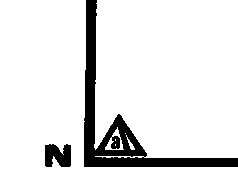
In this diagram, the pyramid symbol marked “a” represents Adam; the line marked as “N”, which continues on to the right, represents the plane Adam is existing on at that time – a plane of human perfection; different, as we discussed previously, to all other beings at that time.
As the Bible’s account of mankind’s creation and early days continues, toward the end of chapter two, God creates what verse 20 calls a “help meet for him”. This new creation was named “Woman” in verse 23, and in Genesis 3:20, we find that specifically her name was “Eve.”Genesis 2:8 also describes a garden that God created in a place called Eden. Verse 8 also indicates that it was in this garden, prior to the creation of the woman Eve, that God “put the man whom he had formed.” Verse 9 briefly describes the beauty of this garden, where “every tree that is pleasant to the sight, and good for food” grew. At the end of the verse, there is also another, special tree indicated as being in the garden, which the end of verse 9 describes as “the tree of knowledge of good and evil.” The Genesis account does not provide any in-depth details about this tree, other than calling it out specifically. However, a little further on in verse 16 and 17, God issues a command to “the man”:
Genesis 2:16 And Jehovah God commanded the man, saying, Of every tree of the garden thou mayest freely eat:
Genesis 2:17 but of the tree of the knowledge of good and evil, thou shalt not eat of it: for in the day that thou eatest thereof thou shalt surely die.
This command given in this statement is extremely clear, leaving no doubt as to either the prohibited act (eating of the tree of good and evil) or the consequences of that act, if committed (death). For a time, both the man and the woman, Adam and Eve obeyed the commandment, and were blessed with a perfect life in the garden that had been made for them.
However, Genesis chapter 3, a new element enters the account. Up until now, the account has focused on God, Adam and Eve, but in chapter 3, the serpent is introduced. Through the mouth of the serpent, a fourth member of the account spoke – the adversary; otherwise known as Satan. In verses 1-5, Satan proclaims the first, and perhaps greatest lie ever told on Earth, to Eve:
Genesis 3:3 but of the fruit of the tree which is in the midst of the garden, God hath said, Ye shall not eat of it, neither shall ye touch it, lest ye die.
Genesis 3:4 And the serpent said unto the woman, Ye shall not surely die:
Shortly after, in verse 6, we find both Adam and Eve disobeying God’s command, and eating the fruit of the tree of good and evil. From this one act, Adam, Eve, and all of their descendants down through time, including us today, were (and are) now subject to sin, and its terrible consequences.
Previously, we had envisioned Adam, the start of the human race and the start of God’s plan for mankind as a pyramid symbol, sitting on a plane of human perfection. In later posts, we will consider that perhaps the meaning of this plane can be extended to cover something a little more than just human perfection, but for now, we can consider it as such. On this plane, prior to disobedience and sin, Adam had a special relationship with God. However, once this disobedience happened, Adam, and indeed Eve, and their descendants, were out of harmony with God. God had previously delivered his warning of the consequences of disobedience, and in Genesis chapter 3 verses 17-19, we see the proclamation of this consequence:
Genesis 3:17 And unto Adam he said, Because thou hast hearkened unto the voice of thy wife, and hast eaten of the tree, of which I commanded thee, saying, Thou shalt not eat of it: cursed is the ground for thy sake; in toil shalt thou eat of it all the days of thy life;
Genesis 3:18 thorns also and thistles shall it bring forth to thee; and thou shalt eat the herb of the field;
Genesis 3:19 in the sweat of thy face shalt thou eat bread, till thou return unto the ground; for out of it wast thou taken: for dust thou art, and unto dust shalt thou return.
Mankind was now on a different plane on existence. The word “degraded” means that the condition of something is now worse than it was at some previous state or time. This word certainly now applied to Adam, Eve and their descendants, after their disobedience resulted in the just punishment enacted upon them. In the next post, we’ll examine this concept even more. For now, though, let’s conclude this post’s thoughts with the addition of a new line on the timeline outline that we started. We’ll place this new line below the previous line representing human perfection (which we had labeled “N”) to represent the fact that this new state was “lower” than the previous state, and represents Adam’s fall from the perfect human condition because of his disobedience. We’ll label this new line or plane as “R”, to represent this state of being that God proclaimed would lead to death. On this line, or plane, we’ll add a larger symbol than the small pyramid we had for Adam. This larger symbol represents all of the descendants of Adam and Eve that were also born into this degraded state.

- KEY TO OUR PLAN SO FAR
- PLANES
- N: Plane of Human Perfection
- R – Plane of Depraved Mankind
- OBJECTS
- a – Adam, created perfect (Genesis 1:27)
- b – Mankind, Degraded by Sin (Psalms 51:5, Romans 3:9-12)
- PLANES
So far, we’re starting to see some of the answers to some of the questions about why things seem imperfect to us; why there is death and sickness. Because of disobedience to God’s command in the garden, mankind is out of harmony with God; the presence of sin leads mankind to a degraded state. But rest assured, this is by far not the whole picture, and as we’ll begin to see as we lay out more of the plan, that God indeed had a reason for allowing the events described here to happen, and that he has a most wonderful plan for all mankind – everyone who every lived or will live.
In the next post, we’ll examine this new, degraded state, as well as this new symbol for Adam’s descendants, as well as adding a new major milestone to the timeline plan. In the meantime, if you would like some additional resources to look into, here are some resources you might find interesting:
- A link to an excellent summary booklet on the subject of “Why God Permits Evil” https://chicagobible.org/product/why-god-permits-evil-3/
- Much of the material that will be covered in this study is laid out in the booklet “God’s Grand Plan of the Ages” https://chicagobible.org/product/god-s-grand-plan-of-the-ages/
- For a much more definitive, in-depth study into God’s Plan, “The Divine Plan of the Ages” will prove to be an invaluable resource https://chicagobible.org/product/01-the-divine-plan-of-the-ages/
- (Please note that although these links will take you to the Chicago Bible Students online bookstore, where physical copies of these books/booklets may be purchased. Each of the books/booklets may also be downloaded from the bookstore, free of charge, with no obligation to provide any personal information)
 State College Bible Students