“The World That Was”
“…the world that then was, being overflowed with water, perished” – 2 Peter 3:6
In the last post in this study, we began to lay out, in graphical format, God’s plan for mankind, as laid out in the Bible. We began this plan with the creation of the first human being, Adam. We reviewed, that according to Genesis 1:27, Adam was created “in the image of God.” We also reviewed that the implication of this statement was that just as God is perfect, so was Adam created perfect. In time, we further considered how God created Eve, as a companion human being for Adam. We also saw how, after the pair was created, they were tested for obedience. In Genesis 2:16-17, we saw God giving Adam a command not to eat of a certain tree. Yet, we also saw in Genesis 3:1-13, the pair disobey God’s direction and eat fruit from the tree. This disobedience was the first sin, and caused the pair to fall from a state of human perfection to a lower state; degraded, or made less than they were before, by sin.
The creation of Adam in a perfect human state, as we saw, did not preclude him from losing that state. We discussed how God desired a creation that was not “programmed” to love and obey Him. God, in His infinite wisdom, understands that the best kind of love is one that is given from the heart, not commanded. In one of his Biblical comments, Pastor Charles Russell comments on the difference between Adam’s perfect condition and having a perfect character:
It should ever be borne in mind that perfection of being and perfection of character are two different things. Perfection of being is the work of God, while perfection of character is the work of the intelligent creature, wrought out in obedience to divine law and under the divine direction and supervision. Adam was a perfect being, innocent, free and glorious in his pristine beauty; but in the work of character-building he soon failed, and hence lost his perfection. Character cannot be developed wholly without trial. (R1807)
In the last post, we undertook the challenge of using the Bible to start to outline God’s plan for mankind in terms of a timeline, or chart. We began with two parallel lines, one on top of the other, to represent the two states of being, or planes, that Adam existed on – one of a perfect human condition, prior to his disobedience, and one representing the degraded, lesser human condition to represent his condition after his disobedience. We labeled these planes N and R, respectively. We then added a pyramid piece sitting on top of line R, the plane of human perfection, to represent Adam prior to his disobedience; to clearly mark the beginning of mankind in this perfect human state. We also then added a larger, partial pyramid, which we labeled b, resting on the plane of degraded mankind, to represent Adam, after his disobedience and fall from the state of perfection, as well as his descendants, in the now degraded human condition. Remember, our timeline looked like this:

Before we continue to examine this pyramid piece representing Adam’s descendants (marked b), there is an important part of the Genesis account of Adam and Eve’s disobedience that should be noted, as it will become vitally important later, as we continue down the plan’s execution. We reviewed how in Genesis 3, the adversary, in the form of a serpent, through great lie (verse 4 – “Ye shall not surely die) convinced Eve, and indirectly Adam, to disobey God’s instruction and eat fruit from the forbidden tree. We reviewed how that sin caused God to deliver a just punishment, and in verses 16-24, God removes them from the garden, and Adam, Eve, and their descendants fall from the plane of human perfection to the plane of degraded mankind. However, before delivering his judgment, God delivers an even sterner proclamation to the adversary.
Genesis 3:14 And Jehovah God said unto the serpent, Because thou hast done this, cursed art thou above all cattle, and above every beast of the field; upon thy belly shalt thou go, and dust shalt thou eat all the days of thy life:
Genesis 3:15 and I will put enmity between thee and the woman, and between thy seed and her seed: he shall bruise thy head, and thou shalt bruise his heel.
We will return to these verses in subsequent posts, and examine them in depth. The message behind these two verses is that although God knew He would need to deliver punishment to Adam, Eve and their descendants, He was also declaring, through this strong statement to the adversary, that this was not the end of the matter. Time would eventually uncover the meaning of this statement, that one day, a descendant of Eve’s would cause a fatal blow, a “bruise to the head” to the adversary and his plans. This proclamation, thousands of years later, serves as a great comfort to believers in God’s word and plan that, even as mankind’s fall into sin and death was first playing out, God had anticipated the fall, and had a plan for mankind’s eventual recovery. This same “bruising to the adversary’s head” is spoken of by the Apostle Paul, centuries later, in the New Testament, first in Romans:
Romans 16:20 And the God of peace shall bruise Satan under your feet shortly. The grace of our Lord Jesus Christ be with you.
And also in Hebrews:
Hebrews 2:14 Since then the children are sharers in flesh and blood, he also himself in like manner partook of the same; that through death he might bring to nought him that had the power of death, that is, the devil;
The Bible does not say much about what happens to Adam and Eve after they received their judgment and were removed from the garden. Genesis chapter four describes the tragic account of their two sons, Cain and Abel, demonstrating the further degraded state of mankind to the point of brother murdering brother. Genesis chapter 5 verse 5 tells us that Adam lived 930 years then died, bringing to mind the thought of II Peter 3:8, where the apostle tells us to consider that “one day is with the Lord as a thousand years”. Given God’s warning in Genesis 2:17 that “in the day thou eatest thereof [the fruit of the tree of knowledge of good and evil] thou shalt surely die”, there seems to be a symmetry to these two thoughts.
The majority of chapter 5 lists out the male descendants of Adam and Eve, along with their lifespans. However, the Bible does not give any detailed information about any of these people, until chapter six. Genesis chapter six gives us a small glimpse into something very significant that was happening in the world at that time:
Genesis 6:1 And it came to pass, when men began to multiply on the face of the ground, and daughters were born unto them,
Genesis 6:2 that the sons of God saw the daughters of men that they were fair; and they took them wives of all that they chose.
Genesis 6:4 There were giants in the earth in those days, and also after that, when the sons of God came unto the daughters of men, and they bare children to them: the same were the mighty men that were of old, the men of renown.
In those days, spiritual beings, referred to as “the sons of God” in these verses, had the ability to take human form. Some of them, according to this account, did so, and, upon mating with human women, produced what verse four refers to as “giants”, sometimes referred to as Nephilim. This hybrid race was not part of God’s plan for mankind, and was one of the key factors in God determining that a corrective action had to be taken. Chapter 6 describes just how bad the situation in the world had gotten:
Genesis 6:5 And Jehovah saw that the wickedness of man was great in the earth, and that every imagination of the thoughts of his heart was only evil continually.
Genesis 6:11 And the earth was corrupt before God, and the earth was filled with violence.
Genesis 6:12 And God saw the earth, and, behold, it was corrupt; for all flesh had corrupted their way upon the earth
The corrective action that God determined necessary was the complete destruction of both this hybrid race between “the sons of God” and “the daughters of man”, as well as the degraded portion of mankind that had chosen to deviate so completely from God’s plan and will. Today, some may look back on this decision and think, how could a God of love allow, and even command, the deaths of so many people? We will return to this thought in later posts as we progress through the outline of the plan; for now, suffice it to say that we will see that God’s plan of salvation includes those of the human family who lost their lives in this action.
In His mercy, God recognized a man of the time, Noah by name, and his family, as individuals that he determined to save from this destruction. Genesis chapters six through nine chronicle the account of Noah and his family. These chapters describe the grace that God showed them by instructing them on how to avoid the destructive flood that he would soon allow to be visited upon the earth. Genesis 7:21-23 make the results of this destructive cleansing very clear:
Genesis 7:21 And all flesh died that moved upon the earth, both birds, and cattle, and beasts, and every creeping thing that creepeth upon the earth, and every man:
Genesis 7:22 all in whose nostrils was the breath of the spirit of life, of all that was on the dry land, died.
Genesis 7:23 And every living thing was destroyed that was upon the face of the ground, both man, and cattle, and creeping things, and birds of the heavens; and they were destroyed from the earth: and Noah only was left, and they that were with him in the ark.
God’s plan for mankind had come to a decisive marking point. Mankind, as it had existed from the creation of Adam and Eve was now fundamentally changed; reduced to one man and his family, who had found grace in God’s sight. Many centuries later, the apostle Peter talks about this marking point, saying “the world that then was, being overflowed with water, perished” (II Peter 3:6). Through the wondrous record keeping of the Bible, we even know how many years this “world that then was” that existed from Adam’s creation to Noah’s time, covered. Previously, we referred to Genesis chapter 5 to determine, from verse 5, that Adam lived 930 years. However, verse 5 also describes the subsequent generations of the male offspring of Adam, and their ages at the births of their next generation, up unto the time of Noah, and even indicating Noah’s age at the time of the flood. In his Biblical commentary “The Time is at Hand”, Pastor Charles Russell outlines the following summary table of these ages of each male offspring, up until the time of the flood waters drying up. As can easily be traced through using the table and the scriptural references in it, we see that the time of the creation of Adam to the time when the flood waters receded was 1656 years:
| “Adam lived 130 years and begat a son and called his name Seth.” | Genesis 5:3 | 130 years |
| Genesis 5:6 | 105 years | |
| “Enos lived 90 years and begat Cainan.” | Genesis 5:9 | 90 years |
| “Cainan lived 70 years and begat Mahalaleel.” | Genesis 5:12 | 70 years |
| “Mahalaleel lived 65 years and begat Jared.” | Genesis 5:15 | 65 years |
| “Jared lived 162 years and begat Enoch.” | Genesis 5:18 | 162 years |
| “Enoch lived 65 years and begat Methuselah.” | Genesis 5:21 | 65 years |
| “Methuselah lived 187 years and begat Lamech.” | Genesis 5:25 | 187 years |
| “Lamech lived 182 years and begat a son and called his name Noah.” | Genesis 5:28 | 182 years |
| “Noah was 600 years old when the flood of waters was upon the earth.” | Genesis 7:6 | 600 years |
| Total from the creation of Adam to the day the flood was dried up. | 1656 years |
Considering the significance of the flood’s effect on mankind, it seems appropriate that we add another feature to the plan/timeline we created in the previous post. Since the flood marked the end of “the world that was”, it seems appropriate to mark a boundary on our plan/timeline, to clearly encompass all of what we have marked on our chart under one, overarching umbrella. This “umbrella”, referred to by Peter as “the world that was” could be referred to by any number of titles – world (meaning, the world during this specific period of time), age, or epoch. The word “dispensation” includes this idea of referring to a period of time, but adds the thought of there being a system of order or organization at the time. As we have seen in the scriptures from Genesis, it seems appropriate to refer to this time as having been under the organization of the “sons of God” – the angels (always remembering that this organization was at God’s permission and in harmony with his overall plan). Remember that at least part of the reason for the flood was that these heavenly beings took on human form and produced offspring. The result was rampant evil in the world, causing God to order the great cleansing flood. Therefore, it seems appropriate to refer to this time as “the first dispensation”, under the ministration of the angels.
This makes our updated chart look like the following:
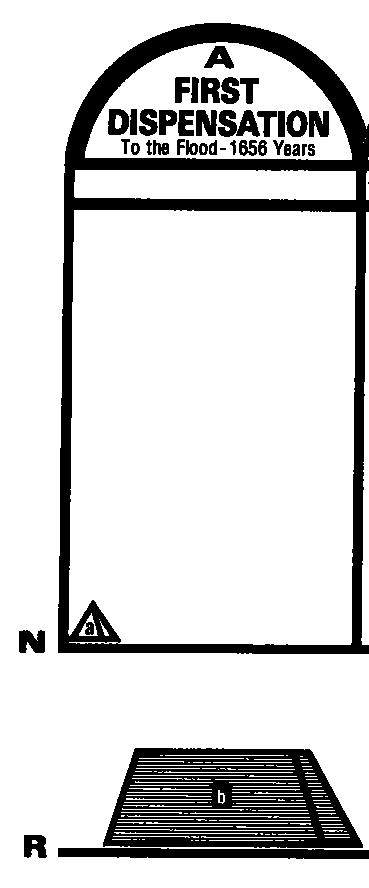
- KEY TO OUR PLAN SO FAR
- AGES
- A – First Dispensation (Creation to Flood)
- PLANES
- N – Plane of Human Perfection
- R – Plane of Depraved Mankind
- OBJECTS
- a – Adam, created perfect (Genesis 1:27)
- b – Mankind, Degraded by Sin (Psalms 51:5, Romans 3:9-12)
- AGES
Note that the pyramid piece we added to the chart in the last study, representing the degraded descendants of Adam and Eve, ends at our new boundary line, marking the end of this First Dispensation. The flood ended mankind, with the exception for Noah and his family, who, by God’s grace, were spared. In our next post, we’ll begin to look at God’s plan for mankind after the flood. Now that the first age, or dispensation was over, the second dispensation was primed to begin. We will see that the Bible provides us far more details about this period of time; enough to break the time period into several sub-sections. We will also see God begin to take a more direct hand with mankind, and will witness the giving of one of the most glorious promises ever made.
Other Posts in This Study
Further Readings and References
- For those wishing to download the entire Biblical study referenced in this post, “The Time is At Hand”, you may order a print version, for a small fee from the Chicago Bible Students book store
- A link to an excellent summary booklet on the subject of “Why God Permits Evil”
- Much of the material that will be covered in this study is laid out in the booklet “God’s Grand Plan of the Ages”
- For a much more definitive, in-depth study into God’s Plan, “The Divine Plan of the Ages” will prove to be an invaluable resource
- (Please note that although these links will take you to the Chicago Bible Students online bookstore, where physical copies of these books/booklets may be purchased. Each of the books/booklets may also be downloaded from the bookstore, free of charge, with no obligation to provide any personal information. Simply check under the description of each item to find the download link)
 State College Bible Students