“The Patriarchal Age part 1”
“…in thy seed shall all the families of the earth be blessed” – Genesis 28:14
When we last looked into God’s plan for mankind as recorded in the Bible’s book of Genesis, we saw that after the account of Adam and Eve’s sons, Cain and Abel, in Genesis chapter 4, the Bible proceeds, in chapter 5, to record the lineage of Adam and Eve’s descendants. However, we also discussed that the Bible does not provide details on any one of these figures, other than recording their names and ages when they fathered the next of their generations, and also how many years they lived. We saw that it was not until Genesis chapter 6 that the Bible specifies that God dealt with any one person specifically. We saw that in Genesis chapters 6-9, God deals with mankind specifically through one man, Noah. We saw how that through this interaction, God instructed Noah and his family to perform a certain great task, that saved them from a large scale cataclysm that consumed all of the rest of mankind at the time. We discussed how this cataclysm serves as a key division point on our outline of God’s plan for mankind, serving as a division between one age and the next. As we shall begin to see in our next study, the stage was now set for a new type of interaction between God and mankind.
In Genesis chapters 10-11, we see a brief account of some of Noah’s ancestors, and their attempts to construct a large tower. Although this account could serve as the subject of entire studies on its own, note here that God did not interact with any one person. The remainder of chapters 10 and 11 give us another recording of the ages of Noah’s descendants, the ages they were when they fathered the next of their generations, and how long they lived. Although these recordings can sometimes make for dense reading, they remain valuable, because they provide us a key resource for calculating dates associated with the execution of God’s plan.
Beginning with chapter 12, Genesis begins to outline a new set of interactions between God and mankind; this one specifically with a man named Abram. Abram is significant, because after Noah, he is the first person to whom God spoke to directly:
Genesis 12:1 Now Jehovah said unto Abram, Get thee out of thy country, and from thy kindred, and from thy father’s house, unto the land that I will show thee:
Genesis 12:2 and I will make of thee a great nation, and I will bless thee, and make they name great; and be thou a blessing;
Genesis 12:3 and I will bless them that bless thee, and him that curseth thee will I curse: and in thee shall all the families of the earth be blessed.
As with Noah, here we see the beginning of a conversation with God and one man, in this case, Abram, whose name was later changed by Abraham. Abraham was specially selected by God as the recipient of his communications. Genesis chapters 12 through 25 outline the account of Abraham’s life. These chapters detail the many experiences of Abraham and his family.
The accounts of Abram (later Abraham), his wife Sarai (later Sarah) and their families are worthy of individual studies on their own. However for the purposes of our current study, and the outline of God’s plan for mankind, we will concentrate on one specific set of communications between God and Abraham. Genesis chapter 12 starts with God instructing Abram to take his family and move them “unto a land I will shew thee” (Genesis 12:1-2), and further promises that if Abram obeys this instruction, he will bless Abram and “make [him] a great nation”. Note that chapter 12 starts with the account of God delivering this instruction to Abram, immediately after chapter 11, which, although introduced us to Abram and his family, provided very little other details about their early life. In this way, we perhaps are to realize that, since this is where the biblical account of Abram really begins in detail, that this interaction marks what God wants us to consider important. In fact, in chapter 13, after Abram has begun his move, we see that God repeats His promise to Abraham, this time providing a little more detail:
Genesis 13:14 And Jehovah said unto Abram, after that Lot was separated from him, Lift up now thine eyes, and look from the place where thou art, northward and southward and eastward and westward:
Genesis 13:15 for all the land which thou seest, to thee will I he wants give it, and to thy seed for ever.
Genesis 13:16 And I will make thy seed as the dust of the earth: So that if a man can number the dust of the earth, then may thy seed also be numbered.
Throughout Abram/Abraham’s life, God repeats this promise. We see God stating the promise again in chapter 15:
Genesis 15:4 And, behold, the word of Jehovah came unto him, saying, This man shall not be thine heir; But he that shall come forth out of thine own bowels shall be thine heir.
Genesis 15:5 And he brought him forth abroad, and said, Look now toward heaven, and number the stars, if thou be able to number them: and he said unto him, So shall thy seed be.
We see the promise repeated again in chapter 17:
Genesis 17:2 And I will make my covenant between me and thee, and will multiply thee exceedingly.
Genesis 17:3 And Abram fell on his face: and God talked with him, saying,
Genesis 17:4 As for me, behold, my covenant is with thee, and thou shalt be the father of a multitude of nations.
Genesis 17:5 Neither shall thy name any more be called Abram, but thy name shall be Abraham; for the father of a multitude of nations have I made thee.
Genesis 17:6 And I will make thee exceeding fruitful, and I will make nations of thee, and kings shall come out of thee.
Genesis 17:7 And I will establish my covenant between me and thee and thy seed after thee throughout their generations for an everlasting covenant, to be a God unto thee and to thy seed after thee.
Genesis 17:8 And I will give unto thee, and to thy seed after thee, the land of thy sojournings, all the land of Canaan, for an everlasting possession; and I will be their God.
Genesis 17:9 And God said unto Abraham, And as for thee, thou shalt keep my covenant, thou, and thy seed after thee throughout their generations.
And once more in chapter 22:
Genesis 22:15 And the angel of Jehovah called unto Abraham a second time out of heaven,
Genesis 22:16 and said, By myself have I sworn, saith Jehovah, because thou hast done this thing, and hast not withheld thy son, thine only son,
Genesis 22:17 that in blessing I will bless thee, and in multiplying I will multiply thy seed as the stars of the heavens, and as the sand which is upon the seashore. And thy seed shall possess the gate of his enemies.
Genesis 22:18 And in thy seed shall all the nations of the earth be blessed. Because thou hast obeyed my voice.
In a previous study on God’s plan, we examined the words that God spoke to the adversary, after Adam and Eve’s disobedience. Note how the similarity between these words and those repeated to Abraham later in Genesis:
Genesis 3:15 and I will put enmity between thee and the woman, and between thy seed and her seed: he shall bruise thy head, and thou shalt bruise his heel.
Note that, when reading these these words from God in close context with the words spoken to Abraham, there is a striking similarity in wording to the subsequent promises. In Genesis 3:15, God is proclaiming that the seed, or descendant of “the woman” (Eve) will “bruise thy [the adversary’s] head”. In the promises to Abraham, God repeatedly refers to the seed (descendants) of Abraham first, multiplying in number, and second, that in those descendants, all the families of the earth will be blessed. The two sets of promises, given at very different times, are really different facets of the same promise, and illustrate the unfolding of God’s plan as mankind’s generations progress. From mankind’s earliest moments, we see, through the recordings of these promises in the Bible, that God had no intention of abandoning mankind, and in fact, has been, from earliest times, attempting to reassure mankind of that fact. Given the fact that mankind was deceived by the adversary by the first great lie in Genesis 3:4 that “ye shall not surely die” because of sin and disobedience, a promise that there will come one who will “bruise the adversary’s head” – that will permanently end the adversary and his ability to deceive mankind – is truly a promise that will bring blessings and everlasting joy to all mankind.
In our review of mankind’s history immediately before the flood, though the flood, and after the flood (as we decided that the flood was a significant marker in God’s plan for mankind), we notice that God has begun to deal with mankind in a very specific way. In looking at the accounts in Genesis chapters 6-10 and also in chapters 12-25, we see that God chose to deal with mankind primarily by communicating first with Noah, then with Abram, or Abraham, as God subsequently renamed him. In those times, it was common for a man to represent or lead his family; in some cases, both his immediate family of his wife and children, but also in some cases extended family and even non-relatives. The term that may be applied to a man in this role is “patriarch.” Although the term patriarch is not used that often in the Bible, the Apostle Paul, many years after the times of Noah and Abraham, refers to them in the New Testament book of Hebrews, in chapter 12. We will examine this reference in more detail in the next study. For now, we see a new age dawning, after the flood. We see, and will continue to see, in part two of this study, God beginning to deal with mankind through these patriarchs. We see, and will continue to see God giving and re-emphasizing His promises to mankind through these patriarchs. It seems appropriate then, that when we consider the next addition to our chart of God’s plan for mankind that we mark the beginning of this new age, after the flood, and name it “The Patriarchal Age.” For now, we will just mark the addition of the age with a letter D, and leave it empty.
In part two of the study of this new Patriarchal Age, we will consider two further patriarchs of the time that God chose to deal directly with, and we will see a repeat of God’s promises to mankind through these patriarchs. Clearly, the promise God was making was something that He felt was worthy of continued emphasis. When a teacher in school emphasizes a point repeatedly, or when our parents repeatedly reinforce a particular message, it is usually because that point is so important that they feel the need to ensure that we pay attention to it and remember it. If the Supreme Creator of Everything decides that He needs to repeat a message, we should treat it with a great deal of importance. We will see, in part two of this study, not only the repetition of this promise, but also see the effect that faith in God had on these patriarchs, and the people around them, and have a few more items to add to our growing chart.
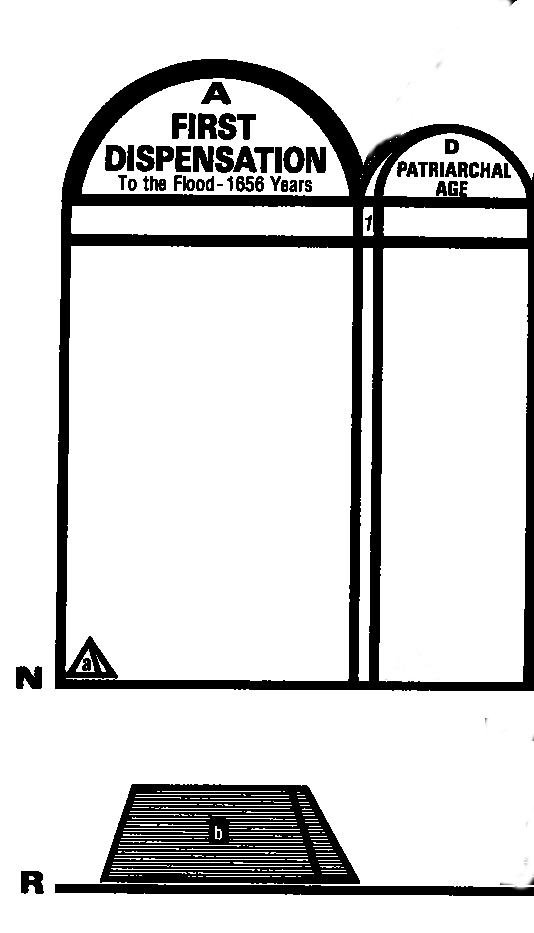
- AGES
- A – First Dispensation (Creation to Flood)
- D – Patriarchal Age
- N – Plane of Human Perfection
- R – Plane of Depraved Mankind
- a – Adam, created perfect (Genesis 1:27)
- b – Mankind, Degraded by Sin (Psalms 51:5, Romans 3:9-12)
Other Posts In This Study
- A Study in God’s Plan for Mankind – Study 1: In the Beginning
- A Study in God’s Plan for Mankind – Study 2: The World That Was
Further Readings and References
- A link to an excellent summary booklet on the subject of “Why God Permits Evil”
- Much of the material that will be covered in this study is laid out in the booklet “God’s Grand Plan of the Ages”
- For a much more definitive, in-depth study into God’s Plan, “The Divine Plan of the Ages” will prove to be an invaluable resource
- (Please note that although these links will take you to the Chicago Bible Students online bookstore, where physical copies of these books/booklets may be purchased. Each of the books/booklets may also be downloaded from the bookstore, free of charge, with no obligation to provide any personal information. Simply check under the description of each item to find the download link)
 State College Bible Students