“The Patriarchal Age part 2”
“… I am the God of thy father, the God of Abraham, the God of Isaac, and the God of Jacob. And Moses hid his face; for he was afraid to look upon God.” – Exodus 3:6
In the last posting, we discussed that at the time of the great flood described in Genesis, God had begun to deal with mankind through one man named Noah. Noah was the head of his family, and we discussed how the term “patriarch” is appropriate for him. We also discussed how, many years later, God began communicating and dealing with another patriarch; a descendant of Noah named Abram (whose name later was changed by God to Abraham). Although both Noah and Abraham received instructions from God, and both pleased him by their obedience, we also saw how God gave Abraham a special promise:
Genesis 12:1 Now Jehovah said unto Abram, Get thee out of thy country, and from thy kindred, and from thy father’s house, unto the land that I will show thee:
Genesis 12:2 and I will make of thee a great nation, and I will bless thee, and make they name great; and be thou a blessing;
Genesis 12:3 and I will bless them that bless thee, and him that curseth thee will I curse: and in thee shall all the families of the earth be blessed.
Abraham differed from Noah, in that this wonderful promise served to clarify further some of God’s plan for mankind was specifically made to Abraham. A promise made by the perfect creator of the universe is a special thing indeed; one that cannot be broken, delayed or sidetracked. At the conclusion of the previous post, we left off with the thought that there would be two more patriarchs to consider in the context of this promise. These two patriarchs are Abraham’s son and grandson, Isaac and Jacob. We further concluded that, since there seemed to be a new phase of God communicating with mankind through these patriarchs and through this repeated promise, that it would be appropriate to add a new era, or “age” on our timeline, beginning after the conclusion of the flood. We called this “age” the “Patriarchal Age”. In this post, we will examine Isaac and Jacob, and will see the repeated promise by God to mankind, through each of them. We will also examine references to them, throughout the Bible, that sets these three (Abraham, Isaac and Jacob) apart for special consideration. Lastly, we will see how these three earned a special relationship with God through their faith and obedience, and will conclude with the addition of a new object for our chart, and briefly look at the events that lead up to the beginning of the next “age”.
In Genesis chapter 21, we see the birth of Abraham’s son, Isaac. Interestingly, God’s dealings with and through Isaac began even before his birth. In Genesis chapter 18, we see “three men” visiting Abraham. Although the scriptures do not plainly say so, it is clear from the context of the later verses that these three men were, in actuality, messengers of God, or angels, that had taken on temporary human forms. These messengers, in verse 10, inform Abraham that Sarah, his wife, will have a son. Two things about this promise make it very significant. First, remember that God had promised Abraham that through his descendants, great blessings would come to all mankind. Although Abraham had other sons, the promise of a son with his beloved wife, Sarah, seems that it would carry a special significance. Second, the messengers delivered the promise of Sarah’s son very late in Abraham and Sarah’s life. Verse 11 specifically states that Sarah was at an age where childbirth was not generally thought feasible. Sarah evidently believed this so strongly, that when she heard this promise of a son, she laughed (verse 12). Nevertheless, God’s promises are the firmest and most reliable thing in all of creation, and indeed, Genesis chapter 21 verses 1-3 describe the birth of the promised son, Isaac.
Chapter 22 outlines an account that, by today’s standards, some may find a little troubling, but given its outcome, instead creates a wonderful blessing for those who consider the account in the way God intended it. When Isaac grew to become a young boy, God instructed his father, Abraham, to take Isaac into the mountains and offer him as sacrifice to God. Abraham did so, but prior to actually requiring Abraham to sacrifice Isaac, God stopped the proceedings. It may be difficult for some today to consider a father who would put his child into harm’s way; however, we should remember that Abraham had communication with God Himself. He knew there was no possibility that he was being deceived; he knew himself to be of a sound mind. It is likely that Abraham trusted in God to deliver both himself and his son somehow, even if he obeyed what, at the time, must have seemed like a terrible and trying command. Why would God command such a thing from Abraham? God loved Abraham, and He loved Isaac, enough to take special attention to Isaac’s birth. Clearly, for God to require such an action, He must have been trying to convey a message of such importance to Abraham, Isaac, and later all mankind who took the time to examine the message. The message seems to be of a father who willingly offers up his most beloved son as a sacrifice for some greater purpose. We will return to this very account later in our plan, and see that it was indeed intended to be a picture of a greater and farther reaching aspect of God’s plan for mankind.
Genesis chapter 25:5 describes how, later in life, Abraham “gave all that he had” to Isaac. This would have included all leadership responsibilities, transferring the title of “patriarch” from Abraham to Isaac. Later, in verses 24-26, we see the birth of two of Isaac’s sons, Esau and Jacob. Esau and Jacob were twins, although Esau was born first, and Jacob born immediately after. In those days, it was customary for the eldest son to inherit all that family had, including titles. Chapter 27, however, outlines a set of circumstances by which Jacob instead becomes the inheritor of Isaac’s birthright. In subsequent chapters, we see God dealing with Jacob. In chapter 28, we see God delivering a special dream to Jacob. Later, in chapter 31, we see God specifically sending instructions to Jacob. In chapter 32, God sends messengers to communicate with Jacob; one of which Jacob has a life-changing interaction with (note – in the next posting, we take a pause from our studies outlining God’s plan to examine this interaction between Jacob and one of God’s messengers in more detail). Still later, in chapter 35, we see God again communicating with Jacob, repeating the promise that he had given to Abraham now to Jacob, and also changing Jacob’s name to Israel:
Genesis 35:10 And God said unto him, Thy name is Jacob: thy name shall not be called any more Jacob, but Israel shall be thy name: and he called his name Israel.
Genesis 35:11 And God said unto him, I am God Almighty: be fruitful and multiply; a nation and a company of nations shall be of thee, and kings shall come out of thy loins;
In turn, Jacob had a number of sons, and grandsons, as well. Although the Bible gives accounts of these sons, none seem to have the same level of direct interaction with God that Abraham, Isaac and Jacob were privileged to have. Joseph seems to, perhaps, been specially focused upon in subsequent chapters, and it’s clear that God worked with him, but even Joseph did not obtain the status of “patriarch”. In fact, when he knew his life was drawing to a close, Jacob (or Israel, as he was then known) instead, passed down his blessings, and a prophecy, to twelve of his sons and grandsons.
In the years after Jacob/Israel’s death, the Bible describes several times when God either refers to Himself or others refer to Him, as “the God of Abraham, Isaac and Jacob”. This shows that God considered His relationship with Abraham, Isaac and Jacob as something special; that He wanted people, throughout the ages, to remember Him in relationship to these three patriarchs. Some of the many examples of this are:
Genesis 50:24 And Joseph said unto his brethren, I die; but God will surely visit you, and bring you up out of this land unto the land which he sware to Abraham, to Isaac, and to Jacob.
Exodus 3:6 Moreover he said, I am the God of thy father, the God of Abraham, the God of Isaac, and the God of Jacob. And Moses hid his face; for he was afraid to look upon God.
Exodus 3:15 And God said moreover unto Moses, Thus shalt thou say unto the children of Israel, Jehovah, the God of your fathers, the God of Abraham, the God of Isaac, and the God of Jacob, hath sent me unto you: this is my name forever, and this is my memorial unto all generations.
Exodus 6:3 and I appeared unto Abraham, unto Isaac, and unto Jacob, as God Almighty; but by my name Jehovah I was not known to them.
Exodus 32:13 Remember Abraham, Isaac, and Israel, thy servants, to whom thou swarest by thine own self, and saidst unto them, I will multiply your seed as the stars of heaven, and all this land that I have spoken of will I give unto your seed, and they shall inherit it for ever.
Exodus 33:1 And Jehovah spake unto Moses, Depart, go up hence, thou and the people that thou hast brought up out of the land of Egypt, unto the land of which I sware unto Abraham, to Isaac, and to Jacob, saying, Unto thy seed will I give it:
Leviticus 26:42 then will I remember my covenant with Jacob; and also my covenant with Isaac, and also my covenant with Abraham will I remember; and I will remember the land.
Deuteronomy 1:8 Behold, I have set the land before you: go in and possess the land which Jehovah sware unto your fathers, to Abraham, to Isaac, and to Jacob, to give unto them and to their seed after them.
Deuteronomy 6:10 And it shall be, when Jehovah thy God shall bring thee into the land which he sware unto thy fathers, to Abraham, to Isaac, and to Jacob, to give thee, great and goodly cities, which thou buildest not,
Jesus’s words:
Matthew 22:31 But as touching the resurrection of the dead, have ye not read that which was spoken unto you by God, saying,
Matthew 22:32 I am the God of Abraham, and the God of Isaac, and the God of Jacob? God is not [the God] of the dead, but of the living.
Mark 12:26 But as touching the dead, that they are raised; have ye not read in the book of Moses, in [the place concerning] the Bush, how God spake unto him, saying, I [am] the God of Abraham, and the God of Isaac, and the God of Jacob?
Peter’s words:
Acts 3:13 The God of Abraham, and of Isaac, and of Jacob, the God of our fathers, hath glorified his Servant Jesus; whom ye delivered up, and denied before the face of Pilate, when he had determined to release him.
Because of their great faith, these three patriarchs, Abraham, Isaac and Jacob, were granted a special relationship with God. Remember that after Adam and Eve’s disobedience, sin prevented most individuals from having any kind of relationship with God. Yet, these three patriarchs enjoyed not even communication with God, but received a great promise directly from Him. Thinking about this concept from a Biblical point of view, it is perhaps easy to take this statement for granted. Imagine, though, how fundamentally life changing it would be if you or someone you knew had a proven, direct communication, and more so a great promise, from the supreme creator of the universe. How greatly this would alter the course of mankind!
According to Vine’s Expository Dictionary of Old and New Testament words, the term “justification” means “to show to be right or righteous”. Although we will continually refer back to this concept of justification as we continue down the plan in subsequent studies, for now let us consider how important a concept it is that only one who is “right or righteous” can have a relationship with God. It was, remember, because of sin that after Adam and Eve’s disobedience, mankind in general fell from plane N, the plane of human perfection, down to plane R, the plane of depraved mankind. It was due to that disobedience and subsequent sin in the world, that Adam’s descendants fell into that large partial pyramidal shaped object we marked “b” – mankind degraded by sin. However, now we seem to have these three patriarchs (and other people such as Noah as well) having communication with God. How is this possible?
The Apostle Paul explains this, many years later, in his letter to the Hebrews.
Hebrews 11:8 By faith Abraham, when he was called, obeyed to go out unto a place which he was to receive for an inheritance; and he went out, not knowing whither he went.
Hebrews 11:9 By faith he became a sojourner in the land of promise, as in a [land] not his own, dwelling in tents, with Isaac and Jacob, the heirs with him of the same promise:
Here, we see Paul laying out the case that Abraham, Isaac and Jacob were able to have this special communication with God due to their great faith in him and his works. Although they were undoubtedly not perfect, God saw something special in their faith that set them apart from the rest of mankind; this “something” allowed him to communicate with them and have a relationship with them. This concept is sometimes referred to as “justification by faith” – Abraham, Isaac and Jacob’s faith was so strong that it allowed God to consider them made righteous enough to communicate with them and deliver His promise to mankind through them.
James speaks of the same concept, when he refers to Abraham:
James 2:21 Was not Abraham our father justified by works, in that he offered up Isaac his son upon the altar?
James 2:22 Thou seest that faith wrought with his works, and by works was faith made perfect;
From this we can expand the definition of what plane N refers to. Plane N, which we previously called a “plane of human perfection” (a plane above the “depraved mass of mankind”) can now be considered not only a plane of human perfection, but of friendship with God. It can also be thought of at “tentative justification”, because if Abraham, Isaac and Jacob had truly been made fully righteous by their faith, they would not have been punished with death, but instead enjoyed eternal life. As we shall see in future posts, there is only one way open to mankind to obtain an actual justification; an actual “being made righteous.”
Pastor Charles Russell offers a brief explanation to this thought of the justification that was granted to Abraham through his faith, that allowed him to enjoy this communication with God:
“… Abraham was justified by his faith to fellowship with God, and his faith would have justified him to complete restitution privileges, had he lived, under the privileges of the Millennium–or to faith-restitution with sacrificing privileges had he lived after instead of before our Lord died for our sins and provided justification to life for believers. The death of Christ is the basis of all reconciliation to God by actual restitution during the Millennium or by faith-restitution for sacrificing now. Faith so justified Abraham and the entire class of ancient worthies that, as soon as the antitypical Atonement Day shall have ended and the Millennial morning of blessing shall be ushered in under the New Covenant, those Ancient Worthies will come forth from the tomb perfect–justified–restored fully, right and in harmony with God. “They had this testimony, that they pleased God”–they were justified to perfect human conditions by their faith in the promises, but the basis of those promises was the sacrifice of Christ (Head and Body); hence they could not get the blessing promised to them until the completion of the sufferings of Christ, until the end of this Gospel Age, the close of this antitypical Day of Atonement. This is the Apostle’s testimony, “God having provided some better thing for us (as members of the great Priest, Mediator and King) that they without us should not be made perfect.” –Heb. 11:40. “ – R4554
As we said before, we will return to this concept of justification repeatedly in future posts. For now, we add a new symbol to our chart – a new pyramid, which we will insert on the Plane of Human Perfection, Friendship or Tentative Justification (plane N), and will label this new pyramid piece c. This piece will represent Abraham, Isaac and Jacob, on plane N because they were justified by their faith.
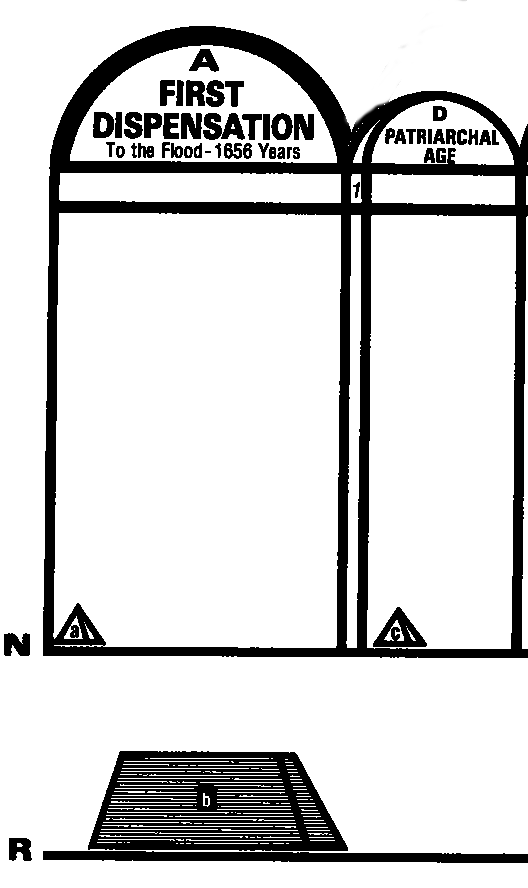
- KEY TO OUR PLAN SO FAR
- AGES
- A – First Dispensation (Creation to Flood)
- D – Patriarchal Age
- PLANES
- N – Plane of Human Perfection, Friendship or Tentative Justification
- R – Plane of Depraved Mankind
- OBJECTS
- a – Adam, created perfect (Genesis 1:27)
- b – Mankind, Degraded by Sin (Psalms 51:5, Romans 3:9-12)
- c – Abraham, Isaac and Jacob, Justified by Faith (Acts 7:32, James 2:23, Galatians 3:6)
- AGES
Note that in Hebrews 11, as well as in James 2, both Paul and James discuss other prominent figures in the Old Testament who also received tentative justification by their faith – righteousness that was granted to them because of their special and great faith in God. However, Abraham, Isaac and Jacob are called out specially to be represented by this pyramid piece c, as they were the recipients of the promise of God. Further, God Himself refers to Himself as “the God of Abraham, Isaac and Jacob” as we discussed before, so it seems appropriate to have a special symbol denoting them. These other figures, such as Enoch, Moses, and so forth, that also received this special justification, are the class of people referred to as “Ancient Worthies” in the above commentary by Pastor Russell.
In Genesis 32:28, we see God changing Jacob’s name to Israel. We also start to see a shift in God’s dealings with mankind. We start to see the Bible focus more on Jacob/Israel’s twelve children and grandchildren as opposed to one specific patriarch. This shift in focus heralds the ending of the Patriarchal Age; the ending of the age when God communicated his promise through Abraham, Isaac and Jacob, and the beginnings of another, different phase in the communication between God and mankind. In our next post, we will examine Jacob/Israel’s twelve children/grandchildren, and begin a set of studies in the next phase, or age, of God’s plan; an age which will end in one of the most significant events in all of human history.
Posts in the “God’s Plan for Mankind” Study
- A Study in God’s Plan for Mankind – Study 1: In the Beginning
- A Study in God’s Plan for Mankind – Study 2: The World That Was
- A Study in God’s Plan for Mankind – Study 3: The Patriarchal Age part 1
- A Study in God’s Plan for Mankind – Study 4: The Patriarchal Age part 2
- A Study in God’s Plan for Mankind – Study 4a: Jacob’s Hip
- A Study in God’s Plan for Mankind – Study 5: The Jewish Age part 1: The Children of Israel
- A Study in God’s Plan for Mankind – Study 6: The Jewish Age part 2: Typical Justification and Life
- A Study in God’s Plan for Mankind – Study 7: The Jewish Age part 3: Judges, Kings and Prophecies
- A Study in God’s Plan for Mankind – Study 8 – The Jewish Age Harvest part 1: Prophecies Fulfilled
- A Study in God’s Plan for Mankind – Study 9 – The Jewish Age Harvest part 2: The Four Phases of Jesus’s Human and Post-Resurrection Existence
- A Study in God’s Plan for Mankind – Study 10 – Beginnings, Endings and Overlaps
- A Study in God’s Plan for Mankind – Study 11 – The Gospel Age part 1: Justification by Faith
- A Study in God’s Plan for Mankind – Study 12 – The Gospel Age part 2: The Promise of the Restitution of All Things
- A Study in God’s Plan for Mankind – Study 13 – The Gospel Age part 3: The Cost of Mankind’s Ransom
- A Study in God’s Plan for Mankind – Study 13a – The Gospel Age part 3a: Faith: The Work of a Lifetime
- A Study in God’s Plan for Mankind – Study 14 – The Gospel Age part 4: The High Calling
- A Study in God’s Plan for Mankind – Study 15 – The Gospel Age part 5: God’s Plan and the Permission of Evil
- A Study in God’s Plan for Mankind – Study 16 – The Gospel Age part 6: The Great Company
- A Study in God’s Plan for Mankind – Study 17 – The Gospel Age part 7: The Gospel Age in Summary
- A Study in God’s Plan for Mankind – Study 18 – The Gospel Age Harvest part 1: An Introduction to the Concept of the Harvest at the End of the Gospel Age
- A Study in God’s Plan for Mankind – Study 19 – The Gospel Age Harvest part 2: The Lord’s Return and Presence in the Gospel Age Harvest
- A Study in God’s Plan for Mankind – Study 20 – The Gospel Age Harvest part 3: The Completion of the Church Class
Further Readings and References
- Much of the material that is covered in this study is laid out in the booklet God’s Grand Plan of the Ages
- For a much more definitive, in-depth study of God’s plan for mankind, The Divine Plan of the Ages will prove to be an invaluable resource
- For those wishing to read the full article concerning Abraham, that was quoted in this study, you can reference it at this site. Search for the name of the article “Abraham’s Justification and Ours”
- (Please note that although some of these links will take you to the Chicago Bible Students online bookstore, where physical copies of these books/booklets may be purchased, each of the books/booklets may also be downloaded from the bookstore, free or charge, with no obligation to provide any personal information. Simply click under the description of each item to find the download link)
 State College Bible Students