The Jewish Age part 2: “Typical Justification and Life”
The term “justification” means the act or process of making something or someone right, or just. When applied to religious topics, justification often includes the further thought of making someone (more than something) “right” with God. In our very first study on God’s plan, we examined the early chapters of Genesis, where we considered how the scriptures record that Adam was created in God’s image; implying that he was created in a state of human perfection. We saw that because of that state of perfection, Adam was able to maintain a relationship with God. He was able to talk with God in a far more intimate manner than perhaps we are used to thinking of today. We saw that this relationship with God put Adam on a special plane of existence, a plane of human perfection.
We further saw that although Adam was created perfect, God gave him free will. He had the ability to make choices, and one choice led him to disobey God. To disobey God is to sin. We saw that because of this sin, Adam, and all his descendants, dropped to a lower plane of existence. We discussed how the term “depraved” means corrupted or degraded, and saw how as a result of sin, mankind in general was now existing on this lower plane of depraved humanity. We further saw that mankind in general could thus not have a relationship with God, because God fundamentally bear imperfection and sin.
In later studies, we saw how God began to deal with certain individuals here and there. We discussed how their great faith in God granted these individuals a kind of tentative, or not finalized, justification or righteousness, that allowed God to deal with them. James discusses an example of this type of tentative righteousness, when considering Abraham:
James 2:23 and the scripture was fulfilled which saith, And Abraham believed God, and it was reckoned unto him for righteousness; and he was called the friend of God.
When we left the last study, we saw God had begun to deal with a much broader segment of people than the scriptures reveal to that point. The books of Exodus, Leviticus, Numbers and Deuteronomy describe God’s dealings with the descendants of Abraham’s grandson Jacob, who was later in his life renamed to be Israel. As we left off in the last study, we saw God deliver a series of laws to the descendants of Israel through his spokesperson, Moses. This law, as we saw, began with what has become known as the Ten Commandments, and was followed up by a series of much more detailed laws, including extremely precise requirements for sacrifices, dietary requirements, managing of personal resources, and relationships between people.
Although there are many details to these laws that have been analyzed, interpreted and studied by many scholars and people over the centuries, there are a few important high level thoughts to keep in mind. First, it is important to keep in mind that God delivered this law, through Moses, to the descendants of Israel alone. Although it is important for people today to understand the intention behind the Ten Commandments, it is not necessary, or perhaps even proper, for Christians today to attempt to follow the law as laid out in these book in the Bible. As we will see in further studies as we progress through God’s plan, the Apostle Paul discusses this very concept in the book of Romans (primarily in Romans chapters 8 and 9, but also throughout the entire book). Paul makes a clear distinction between “natural Israelite’s”, as the future descendants of Israel/Jacob would come to be known, and the Gentiles, which came to be a term used to refer to all the rest of mankind who were not descendants of Israel (or more accurately, perhaps, those who were not descendants of Israel and also not of the Jewish faith).
A second consideration, more relevant to this current study, is laid out in Leviticus 18:4 and 5:
Leviticus 18:4 Mine ordinances shall ye do, and my statutes shall ye keep, to walk therein: I am Jehovah your God.
Leviticus 18:5 Ye shall therefore keep my statutes, and mine ordinances; which if a man do, he shall live in them: I am Jehovah.
God, through Moses, is clearly telling the descendants of Israel, here are all of my laws. If anyone can keep all of these laws, then that person will be granted life for as long as they keep these laws (“which if a man do, he shall live in them”. Many years later, Paul referred to this thought in his letter to the Romans:
Romans 10:5 For Moses writeth that the man that doeth the righteousness which is of the law shall live thereby.
The quote above is from the King James translation of the Bible. The thought that a total obedience to this law by any of the natural Israelites would grant them life (and thus justification, or righteousness, in God’s eyes) is perhaps more emphatically expressed in a different Biblical translation. Below is the same verse, but from the Rotherham’s Emphasized Bible translation:
Romans 10:5 For, Moses, writeth that-as touching the righteousness that is by law, The man that hath done it, shall live thereby;
Before continuing on with this study, let us first examine another time when this same idea, in fact the same scripture, of Leviticus 18:5, was again used many years after God proclaimed it, through Moses, to the descendants of Israel. During his time on Earth, Jesus was approached by a lawyer, who asked him a very profound and important question:
Luke 10:25 And behold, a certain lawyer stood up and made trial of him, saying, Master, what shall I do to inherit eternal life?
Jesus, perhaps taking this as an opportunity to emphasize a point that he thought very important, responded to the lawyers question with a question of his own:
Luke 10:26 And he said unto him, What is written in the law? how readest thou?
Think of yourself in the place of this young lawyer. You have obviously, as a lawyer, devoted much time and energy into studying the intricacies of the law. Now, you are put on the spot by one you consider so learned that you refer to him as “Master”, and this man is asking you to tell him, off the top of your head, not only what is written in the law that you have devoted so much of your time to studying, but how do you interpret it (“how readest thou)? The account in Luke does not record any hesitation on behalf of the lawyer:
Luke 10:27 And he answering said, Thou shalt love the Lord thy God with all thy heart, and with all thy soul, and with all thy strength, and with all thy mind; and thy neighbor as thyself.
The lawyer, was quoting a portion of the law, recording in Leviticus (19:18). Although this thought could in itself form undoubtedly several meaningful studies, Jesus tells the lawyer that he responded to the question correctly. Although the details of the law were perhaps complex, the spirit behind the law was summarized in the lawyer’s answer.
Given this understanding, that perfect keeping of the law given by God would allow any of the descendants of Israel to be justified in His eyes, a reasonable question might be, why didn’t the Bible, or history for that matter, ever record any Israelite living forever? The answer is simple. The Israelite’s, just as every other person ever born, were descendants of Adam. Having descending from Adam after his fall from perfection implies that each of Adam’s descendants was also imperfect. God’s laws commanded perfect obedience, and the descendants of Israel, being born imperfect just like every other person found it impossible to perfectly keep the law God delivered to them.
This thought may raise two additional thoughts. First, if the law that God gave to the children of Israel offered life to only those who could perfectly keep it, but, since people aren’t perfect, and none of the children of Israel realistically could keep the law given by God, what was the point of God giving the law? Second, if the law was only given to the descendants of Israel, what about all of the rest of the people either then, or down through history, even to the present day, who were or are not descendants of Israel? How does this giving of God’s law even affect all of these people? Did they ever have, or will they ever have, a chance or hope at life?
The answer to both of these question is actually the same. God was providing the means by which the descendants of Israel could become justified according to His perfect justice. God no doubt knew ahead of time that none would be able to perfectly keep the law He had laid out, or even to perfectly keep the spirit of that law. God was, unbeknownst to the Israelite’s at the time, laying out the next portion of His plan. By delivering His law, His plan now needed someone who could keep it completely and perfectly; in other words, fulfill it, both in every practical aspect as well as in its spirit. God was sending the message that in order to gain life, He can accept nothing less than absolute perfection; sacrifices performed as atonement for sins committed, as outlined in the law, may have provided relief from the impacts of both unintentional and intentional sins (as outlined in Leviticus 5:14-19 and Leviticus 6:1-7/Leviticus 7:1-7, respectively), but were not lasting solutions. Many years later, Paul referred to this exact concept in his letter to the Hebrews:
Hebrews 10:1 For the law having a shadow of the good [things] to come, not the very image of the things, can never with the same sacrifices year by year, which they offer continually, make perfect them that draw nigh.
Hebrews 10:4 For it is impossible that the blood of bulls and goats should take away sins.
A perfect keeping of the law, in deed and spirit, would surely point out someone significant; someone worthy of true justification and life in God’s eyes. As we will see in future studies, eventually, such a person would come, and as we shall see, his ability to keep the law, and what he chose to do with the justification and right to life that the perfect keeping of the law granted him, had, and continues to have, profound impacts to not only those who are descendants of Israel, but all people who were ever, and will ever, be born.
Much like the institution of the Passover remembrance covered earlier, God intended much of the circumstances surrounding the law to serve as a picture of future events and circumstances to come. These kind of “pictures” are often referred to as “types”. Especially when seen from the present day, it is clear that God was laying out another type, or set of types, in his law, the sacrifices demanded by it, and the keeping of it.
To summarize these thoughts:
- Only a perfect keeping of the law would cause a descendant of Israel to become justified in God’s eyes. That person would have a right to life
- Blood was required to provide atonement for sins caused by disobedience to God and His law. This atonement was only temporary, and was meant to serve as a picture, or “type”, of some greater event in the future.
- The law was given to the descendants of Israel only. That meant that at that time, only the descendants of Israel had any hope of attaining any type of justification with God. The remainder of mankind, who had not descended from Israel/Jacob, were left in the same state they had been in since Adam’s disobedience.
With this summary in mind, we make some new additions to our chart of God’s plan for mankind. First, although we saw how the transition from God dealing with mankind through a small set of people referred to as “patriarchs” to a wider subset of mankind, specifically the descendants of the last of these patriarchs, Israel, caused the ending of the previous age (the Patriarchal Age), and the start of a new age, we did not assign a name to the new age.
According to Strong’s concordance, the terms “Jew” or “Jewish” do not begin to appear in the Old Testament of the Bible until later books that the few we have so far considered. A brief outline of the occurrences of these terms, according to Strong’s concordance, follows:
- The term “Jew is only used in three different books of the Old Testament
- Ester
- Jeremiah
- Zechariah
- The term “Jews is used in six different books of the Old Testament:
- 2 Kings
- Ezra
- Nehemiah
- Ester
- Jeremiah
- Daniel
- The term “Jewish” is not used in the Old Testament
According to Easton’s Bible Dictionary, the term “Jew” originally was applied to descendants of one of Israel’s sons, whose name was Jacob. Eventually, however, this term began to apply to all of the descendants of Israel:
Jew: the name derived from the patriarch Judah, at first given to one belonging to the tribe of Judah or to the separate kingdom of Judah (2 Kings 16:6; 25:25; Jer. 32:12; 38:19; 40:11; 41:3), in contradistinction from those belonging to the kingdom of the ten tribes, who were called Israelite’s. During the Captivity, and after the Restoration, the name, however, was extended to all the Hebrew nation without distinction (Esther 3:6, 10; Dan. 3:8, 12; Ezra 4:12; 5:1, 5). – Easton’s Bible Dictionary
After the brief outline and consideration of the law given to the descendants of Israel in this study, it seems appropriate to label this new age as “the Jewish Age”. As noted several times, that although when viewed as a whole, God’s plan certainly includes all people who were ever born or will ever be born, during this specific period of time we are labeling as the Jewish Age, God was only dealing with the chosen group of people who had descended from Israel.
To highlight the fact that God was dealing with the descendants of Israel specially during this period, it seems appropriate to add a new symbol to our chart during this age, just as we added symbols for Adam during the First Dispensation, and a different symbol for the patriarchs under the Patriarchal Age. Since this symbol represents a much broader set of people than these two previous symbols, we will make our symbol be a larger piece of a pyramid, and we will label this piece “e”.
Remember that previously in our chart, we also had a large pyramid piece we labeled “b”, which we said represented mankind after Adam’s disobedience. We also said that this piece “b” rested on a plane we labeled as “R”, which we called “the Plane of Depraved Mankind”, and we further saw that this plane ended in death.
Thus, in this new Jewish Age, we carry over this concept for the majority of mankind who were not descendants of Israel. Without the offer of life given by the law, this majority of mankind had no hope of escape from their sinful condition, and thus from death. We will make this pyramid piece a little larger, since the population is symbolizes is larger than piece “b”, and label this new pyramid piece “d”. Even though the piece is new, the concept of the symbol is the same; “b” and “d” are both the world of mankind, degraded by sin, and unable to attain justification in God’s eyes.
However, the introduction of the law by God does separate the descendants of Israel from the majority of mankind at this time. The law, and the sacrifices required by the law, pointed to a new kind of justification. As we discussed, this justification provided the opportunity for life, but required perfect adherence to the law in both deed and spirit, and sacrifices to provide atonement, however brief and transitory, from sins against the law. This justification, as we briefly touched upon, was intended to be a picture, or a “type” of a greater form of justification that was to come. Thus, we add a new plane to are chart, labeled “P”, and titled “Plane of Typical Justification”. We add these two new symbols, “e” for the descendants of Israel, thus “typically” justified by God’s law, and “d” for the greater balance of mankind, to the Jewish Age.
Note that we are adding these new symbols below the plane “N” that we had previously created, on which we placed the symbols for Adam and the patriarchs. Remember that we had labeled plane “N” as “the Plane of Human Perfection, Friendship or Tentative Justification”. Since this new type of justification is of a lesser state than this, in that, as noted previously, none of the Jewish people could perfectly keep the law in either deed or spirit, it seems appropriate to separate our new plane of typical justification from this previous plane, and indeed place it lower (but still above plane “R” – the Plane of Depraved Mankind.
With the addition of the new plane P, the two new symbols “e” and “d”, and the title of the new age now specified as the Jewish Age (which we will label “E”), our chart now looks like this:
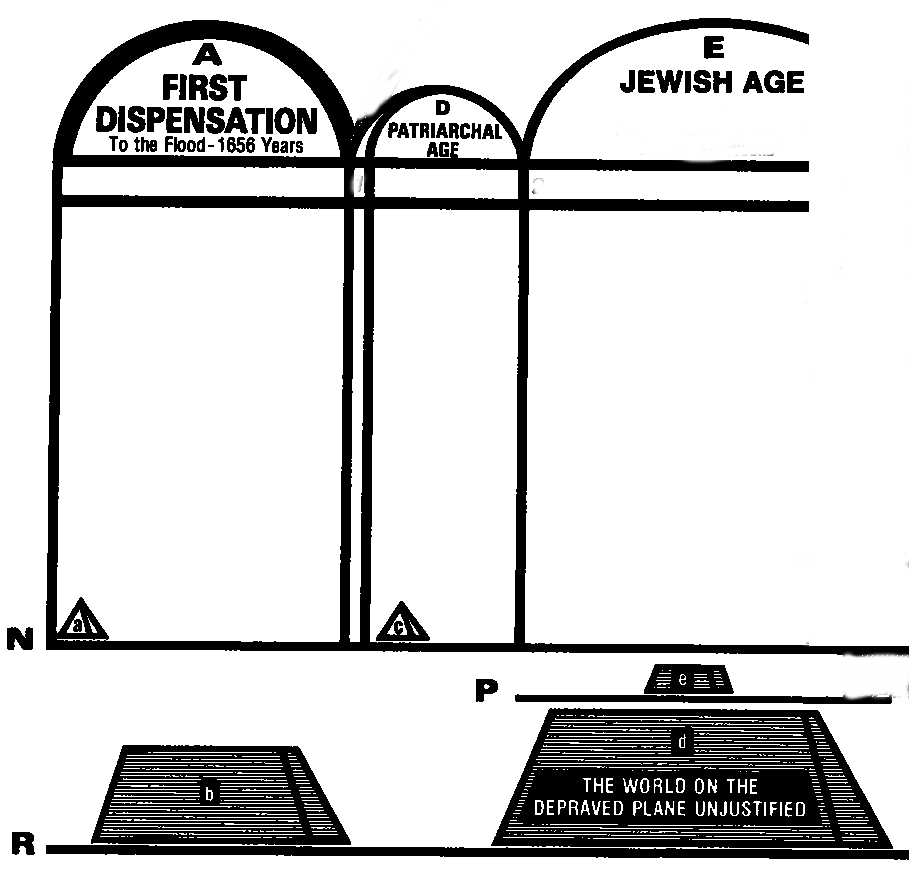
- KEY TO OUR PLAN SO FAR
- AGES
- A – First Dispensation (Creation to Flood)
- D – Patriarchal Age
- E – Jewish Age (new addition)
- PLANES
- N – Plane of Human Perfection, Friendship or Tentative Justification
- P – Plane of Typical Justification (new addition)
- R – Plane of Depraved Mankind
- OBJECTS
- a – Adam, created perfect (Genesis 1:27)
- b – Mankind, Degraded by Sin (Psalms 51:5, Romans 3:9-12)
- c – Abraham, Isaac and Jacob, Justified by Faith (Acts 7:32, James 2:23, Galatians 3:6)
- d – World of Mankind Unjustified (Romans 3:9-12) (new addition)
- e – Israel’s Typical Justification (Hebrews 10:1,4) (new addition)
- AGES
In our next study, we will continue to follow the descendants of Israel as they begin to form a true nation. We will examine two systems of government adopted by the Israelite’s and will assess, through an overview of the remaining books of the Old Testament, whether the newly formed nation of Israel was able to follow through on its promise to remain loyal to God, and begin to assess what these scriptures reveal about the consequences of those actions, some of which have direct impacts to the present day world.
Posts in the “God’s Plan for Mankind” Study
- A Study in God’s Plan for Mankind – Study 1: In the Beginning
- A Study in God’s Plan for Mankind – Study 2: The World That Was
- A Study in God’s Plan for Mankind – Study 3: The Patriarchal Age part 1
- A Study in God’s Plan for Mankind – Study 4: The Patriarchal Age part 2
- A Study in God’s Plan for Mankind – Study 4a: Jacob’s Hip
- A Study in God’s Plan for Mankind – Study 5: The Jewish Age part 1: The Children of Israel
- A Study in God’s Plan for Mankind – Study 6: The Jewish Age part 2: Typical Justification and Life
- A Study in God’s Plan for Mankind – Study 7: The Jewish Age part 3: Judges, Kings and Prophecies
- A Study in God’s Plan for Mankind – Study 8 – The Jewish Age Harvest part 1: Prophecies Fulfilled
- A Study in God’s Plan for Mankind – Study 9 – The Jewish Age Harvest part 2: The Four Phases of Jesus’s Human and Post-Resurrection Existence
- A Study in God’s Plan for Mankind – Study 10 – Beginnings, Endings and Overlaps
- A Study in God’s Plan for Mankind – Study 11 – The Gospel Age part 1: Justification by Faith
- A Study in God’s Plan for Mankind – Study 12 – The Gospel Age part 2: The Promise of the Restitution of All Things
- A Study in God’s Plan for Mankind – Study 13 – The Gospel Age part 3: The Cost of Mankind’s Ransom
- A Study in God’s Plan for Mankind – Study 13a – The Gospel Age part 3a: Faith: The Work of a Lifetime
- A Study in God’s Plan for Mankind – Study 14 – The Gospel Age part 4: The High Calling
- A Study in God’s Plan for Mankind – Study 15 – The Gospel Age part 5: God’s Plan and the Permission of Evil
- A Study in God’s Plan for Mankind – Study 16 – The Gospel Age part 6: The Great Company
- A Study in God’s Plan for Mankind – Study 17 – The Gospel Age part 7: The Gospel Age in Summary
- A Study in God’s Plan for Mankind – Study 18 – The Gospel Age Harvest part 1: An Introduction to the Concept of the Harvest at the End of the Gospel Age
- A Study in God’s Plan for Mankind – Study 19 – The Gospel Age Harvest part 2: The Lord’s Return and Presence in the Gospel Age Harvest
- A Study in God’s Plan for Mankind – Study 20 – The Gospel Age Harvest part 3: The Completion of the Church Class
Further Readings and References
- The New Albany Bible Students have published a comprehensive study called Paul to the Romans Although the entire book is highly recommended, readers of this post may be find pages 207 to 210 particularly relevant to many of the concepts outlined in this study.
- The Herald of Christ’s Kingdom magazine is published bi-monthly by the Pastoral Bible Institute. Each issue provides rich coverage of a variety of Biblical study topics. Israel is the topic of several issues, such as The Miracles of Israel and Israel at Sixty
- This outline of the Tabernacle, and the sacrifices required by the law provides a concise overview of many aspects of the Jewish law, and their future applications.
- For a scholarly, extensive overview of many aspects of the Jewish tabernacle, Tabernacle Shadows of the “Better Sacrifices” will provide interested students with not only an overview of many of the pictures, or “types” touched on in this study, as well as the eventual happening that these types represented
- For a much more definitive, in-depth study of God’s plan for mankind, The Divine Plan of the Ages will prove to be an invaluable resource
- This study referred to the use of Strong’s concordance as well as to the concept of types, or pictures. Both of these tools and concepts are covered in a separate set of studies on this site entitled “How to Study the Bible”. For an outline to many different methods of Bible study, How to Study the Bible and Have It Make Sense may prove to be very useful to support Bible study
- (Please note that although some of these links will take you to the Chicago Bible Students online bookstore, where physical copies of these books and charts may be purchased, each of the books and charts may also be downloaded from the bookstore, free of charge, with no obligation to provide any personal information. Simply click under the description of each item to find the download link)
 State College Bible Students