The Jewish Age Harvest part 1: “Prophecies Fulfilled”
Say not ye, There are yet four months, and [then] cometh the harvest? behold, I say unto you, Lift up your eyes, and look on the fields, that they are white already unto harvest. – John 4:35
When we closed our last study, we had examined how the descendants of Israel formed a nation, and because of their ancestry, were chosen to special favor by God. We examined how as a result of disobedience to commitments that they, as a nation had made to God, a series of punishments were experienced by them. We also saw how, throughout the hundreds of years after the Israelites settled into the land promised to them by God, many prophets were sent by God to deliver messages of both warnings and hope. Among these many prophets was Daniel, to whom and by whom God delivered a great prophecy of the timing of a coming messiah. Other prophets, such as Isaiah and Zechariah among others, also referred to this messiah, and described him as a king to the nation of Israel. Many prophecies further described the period of time in which this king would come as a time of judgment for the people of Israel.
We begin our study some four hundred or so years after the time of Daniel’s prophecy. Although mankind, at the time, was largely unaware of it, key events in God’s plan for mankind were about to unfold in an extremely dramatic and profound manner.
Before we examine some of these events, and their relevance to God’s plan for mankind, let us take a few minutes to revisit some of the considerations of previous studies, as many of them will see either their fulfillment or their next phase in the events touched upon in this study.
In study 2, we considered how, after Adam and Eve fell from their perfect human condition through their disobedience to a command given by God, God nonetheless delivered a small glimmer of hope to them (as well as to their descendants, us included) that although their punishment might be difficult, there would eventually be deliverance from that punishment, through one of their descendants:
Genesis 3:15 and I will put enmity between thee and the woman, and between thy seed and her seed: he shall bruise thy head, and thou shalt bruise his heel.
In study 3, we considered a descendant of Adam and Eve’s named Abram, who was later renamed Abraham. The scriptures teach that because of his great love and faithfulness and obedience to God, God blessed Abraham with a grand and far-reaching promise. He promised Abraham that his descendants would develop into a great nation, and further that through Abraham and his descendants, all the families of the earth – every single person who ever lived or would ever live – would be blessed
Genesis 12:1 Now Jehovah said unto Abram, Get thee out of thy country, and from thy kindred, and from thy father’s house, unto the land that I will show thee:
Genesis 12:2 and I will make of thee a great nation, and I will bless thee, and make they name great; and be thou a blessing;
Genesis 12:3 and I will bless them that bless thee, and him that curseth thee will I curse: and in thee shall all the families of the earth be blessed.
In study 6, we considered how, several generations after Abraham, God delivered a series of laws to the descendants of Israel (one of Abraham’s grandsons), as well as a series of sacrifices, that, if kept perfectly in word and in spirit would provide that person with justification or righteousness with respect to God’s justice, thus entitling that person to life.
Leviticus 18:3 After the doings of the land of Egypt, wherein ye dwelt, shall ye not do: and after the doings of the land of Canaan, whither I bring you, shall ye not do; neither shall ye walk in their statutes.
Leviticus 18:4 Mine ordinances shall ye do, and my statutes shall ye keep, to walk therein: I am Jehovah your God.
Leviticus 18:5 Ye shall therefore keep my statutes, and mine ordinances; which if a man do, he shall live in them: I am Jehovah.
Lastly, in study 7, we considered how no person was able to perfectly keep the law. The typical animal sacrifices could not provide permanent justification, and thus no one could attain the permanent justification, or righteousness needed to sustain life under the law. We also reviewed how the nation of Israel, as a whole, often departed from their promise to stay faithful to God and worship Him alone, and thus were subject to punishments. We further considered how, during this period, God sent a series of prophets to the Israelites, describing a coming king and judge to the nation.
At this point, it seemed as if mankind was in quite a dilemma. First, as a result of their ancestor’s disobedience, they were under a death sentence; they would be allowed to live to a certain point, then no more. Second, God had delivered a law that would provide justification, and thus a right to life, to a chosen subsection of mankind, but that opportunity did not include the majority of mankind. Third, even with this opportunity, that subsection of mankind could not live up to the requirements necessary to keep that law, and thus attain the justification necessary for life, and in this, they continued to be under the same death sentence as the rest of mankind. Fortunately, God’s plan for mankind had (and continues to have) this dilemma well in hand, as we will see as our study unfolds.
By way of starting this study, let us consider the concept of spiritual beings. Spiritual beings, beings who are not human and who live on an entirely different plane of being than us, are referred to throughout the scriptures. However, one spiritual being, described in the first chapter of the book of John, stands apart from the others. In his writings, the Apostle John refers to this being as “the Word”. “Word” as used here, is Strong’s Greek word 3056, which in Greek is the word “Logos”. John describes the Word, or Logos, as an extremely powerful being, whom, at God’s direction, had at least a part in the creation of all things:
John 1:3 All things were made through him; and without him was not anything made that hath been made.
John further describes how this being chose to fulfill the next step in God’s plan by becoming a human being and living among us (specifically, among the nation of Israel). An interesting note in this scripture is that John describes the Word as “the only begotten of the Father”. This thought is echoed in other scriptures of the New Testament. It carries forward the thought that the Word was the only direct being created by God, and that it was by or through the Word that the remainder of creation was accomplished. John leaves no question as to the identity of this being, who became human to further God’s plan:
John 1:14 And the Word became flesh, and dwelt among us (and we beheld his glory, glory as of the only begotten from the Father), full of grace and truth.
In our Christmas study, we reviewed how the Word did not just manifest himself as a fully grown human being, as other spiritual beings in the Old Testament had. He instead allowed himself to be born from a human mother named Mary, who subsequently named him Jesus.
The concept of spiritual beings taking on human form is not a new concept, according to the scriptures. In the Old Testament, spiritual beings (angels) had taken the form of people several times, sometimes for good and sometimes for not. Some examples of this are:
Genesis 6:2 that the sons of God saw the daughters of men that they were fair; and they took them wives of all that they chose.
Genesis 19:1 And the two angels came to Sodom at even; and Lot sat in the gate of Sodom: and Lot saw them, and rose up to meet them; and he bowed himself with his face to the earth as a perfect man
Genesis 32:24 And Jacob was left alone; and there wrestled a man with him until the breaking of the day.
However, Jesus was unique, standing out from these other instances. First, as stated previously, he, in his human form, was born to a woman, Mary:
Matthew 1:20 But when he thought on these things, behold, an angel of the Lord appeared unto him in a dream, saying, Joseph, thou son of David, fear not to take unto thee Mary thy wife: for that which is conceived in her is of the Holy Spirit.
Matthew 1:21 And she shall bring forth a son; and thou shalt call his name JESUS; for it is he that shall save his people from their sins.
By being born to Mary, Jesus fulfilled one of the God’s long standing promises to mankind. As remembered earlier in this study, God’s promise to Abraham was that through him and his seed (his descendants) would all the families of the earth be blessed. By being born to one of Abraham’s descendants, Jesus fulfilled this aspect of God’s promise.
During his time as a human being, Jesus also lived a perfect life. He was able to perfectly keep all of the laws that God had given to the Israelites. In this, he stood clearly out from among the other people of the day. This concept is referred to several times throughout the New Testament; as in these examples:
Hebrews 7:26 For such a high priest became us, holy, guileless, undefiled, separated from sinners, and made higher than the heavens;
Matthew 5:17 Think not that I came to destroy the law or the prophets: I came not to destroy, but to fulfil.
Philippians 2:8 and being found in fashion as a man, he humbled himself, becoming obedient [even] unto death, yea, the death of the cross.
Perfectly keeping God’s law, remaining perfectly obedient to God until the time of his death, certainly identified Jesus as the long promised messiah, but there was another aspect to his becoming a man. A time of judgment was due for Israel, and Jesus, in his human form, had come to find who, among God’s chosen people, was ready to truly follow God after so many generations of preparation under the law. As noted in our Christmas study, a prophet during Jesus’s time, known as John, also known as John the Baptist, (a different John than the apostle John, whose book of the New Testament we quoted previously) was preaching to the Israelites that the time of the messiah had come. As part of this message, John preached that the coming messiah would institute a time of judgment on the nation of Israel:
Luke 3:17 whose fan is in his hand, thoroughly to cleanse his threshing-floor, and to gather the wheat into his garner; but the chaff he will burn up with unquenchable fire.
In these words, John refers to the use of a fan, as well as wheat, chaff and a garner. All of these objects are used in the process of harvesting wheat. The use of the concept of the harvesting of wheat, where good product is gathered together, and bad product, as well as waste, is discarded and destroyed, to represent the judging and gathering together of people who are pleasing to God, is not unique to John’s prophecy, and it was a concept which the Israelites of the time were no doubt familiar with. John’s words echoed the words of an earlier prophet, Micah, who many years earlier, delivered a similar prophecy
Micah 4:12 But they know not the thoughts of Jehovah, neither understand they his counsel; for he hath gathered them as the sheaves to the threshing-floor.
Having had centuries as God’s favored people; having had the advantage of being given God’s law, as well as the words of the many prophets inspired by God, a further aspect to Jesus’s time on earth was thus to determine the results of that favor. Beginning with his baptism at age 30, Jesus began to visit and preach to the Jewish people. In a sense, Jesus was “harvesting” the people of Israel. They had been collectively given centuries to “ripen” their thought processes and hearts due to their possession of God’s law, and now, Jesus had come to determine the “fruits” of that possession; to gather together those among the Israelites who had developed hearts and minds that were in accordance with the principles of God’s law.
It is important to note that at this point in time, Jesus was exclusively focused on the Jewish people, the descendants of Israel, as noted in his own words:
Matthew 15:24 But he answered and said, I was not sent but unto the lost sheep of the house of Israel.
Before we continue on, let us pause to consider two points. First, although Jesus made it clear that his purpose was to gather together those who would follow him and remain faithful to both him and his Father from among the Jewish people only (which fits with the concept of referring to this time as a “harvest” period at the end of the Jewish Age), this did not prevent him from, at times, interacting with those not of the Jewish faith (collectively referred to as Gentiles). In fact, the verse quoted above, from Matthew 15, is part of a larger encounter that Jesus had with a Canaanite woman. The woman, who had heard of Jesus, and who had a daughter who had been unwell for some time, came to Jesus for help, despite not being an Israelite. The apostles, who were with Jesus, petitioned for their master to send the woman away, and, speaking the words quoted above in verse 24, it seemed as if Jesus was dismissing the woman. However, Jesus was touched by the woman’s faith (perhaps more so considering the general lack of faith to those Israelites, in general, that he had come to gather and judge), and thus helped her:
Matthew 15:25 But she came and worshipped him, saying, Lord, help me.
Matthew 15:26 And he answered and said, It is not meet to take the children’s bread and cast it to the dogs.
Matthew 15:27 But she said, Yea, Lord: for even the dogs eat of the crumbs which fall from their masters’ table.
Matthew 15:28 Then Jesus answered and said unto her, O woman, great is thy faith: be it done unto thee even as thou wilt. And her daughter was healed from that hour.
A second important note, which we will only touch on here, as it will be the subject of many coming studies in this series, is that although Jesus’s ministry at that time was limited to only the favored people of the nation of Israel, his ministry would soon become open to all the world of mankind, and remains so to this day.
When he had determined that the time was correct according to his Father’s plan, Jesus announced himself as the long promised messiah and king of the nation of Israel. Until this point, Jesus had given careful instructions to his followers not to make such a proclamation, despite their zeal and faith. Jesus made this announcement by following and fulfilling the words of one of the earlier prophets, Zechariah, through whom God had provided many details about Israel’s future king. One detail of this prophecy concerned the manner in which this future king would announce himself:
Zechariah 9:9 Rejoice greatly, O daughter of Zion; shout, O daughter of Jerusalem: behold, thy king cometh unto thee; he is just, and having salvation; lowly, and riding upon an ass, even upon a colt the foal of an ass.
The account of Jesus fulfilling this prophecy is depicted in Matthew chapter 21, Mark chapter 11, Luke chapter 19 and John chapter 12. The four books of the Bible, often referred to as “the Gospels” offer different insights into, and in some cases separate accounts about, Jesus’s ministry. Incidents or teachings are sometimes recounted in multiple Gospels, but for this account, of Jesus proclaiming himself king and entering Jerusalem, to be represented in all four Gospel books gives weight to the event’s importance.
Although many people did recognize their long awaited king and rejoice, the religious leadership of the Jewish nation, collectively referred to in the scriptures as the scribes and pharisees, did not. Additionally there were those among the leadership of the time who did find themselves believing in Jesus as the prophesied messiah and king, but to maintain harmony with the scribes and pharisees, and to maintain their positions and influence, did not proclaim their beliefs.
John 12:42 Nevertheless even of the rulers many believed on him; but because of the Pharisees they did not confess [it], lest they should be put out of the synagogue:
Even before his asserting his right as king, the aforementioned scribes and pharisees were aware of Jesus’s ministries over the past three years, and were keenly aware that many of the judgments that Jesus was levying against the nation of Israel had direct applications to their roles and offices, and to even their own personal heart conditions. They were aware of the number of people who were responding to Jesus’s call to follow him, aware of the number of people who were beginning to recognize him as the prophesied messiah, and decided that Jesus must be removed. They began to develop a plan that would ultimately result in Jesus’s death:
John 11:47 The chief priests therefore and the Pharisees gathered a council, and said, What do we? for this man doeth many signs.
John 11:53 So from that day forth they took counsel that they might put him to death.
Although we will also consider this concept in greater detail in the next study, after three and a half years of ministry to, and judging of, the Israelites, Jesus willingly submitted himself to be put to death by those who should have been the most welcoming to him, but instead, considered themselves to be his enemies. Although not understood at the time, this sacrifice had a profound impact on the concept of justification under the Law, and the concept of temporary justification through the series of sacrifices given to the Israelites in the Old Testament. By sacrificing the life which, by perfectly keeping every nuance, as well as the spirit, of the law God had given to the Israelites all those centuries ago, he was uniquely entitled to, Jesus brought an end to that law. The scriptures refer to this as Jesus “fulfilling” the law, as Jesus himself proclaimed:
Matthew 5:17 Think not that I came to destroy the law or the prophets: I came not to destroy, but to fulfil.
Matthew 5:18 For verily I say unto you, Till heaven and earth pass away, one jot or one tittle shall in no wise pass away from the law, till all things be accomplished.
The word fulfill in verse 17 is Strong’s Greek word 4137, pleroo. It carries the meaning of accomplish, end or expire. When something is ended, there is no more of it; when something is complete, it no longer continues. In our previous studies, we considered how many centuries earlier, God gave the fledgling nation of Israel his Law, with the promise that perfectly keeping that law, in word and spirit, would result in a person becoming justified, or righteous, in God’s justice, and thus have a right to life. We also discussed how this Law and this opportunity was given to the Israelites alone among all the people of the world, and thus on our outline of God’s plan, we separated the Israelites from the rest of mankind with the addition of a new plane (plane P). When Jesus willingly sacrificed his perfect life; when he willingly gave up the right to life that his justification in God’s justice granted him, he fulfilled the law. No longer could the law provide an individual with justification. Instead, as we will see in the next study, a new path to justification was open, and wonderfully, to the benefit of us all, this new path to justification was, and still remains, open not to just the descendants of Israel, but to all people.
Although this period of harvest, when Jesus ministered to and judged the nation of Israel, contains many important points, incidents, and lessons, each which can be the subject of entire studies in themselves, we consider, in this study, only one further incident, which has significance to our current study and the additions to the outline of God’s plan that we will soon consider. Shortly after assuming his position as king, Jesus came upon a fig tree, which had no fruit on it. This lack of fruit caused Jesus to curse the fig tree:
Mark 11:12 And on the morrow, when they were come out from Bethany, he hungered.
Mark 11:13 And seeing a fig tree afar off having leaves, he came, if haply he might find anything thereon: and when he came to it, he found nothing but leaves; for it was not the season of figs.
Mark 11:14 And he answered and said unto it, No man eat fruit from thee henceforward for ever. And his disciples heard it.
Although taken from a literal point of view, this might seem an odd thing to do, when given further thought, the meaning of this action becomes clear. The fig tree was, and is, a symbol of the nation of Israel. As we just examined, Jesus, having spent the preceding several years among the people of Israel, calling them to follow him, and judging, as a whole, their collective hearts and attitudes after so many centuries under the Law, found only unsatisfying results. Having now declared himself the nation’s prophesied and rightful king, he was proclaiming an end to the nation’s period of favor. This end of favor would fully manifest itself some thirty-seven or so years later, in AD 70, when the nation of Israel, including the rebuilt temple would be completely destroyed, and the Israelites scattered throughout the nations of the earth.
However, the point of a harvest isn’t just to destroy that which isn’t fruitful; it is also to gather together that which is pleasing to the harvester and that which does meet the harvester’s standard. It is important to note that although the nation of Israel, as a whole, was found lacking during this time of the harvest, there were, nonetheless, Jewish people who did recognize Jesus as their long waited-for king and messiah, and left all that they had in order to follow him. Among these people were the apostles, as referred to by one of their number, Peter:
Matthew 19:27 Then answered Peter and said unto him, Lo, we have left all, and followed thee; what then shall we have?
In addition to the apostles, many other people, not mentioned by name in the scriptures, nonetheless heard Jesus’s words, believed in him, and followed him. A few examples of these believers are mentioned in the following scriptures:
John 2:23 Now when he was in Jerusalem at the passover, during the feast, many believed on his name, beholding his signs which he did.
John 8:30 As he spake these things, many believed on him.
As we might expect by such momentous occasions, there is too much to consider regarding the events in the Jewish Age harvest all in one study, so we will end our considerations here for now, and continue to examine some other key considerations of the Jewish Age harvest in our next post. However, before we close, let’s take some time to reflect on some of the major events we covered in this study, and take an opportunity to update our outline of God’s plan.
First, we discussed how the scriptures teach that the spirit being, known as the Word or the Logos, who was directly created by God Himself (“His only begotten son”) took on human form, to the point of being born by a woman, and perfectly kept God’s laws. Remember that on our chart, we had drawn a plane of existence titled plane N, which we had labeled as the Plane of Human Perfection. On this plane, then, we add the first of our additions to the outline – a pyramid piece, representing Jesus in his perfect human form, which we will label “g”.
Second, we discussed that one of the reasons that Jesus came to the Israelites was to judge how God’s favored people has progressed in spirit, attitude and heart condition after living so many centuries with God’s law. We likened this period of judgment to a harvest, that a farmer may perform on a crop once it has had time to mature. We also considered how, after declaring himself to be the long prophesied King of the Jews, he declared their nation to be unworthy, and subsequently, their period of favor began to end. With these two considerations in mind, we draw and end to the Jewish Age on our outline, but also add an overlapping new period of time, or “mini-age”, which, keeping with the thoughts we established previously, we will label a “harvest” period. This harvest period will overlap with the ending of the Jewish Age, and , as we will see in coming studies, the beginning of the next, new age.
Third, we discussed how the ending of Israel’s favor, which would result in the nation’s destruction in AD 70, was a time of trouble for them. We thus add a shaded area to reflect this time of trouble, to the plane of typical justification, where, if you remember, we had place the nation of Israel, covered by the Law and the typical sacrifices laid out by God in the Old Testament, and which we had labeled P. The old system, the system of the Law, and the sacrifices instituted by God to enable typical/temporary justification was at an end, and any great change brings with it a correspondingly great level of uncertainty, unrest and trouble. We create this striped, almost wavy area (as troubles in a society are often felt in waves) to stretch from the beginning of the harvest period, when Jesus became baptized and began, in earnest to judge the nation, to the end of the Jewish Age harvest, when Israel’s disfavor became fully manifested in the destruction of their physical nation and temple. We label this shaded area, representing this time of trouble upon Israel, with the letter “f”.
Fourth, inside this striped area “f”, representing this time of turmoil and judgment for Israel, we add a cross symbol. We add this cross symbol at the very end of plane P. The cross, not surprisingly, represents Jesus’s death, and more specifically, Jesus willingly giving up his perfect life, and thus fulfilling, or bringing and end to the Law. This meant that the way to typical justification, to righteousness (temporary or otherwise) by a keeping of the Law or through sacrifices, was now at an end. Thus, Jesus’s perfect sacrifice brings an end to plane P.
Fifth, and last for this post, we add an additional cross on the plane of human perfection, plane N. We add this second cross just to the right of pyramid “g”, which we added to represent Jesus’s perfect human condition. The cross here represents Jesus’s willing sacrifice of that perfect life, and thus acts as almost as a complimentary period, or punctuation mark, to pyramid “g”.
In the next few studies, we will also consider additional and profoundly important aspects of these two crosses, as well as their impacts and meaning to both the Jewish people (the cross on plane P) as well as to all mankind (the cross on plane N)
With these four new additions to our outline, our plan now looks like this:
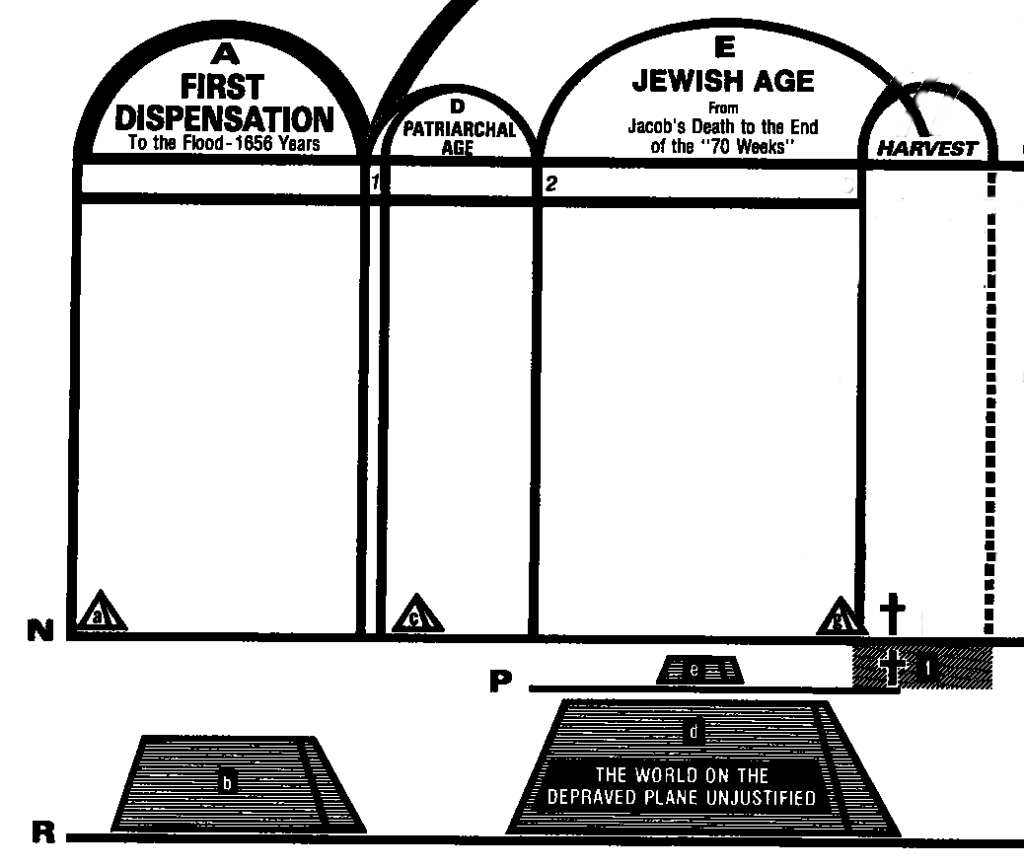
- KEY TO OUR PLAN SO FAR
- AGES
- A – First Dispensation (Creation to Flood)
- D – Patriarchal Age
- E – Jewish Age
- Harvest of the Jewish Age (29 AD to 70 AD) (new addition)
- PLANES
- N – Plane of Human Perfection, Friendship or Tentative Justification
- P – Plane of Typical Justification
- R – Plane of Depraved Mankind
- OBJECTS
- a – Adam, created perfect (Genesis 1:27)
- b – Mankind, Degraded by Sin (Psalms 51:5, Romans 3:9-12)
- c – Abraham, Isaac and Jacob, Justified by Faith (Acts 7:32, James 2:23, Galatians 3:6)
- d – World of Mankind Unjustified (Romans 3:9-12)
- e – Israel’s Typical Justification (Hebrews 10:1,4)
- f – Time of Trouble, Fire of Trial on Fleshly Israel (Luke 3:17, 1 Thessalonians 2:14-16) (new addition)
- g – Jesus, a Perfect Man (John 1:14, Hebrews 2:9,16) (new addition)
- Cross on P – Redemption of the Jews (Galatians 3:13, Luke 1:68,69, Galatians 4:4,5) (new addition)
- Cross on N – Ransom for All (1 Timothy 2:4-6; Romans 5:15-19; 1 Corinthians 15:21, 22; 1 John 2:2) (new addition)
- AGES
In our next post, we will examine in more detail the impact of Jesus’s baptism when he turned 30, and look into what the scriptures teach us about how that act, and how Jesus’s perfect keeping of his vows of consecration for the remaining three and a half years of his life, serves as a crucial element in God’s plan. We will add several new planes to our chart during the study, and examine the scriptural record outlining Jesus’s ascendancy through those planes, to a final plane of existence, where he continues to exist today. As the Jewish Age draws to a close, we will also detail the end of the overlapping harvest period at the end of the Jewish Age, and see the dawning of a new age; an age which will carry us into the present day. Most excitingly, we will revisit the two crosses we added to our chart, and in examining more closely the implications of Jesus’s sacrifice, begin to see how all of these events and how all of this history has a profound meaning, and direct applicability, to all mankind; including those who are not descendants of Israel.
2 Corinthians 9:15 Thanks be to God for his unspeakable gift.
Posts in the “God’s Plan for Mankind” Study
- A Study in God’s Plan for Mankind – Study 1: In the Beginning
- A Study in God’s Plan for Mankind – Study 2: The World That Was
- A Study in God’s Plan for Mankind – Study 3: The Patriarchal Age part 1
- A Study in God’s Plan for Mankind – Study 4: The Patriarchal Age part 2
- A Study in God’s Plan for Mankind – Study 4a: Jacob’s Hip
- A Study in God’s Plan for Mankind – Study 5: The Jewish Age part 1: The Children of Israel
- A Study in God’s Plan for Mankind – Study 6: The Jewish Age part 2: Typical Justification and Life
- A Study in God’s Plan for Mankind – Study 7: The Jewish Age part 3: Judges, Kings and Prophecies
- A Study in God’s Plan for Mankind – Study 8 – The Jewish Age Harvest part 1: Prophecies Fulfilled
- A Study in God’s Plan for Mankind – Study 9 – The Jewish Age Harvest part 2: The Four Phases of Jesus’s Human and Post-Resurrection Existence
- A Study in God’s Plan for Mankind – Study 10 – Beginnings, Endings and Overlaps
- A Study in God’s Plan for Mankind – Study 11 – The Gospel Age part 1: Justification by Faith
- A Study in God’s Plan for Mankind – Study 12 – The Gospel Age part 2: The Promise of the Restitution of All Things
- A Study in God’s Plan for Mankind – Study 13 – The Gospel Age part 3: The Cost of Mankind’s Ransom
- A Study in God’s Plan for Mankind – Study 13a – The Gospel Age part 3a: Faith: The Work of a Lifetime
- A Study in God’s Plan for Mankind – Study 14 – The Gospel Age part 4: The High Calling
- A Study in God’s Plan for Mankind – Study 15 – The Gospel Age part 5: God’s Plan and the Permission of Evil
- A Study in God’s Plan for Mankind – Study 16 – The Gospel Age part 6: The Great Company
- A Study in God’s Plan for Mankind – Study 17 – The Gospel Age part 7: The Gospel Age in Summary
- A Study in God’s Plan for Mankind – Study 18 – The Gospel Age Harvest part 1: An Introduction to the Concept of the Harvest at the End of the Gospel Age
- A Study in God’s Plan for Mankind – Study 19 – The Gospel Age Harvest part 2: The Lord’s Return and Presence in the Gospel Age Harvest
- A Study in God’s Plan for Mankind – Study 20 – The Gospel Age Harvest part 3: The Completion of the Church Class
Further Readings and References
- For an illustrated overview of God’s plan, the booklet God’s Grand Plan of the Ages may be of interest. Clearly written and illustrated in full color, this magazine-formatted digest will doubtlessly prove a delight to the student looking for an overview of many of the topics covered in this series.
- For a much more definitive, in-depth study of God’s plan for mankind, The Divine Plan of the Ages will prove to be an invaluable resource to the student looking to delve into the aspects of God’s plan in a scholarly, logical and measured fashion.
- In this post, we touched on the four Gospel books of the Bible – Matthew, Mark, Luke and John. Each of these books, written by the Apostles, outlines different experiences and aspects of Jesus’s life. However, the books across these books are not in chronological order, and further as we noted, some events are repeated throughout the Gospel books, often with slightly different perspectives. For a study into the life of Jesus, as recorded in the Gospel books, The Life of Christ may be of interest.
- (Please note that although some of these links will take you to the Chicago Bible Students online bookstore, where physical copies of these books and charts may be purchased, each of the books and charts may also be downloaded from the book store, free of charge, with no obligation to provide any personal information. Simply click under the description of each item to find the download link)
 State College Bible Students