“Beginnings, Endings and Overlaps”
In our last few studies, we have been considering the period of time we have come to know as the Jewish Age; that period of time when God specifically dealt with the nation of Israel. We also have been examining a period of time at the end of the Jewish Age, which we have come to call the Jewish Age Harvest period, when Jesus searched among the descendants of Israel for those who would prove faithful enough to follow him. Before moving fully into the considerations of the period of time after the closing of both the Jewish Age and the Jewish Age Harvest period, let us first consider the events that mark the beginnings and endings of these periods of time, as the overlapping of the periods can sometimes lead to idea that these times are more complicated than they perhaps, in actuality, are. In particular let us consider:
- The Jewish Age harvest begins during the conclusion of the Jewish Age.
- The Jewish Age then ends during the Jewish Age Harvest.
- During the Jewish Age Harvest, as we shall see, the next age, which follows the Jewish Age, begins.
- The Jewish Age Harvest then ends, with the new age well under way.
First, let us start by examining again the beginning of the Jewish Age Harvest. In our previous studies, we reviewed how at age 30, Jesus consecrated his life to the service of his Father, symbolizing that consecration with the outward symbol of baptism. At that point, Jesus went forward and began his ministry; in particular, seeking those from the descendants of Israel who had a heart condition, and intellectual mindset, and a fullness of faith such that they would recognize their long-awaited messiah, and thus, follow a similar path as he chose. He sought out those who would also set aside the things of the world in order to follow him and live, in mind and in heart, under the true precepts of his Father’s law.
Thus, on our chart, we mark the beginning of the Jewish Age Harvest with the number 3, which we label as the baptism of Christ, and mark the time of the beginning of the Jewish Age Harvest period at AD 29 (Jesus having been born at AD 0 would mark Jesus’s age at this point as 30 years old).
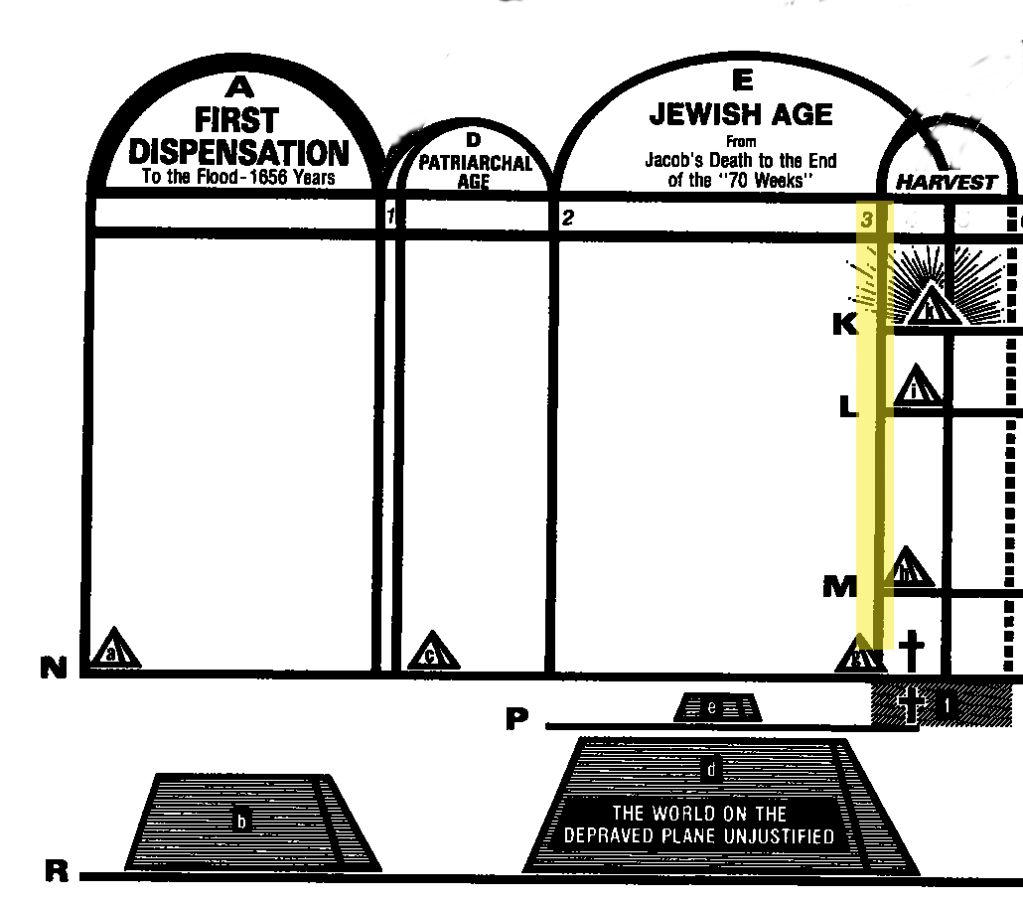
In our previous studies, we briefly touched on Daniel, who was a faithful follower of God many centuries before Jesus’s birth, and due to his great faith, was often blessed by God with visions and prophecies of the future. The book of Daniel records a very important prophecy concerning Israel’s future messiah (future from the perspective of, the messiah was in the future when Daniel received the prophecy from God, not future from our current perspective). The prophecy is recounted in Daniel chapter 9:
Daniel 9:22 And he informed me, and talked with me, and said, O Daniel, I am now come forth to give thee skill and understanding.
Daniel 9:23 At the beginning of thy supplications the commandment came forth, and I am come to shew thee; for thou art greatly beloved: therefore understand the matter, and consider the vision.
Daniel 9:24 Seventy weeks are determined upon thy people and upon thy holy city, to finish the transgression, and to make an end of sins, and to make reconciliation for iniquity, and to bring in everlasting righteousness, and to seal up the vision and prophecy, and to anoint the most Holy.
Daniel 9:25 Know therefore and understand, that from the going forth of the commandment to restore and to build Jerusalem unto the Messiah the Prince shall be seven weeks, and threescore and two weeks: the street shall be built again, and the wall, even in troublous times.
Daniel 9:26 And after threescore and two weeks shall Messiah be cut off, but not for himself: and the people of the prince that shall come shall destroy the city and the sanctuary; and the end thereof shall be with a flood, and unto the end of the war desolations are determined.
Daniel 9:27 And he shall confirm the covenant with many for one week: and in the midst of the week he shall cause the sacrifice and the oblation to cease, and for the overspreading of abominations he shall make it desolate, even until the consummation, and that determined shall be poured upon the desolate.
There is a lot to piece together in this prophecy, and it may help to first examine the context of the time period in which God delivered this prophecy to Daniel. The beginning of the book of Daniel describes a period in Israel’s history when, due to their national disobedience by serving other gods, God allowed the nation of Babylon to conquer Israel. As a result of this conquest, many Israelite children were taken into captivity by Babylon. One of these children was Daniel. Instead of questioning God’s judgment, a judgment which allowed a faithful, obedient follower of God to be taken into captivity by an enemy nation, for sins of others in his country that he, no doubt, did not participate in, Daniel instead maintained a strong, profound faithfulness to God throughout his life. Throughout his captivity, God granted Daniel with many favors, including the ability to interpret dreams and further, chose the faithful Daniel to be the receiver of some of the most important prophecies involving not only his own people, the Israelites, but also the whole number of mankind, including those of us living today.
Although Daniel maintained a firm faith in God and His judgments, chapter nine opens with Daniel experiencing a great sadness over the destruction of his nation. Verse two affirms that Daniel was well learned in the previous prophecies that God had delivered to earlier prophets, such as Jeremiah, which included prophecies involving Israel’s punishment for disobedience. Verses three to nineteen record Daniel’s sincere and fervent prayer on behalf of his nation. At no time does Daniel question the judgment; he instead prays fervently on behalf of his people. In verse twenty-one, God grants Daniel a dramatic answer to his prayers by sending a messenger to Daniel, to deliver a prophecy of deliverance for Israel. This message of prophecy is recorded in verses twenty-two through twenty-seven, which is quoted above.
The prophecy given to Daniel in these verses details the coming of Israel’s messiah, referred to in verse twenty-five as “the anointed one” and “the prince”. As we have noted in previous studies, this messiah did come, in the person of Jesus. In foretelling his coming, a few key time periods are given. Verse twenty-four marks out a period of “70 weeks” that were to have special significance to the nation of Israel. Verse 25 breaks down these seventy weeks somewhat, and offers a very important detail concerning the coming of Israel’s awaited messiah; specifically, that from a certain point in time, a “commandment to restore and rebuild Jerusalem”, it would be “seven weeks, and threescore and two weeks” – or 69 weeks (a score being 20, so threescore would be sixty) until “Messiah the Prince” would arrive.
The concept of a day in God’s prophecies actually representing a year in real time was a concept that many of the Jewish people, such as Daniel, were familiar with. In the book of Numbers, God speaks to Moses and Aaron regarding a period of punishment that the newly forming nation of Israel would experience as a result of disobedience. God lays out a straightforward equation regarding days and years:
Numbers 14:34 After the number of the days in which ye searched the land, even forty days, each day for a year, shall ye bear your iniquities, even forty years, and ye shall know my breach of promise.
Much later, God delivers a prophecy to another prophet Ezekiel, in which He also repeats this equation:
Ezekiel 4:5 For I have laid upon thee the years of their iniquity, according to the number of the days, three hundred and ninety days: so shalt thou bear the iniquity of the house of Israel.
Ezekiel 4:6 And when thou hast accomplished them, lie again on thy right side, and thou shalt bear the iniquity of the house of Judah forty days: I have appointed thee each day for a year.
Although neither of these scriptures bluntly says “when you look at a prophecy of God, and the prophecy refers to days, substitute years where the time period in the prophecy says days”, it seems likely that the Jewish people understood this concept, and its application to the prophecy of Daniel 9. Seventy symbolic weeks would equate to 490 days. By applying the formula of “a year for a day”, the Jewish people (and any other people who also may have been interested in, and somewhat understood God’s prophecies) who thus interpreted the prophecy would have begun to look for their messiah around the time of Jesus, some 490 years after the “going forth of the commandment to restore and to build Jerusalem”, which marked the beginning of the 490 years. As covered in previous studies, the verses of the New Testament do indicate that there were people who knew the time of the messiah had come, perhaps, in part at least, due to their understanding of Daniel’s prophecy:
Luke 3:15 And as the people were in expectation, and all men mused in their hearts of John, whether he were the Christ, or not;
This understanding and expectation is further exemplified by the three wise men who came seeking the messiah. An understanding of Daniel’s prophecy, indicating that the time of the messiah was near, may have been one of the understandings that influenced their desire to seek out the coming king:
Matthew 2:1 Now when Jesus was born in Bethlehem of Judaea in the days of Herod the king, behold, there came wise men from the east to Jerusalem,
Matthew 2:2 Saying, Where is he that is born King of the Jews? for we have seen his star in the east, and are come to worship him.
Before moving on to another important aspect of this prophecy, let us consider one additional, but important, aspect to the part of the prophecy outlined in verse 25. The time period here refers to Jesus as “the anointed one” and “the prince”. As we proposed earlier in this study, Jesus did not become “the anointed one” – did not begin his ministry – until he was thirty years old. It seems reasonable, then, to apply the arrival of “the anointed one” in verse 25 to the year in which Jesus was baptized and began his ministry, rather than the year of his birth.
Verses 26 and 27 outline two additional important points which we will consider next. The first of these points is that “in the midst” of the seventieth week, the messiah will be cut off. Using the equation of a year for a day, we might expect that this prophecy to refer to the “week” representing a period of seven years, and that “in the midst” of that week, if taken as referring to the middle of the “week”, would refer to a period of time three and a half years into the seven year period (three and a half being half of seven). This seems to refer to how, three and a half years after his baptism (after becoming “the anointed one”), Jesus allowed himself to be put to death. As a further consideration, in previous studies, we reviewed the concept that the result of a perfect keeping of the law given by God to the Israelites would result in a justification, or righteousness in God’s justice, which would grant the keeper life. We also reviewed how the sacrifices that God had also instituted with the Israelites were, in part, to reconcile sins that had been committed. We examined the idea that in the perfect keeping of the law, Jesus, in a sense, at his death, completed the law. Once something is completed, its purpose is ended. It seems reasonable, therefore to apply the words “he shall cause the sacrifice and the oblation to cease” of verse 27 to Jesus’s death, and how by perfectly keeping the law, in staying obedient to God until death, Jesus therefore, in a quite literal sense, facilitated an ending of the need for sacrifices as the law had previously required.
Using the time period outlined in verse 27 would bring the end of that final symbolic week, the final week of the total 70 prophetic or symbolic weeks, some three and a half years after Jesus’s death. We would thus expect to see some major event happening there; significant enough to mark the end of these seventy weeks, and an end to the Jewish Age in general. To find such an event, let us now focus our study on the book of Acts.
The book of Acts opens, in chapter one, with the apostles gathered, one final time, with their resurrected master, Jesus. Over the course of the forty days between his resurrection and the opening of the book of Acts, Jesus, in his resurrected form (which we interpret as a spirit form, since Jesus sacrificed his human life, as suggested in our previous study) had spent a significant amount of time with his disciples. The first book of Acts describes Jesus’s ascension to a grander plane of existence. In fact, we find the last recorded words in the book of Acts, of Jesus to his disciples and followers before his ascension, in Acts 1:8:
Acts 1:8 But ye shall receive power, when the Holy Spirit is come upon you: and ye shall be my witnesses both in Jerusalem, and in all Judea and Samaria, and unto the uttermost part of the earth.
This was truly a grand assignment that Jesus gave to his followers, one that continues down through the years to our very present day. We will return to this thought of Jesus’s command to “be my witness”, and what that witness might actually consist of, but before we make these considerations, let us first continue on with the book of Acts just slightly further.
As the second chapter of the book of Acts opens, we find the apostles, and other followers and disciples of Jesus, gathered together on the “day of Pentecost”. Easton’s Bible Dictionary describes Pentecost as a festival observed by the Jewish people:
Pentecost i.e., “fiftieth”, found only in the New Testament (Acts 2:1; 20:16; 1 Cor. 16:8). The festival so named is first spoken of in Ex. 23:16 as “the feast of harvest,” and again in Ex. 34:22 as “the day of the firstfruits” (Num. 28:26). From the sixteenth of the month of Nisan (the second day of the Passover), seven complete weeks, i.e., forty-nine days, were to be reckoned, and this feast was held on the fiftieth day. The manner in which it was to be kept is described in Lev. 23:15-19; Num. 28:27-29. Besides the sacrifices prescribed for the occasion, every one was to bring to the Lord his “tribute of a free-will offering” (Deut. 16:9-11). The purpose of this feast was to commemorate the completion of the grain harvest. Its distinguishing feature was the offering of “two leavened loaves” made from the new corn of the completed harvest, which, with two lambs, were waved before the Lord as a thank offering.
Although the fact that they were gathered together on the day of Pentecost does help us to set a timeline for the events that would take place that day, the true significance of the verses is what happened during their gathering:
Acts 2:2 And suddenly there came from heaven a sound as of the rushing of a mighty wind, and it filled all the house where they were sitting.
Acts 2:3 And there appeared unto them tongues parting among them, like as of fire; and it sat upon each one of them.
Acts 2:4 And they were all filled with the Holy Spirit, and began to speak with other tongues, as the Spirit gave them utterance.
In this manner, the promise that Jesus made prior to his ascension was made reality. The Holy Spirit, the power of God Himself, descended on the gathered disciples, and bestowed them with understandings, even abilities, that they previously had not possessed. Much like the Holy Spirit descending on Jesus in a visible fashion, “like a dove”, during his baptism (see Mark 1:10, for example), the granting of the Holy Spirit to the disciples is accompanied by visible manifestations, such as “a sound..as of a rushing mighty wind” and “cloven tongues like as of fire”. A visible manifestation of the giving and receiving of the Holy Spirit to Jesus was perhaps essential to demonstrate to all gathered (and to us, as we read the records in the scriptures all these centuries later) to ensure that the witnesses understood God’s favor and acceptance of His son, upon which so many foundations of faith would be built. It seems reasonable, then, that a similar physical manifestation of the Holy Spirit upon the disciples gathered together at Pentecost would be equally important, given the nature of the foundation work they were about to undertake.
Chapters two through nine of Acts see the apostles and followers of Jesus take on their master’s instructions in earnest, preaching about their master, God’s plan, and even performing miracles as a sign of their acceptance by God. However, their preaching remained limited to those of the descendants of Israel. In this, we see the fulfillment of the prophecy in Daniel 9, The last week of those prophetic seventy weeks saw Jesus’s death, his “cutting off” in the middle of that week, leaving some odd three and a half more years left in that symbolic week. During these remaining three and a half years, from roughly 33 AD to 36 AD, we see the events of Acts chapters two through nine unfold. Before continuing, it is important to note that not all Biblical chronologies may line the years up in this fashion, but those that do seem to put the Daniel 9 prophecy in harmony with the events of the New Testament.
Acts chapter 10, occurring possibly around AD 36 (again, according to some chronologies), begins by describing a man named Cornelius. Although Cornelius was not of the Jewish faith or a descendant of Israel, and thus labeled as a “Gentile”, Acts 2:2 described Cornelius nevertheless as a man possessing great faith in God:
Acts 10:1 Now there was a certain man in Caesarea, Cornelius by name, a centurion of the band called the Italian band,
Acts 10:2 a devout man, and one that feared God with all his house, who gave much alms to the people, and prayed to God always.
Acts 10 versus three through eight describe a vision given by God to Cornelius, of an angel. In the vision, the angel informed Cornelius he should send for the Apostle Peter, who was staying nearby at the time. At about the same time, Peter also had a vision given to him by God:
Acts 10:11 and he beholdeth the heaven opened, and a certain vessel descending, as it were a great sheet, let down by four corners upon the earth:
Acts 10:12 wherein were all manner of fourfooted beasts and creeping things of the earth and birds of the heaven.
Acts 10:13 And there came a voice unto him, Rise, Peter; kill and eat.
Acts 10:14 But Peter said, Not so, Lord; for I have never eaten anything that is common and unclean.
Acts 10:15 And a voice came unto him again the second time, What God hath cleansed, make not thou common.
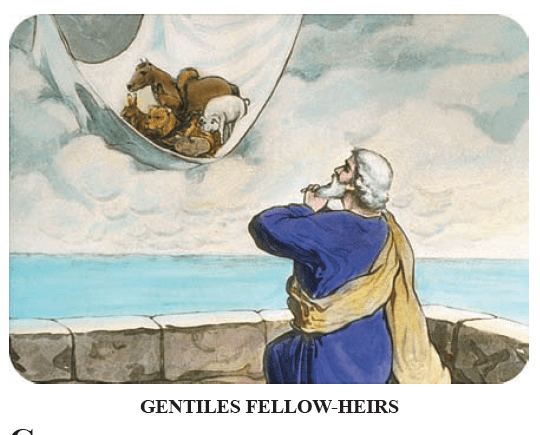
While Peter was pondering his vision, Cornelius’s messengers arrived, and informed Peter of Cornelius’s vision, which had resulted in Cornelius dispatching the messengers to ask Peter to come with them back to Cornelius. Peter agreed, and soon met with Cornelius, who told him of the vision God had sent him in great detail. Peter then understood the meaning of his own vision, which also, perhaps, added extra meaning to the final words of Jesus before his ascension. Peter understood that God was now opening His calling to more than just the descendants of Israel; it was now proper to include the Gentiles in this calling, and in the work that was to follow. Upon this realization, Peter then proceeds to give a beautiful summary of this calling, work and message:
Acts 10:34 And Peter opened his mouth, and said, Of a truth I perceive that God is no respecter of persons:
Acts 10:35 but in every nation he that feareth him, and worketh righteousness, is acceptable to him.
Acts 10:36 He sent the word unto the sons of Israel, preaching good tidings of peace by Jesus Christ (he is Lord of all):
Acts 10:37 that saying ye yourselves know, which was published throughout all Judea, beginning from Galilee, after the baptism which John preached;
Acts 10:38 even Jesus of Nazareth, how God anointed him with a holy spirit and with power: who went about doing good, and healing all that were oppressed of the devil; for God was with him.
Acts 10:39 And we are witnesses of all things which he did both in the country of the Jews, and in Jerusalem; whom also they slew, hanging him on a tree.
Acts 10:40 Him God raised up the third day, and gave him to be manifest,
Acts 10:41 not to all the people, but unto witnesses that were chosen before of God, even to us, who ate and drank with him after he rose from the dead.
Acts 10:42 And he charged us to preach unto the people, and to witness that this is he who is ordained of God to be the Judge of the living and the dead.
Acts 10:43 To him bear all the prophets witness, that through his name every one that believeth on him shall receive remission of sins.

What a wonderful and beautiful message of hope Peter was now delivering; made even more wonderful in that this message was now open to not only those of the Jewish faith, or those who were descendants of Israel, but to any person of any background who was able and willing to accept that a “belief on him [Jesus]” will result in a “remission of sins”. Instead of needing to be born of a certain lineage; instead of having to perfectly keep a strict law for one’s entire life, in both deed and spirit; instead of having to perform a never-ending cycle of animal sacrifices to atone for committed sins; here was a way to receive “remission of sins” – a way to become reconciled with God – that anyone could and can have. By any stretch of any definition, this was indeed good news! What an incredible light this now shed on the words of the angels so long ago, when Jesus was born:
Luke 2:10 And the angel said unto them, Be not afraid; for behold, I bring you good tidings of great joy which shall be to all the people:
Good news such as this, especially good news as given by God, is often referred to as “the gospel message”. According to Strong’s Concordance, the term “gospel” does not occur in the Old Testament, but appears for the first time in the New Testament. Interestingly, all but one occurrences of the term “gospel” are either Strong’s word 2097 or 2098. Strong’s specifies that both words originate from the same root word, and that both words have the meaning of good news, or a good message. Strong’s also adds that the words also bring a secondary flavor to these terms of “bringing”, as in, bringing or declaring good news. Easton’s Bible Dictionary provides this definition of the word “gospel”:
a word of Anglo-Saxon origin, and meaning “God’s spell”, i.e., word of God, or rather, according to others, “good spell”, i.e., good news. It is the rendering of the Greek _evangelion_, i.e., “good message.” It denotes (1) “the welcome intelligence of salvation to man as preached by our Lord and his followers. (2.) It was afterwards transitively applied to each of the four histories of our Lord’s life, published by those who are therefore called ‘Evangelists’, writers of the history of the gospel (the evangelion). (3.) The term is often used to express collectively the gospel doctrines; and ‘preaching the gospel’ is often used to include not only the proclaiming of the good tidings, but the teaching men how to avail themselves of the offer of salvation, the declaring of all the truths, precepts, promises, and threatenings of Christianity.” It is termed “the gospel of the grace of God” (Acts 20:24), “the gospel of the kingdom” (Matt. 4:23), “the gospel of Christ” (Rom. 1:16), “the gospel of peace (Eph. 6:15), “the glorious gospel,” “the everlasting gospel,” “the gospel of salvation” (Eph. 1:13).- Easton’s Bible Dictionary
This message of good news, both to the descendants of Israel first, but soon after to all people, seems to be a significant enough event to warrant the beginning of a new age on our chart of God’s plan for mankind, which, not surprisingly, we title “The Gospel Age”. The gospel message, which we will consider in much greater detail as we progress through the next few studies, at its heart, is one of redemption and reconciliation. As stated before, Jesus is at the heart of this gospel message, and thus it seems appropriate to consider the beginning of the Gospel Age as Jesus’s baptism. As we have covered earlier. Jesus did not begin his ministry until after his baptism, which thus leads to us adding a line to our chart, starting the Gospel Age at the pyramid icon g, which we added to our chart to represent Jesus at the time of his baptism and “spirit begettal”, or receiving of the Holy Spirit.
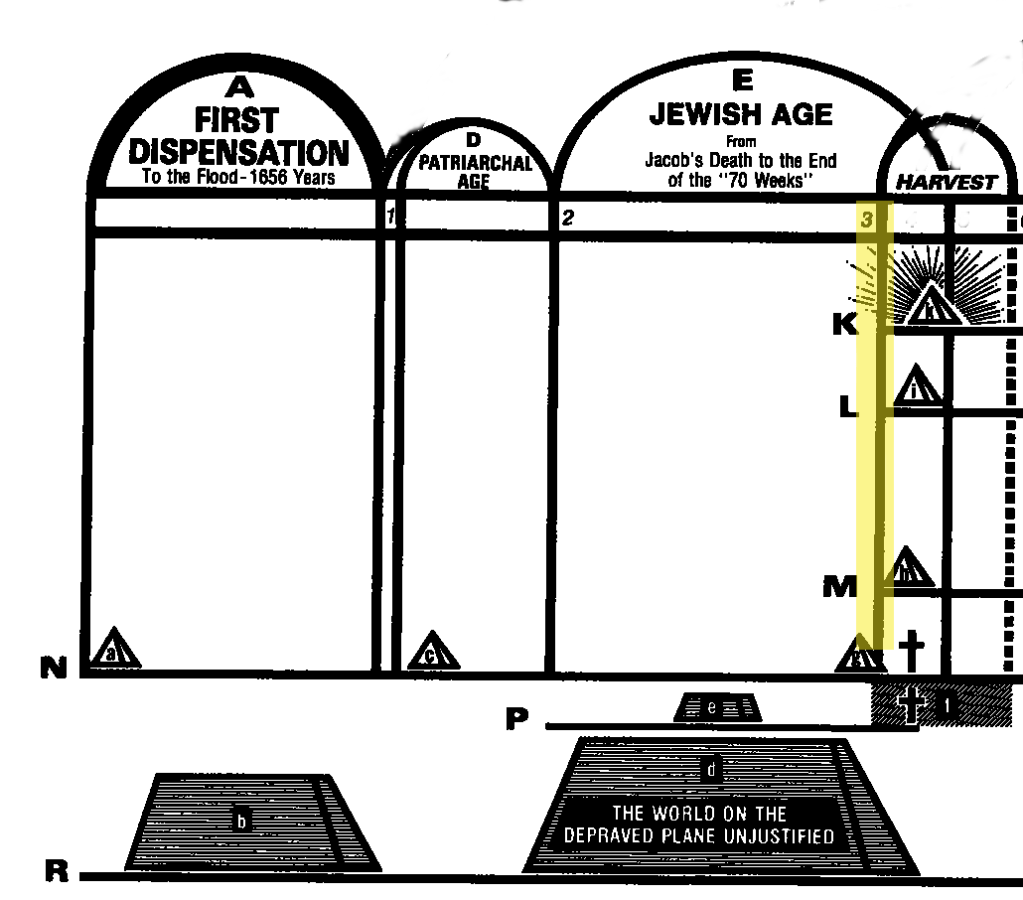
Notice here that this is the same point of time that, in our previous studies, we also specified as the beginning of the Jewish Age Harvest, and note further that this line, or point in time, takes place during the end of the Jewish Age itself. This overlapping of time periods may seem confusing at first, but consideration of each individual aspect of the time of Jesus’s baptism may provide some clarity. First, Jesus was baptized during the period of time when Israel still maintained God’s favor; the law that God had given to Israel was still the only method of receiving justification or righteousness according to God’s justice; thus Jesus’s baptism takes place during the Jewish Age. Jesus also began his ministry after his baptism, and began to seek out those among the Israelites who recognized their messiah, and had the proper condition of mind and heart to follow him after centuries of preparation under God’s law. From this perspective, Jesus’s baptism is also the beginning of the Jewish Age Harvest period, which overlaps with the ending of the Jewish Age itself. Finally, as we have just considered, since Jesus began his ministry after his baptism, his baptism also began the spreading of the gospel message, and thus serves as the beginning (or a beginning, as we shall soon consider) to the Gospel Age. Thus, the beginning of the Jewish Age Harvest coincides with the beginning of the Gospel Age, and both take place at the closing of the Jewish Age.
Let us consider another aspect of the beginning of the Gospel Age, that also shares overlapping time periods with the closing period of the Jewish Age, as well as during the Jewish Age Harvest period, which is the death of Jesus. We previously added a cross symbol on plane N of our chart to represent Jesus’s death. As we covered previously in the study, Jesus’s death took place during the middle of that final symbolic week, which places is at the end of, but still during, the Jewish Age. As we also covered earlier in the study, after Jesus’s death, Jesus’s disciples were granted the Holy Spirit, and continued the harvest among the faithful of the Jewish people for the remainder of that final symbolic week. From this perspective, Jesus’s death took place during the Jewish Age Harvest period. Finally, as we also covered, Jesus’s death brought an ending to the law given to the Jewish people by God, and in so doing brought an end to the concept of justification by the law, which in turn enabled the much greater concept of justification by faith (which we will consider in-depth in forthcoming studies). The concept of justification by faith is one of the core features of the gospel message, and since Jesus’s death enabled justification by faith, Jesus’s death is also an important aspect of the beginning of the Gospel Age. Thus, when we add our arcs to indicate the beginning of the Gospel Age period, we add a second arc, over the cross representing Jesus’s sacrifice and death, and mark this with a number 4, to footnote the time period.

Next, we consider the actual ending of the Jewish Age. We mark this ending point as the end of the prophetic 70 weeks of Daniel 9 – some three and a half years after Jesus’s death. A period of time in which exclusive favor by God to Israel ends at this point, although, as we will see in future studies, this ending of exclusive favor does not mean, in any way, that God was or is finished with Israel and the nation’s position as a favored people and nation. In a very fitting fashion, this point in time also coincides, at least by some chronologies, with the conversion of Cornelius, which marked the extension of the gospel message to the Gentile people. From this perspective, this point in time also serves as an additional aspect to the beginning of the Gospel Age, when the gospel message would spread across the world. Thus, we add one final arc to the beginning of the Gospel Age, connecting this arc to the line marking the ending of the Jewish Age. We also add another footnote/date number here, this one being 5, to mark that this line marks the end of the prophetic 70 weeks.

Finally, we consider the ending of the Jewish Age Harvest period. As covered in our previous studies, Jesus, after claiming his rightful title of the long awaited king, rejected Israel as a nation, due to their lack of heart condition and their denial of him as there awaited messiah and king. Although the Jewish Age Harvest would continue on for some time after that, the year 70 AD saw the eventual destruction of Jerusalem (at least, for a period of time), which brings with it the thought of the ending of the Jewish Age Harvest. We mark this point of time with a dotted line, noting that this point in time is also well into the starting of the Gospel Age.

With our new lines and symbols, we also add a few numbered footnote references to clarify the meanings of some of these points in time. In addition, we also add the beginning outline of the new, dawning age we examined, the Gospel Age, to our chart, and label it with a capital F. Thus, our chart, now updated to note the new age, as well as these footnotes, beginnings, endings and overlaps now looks like this:
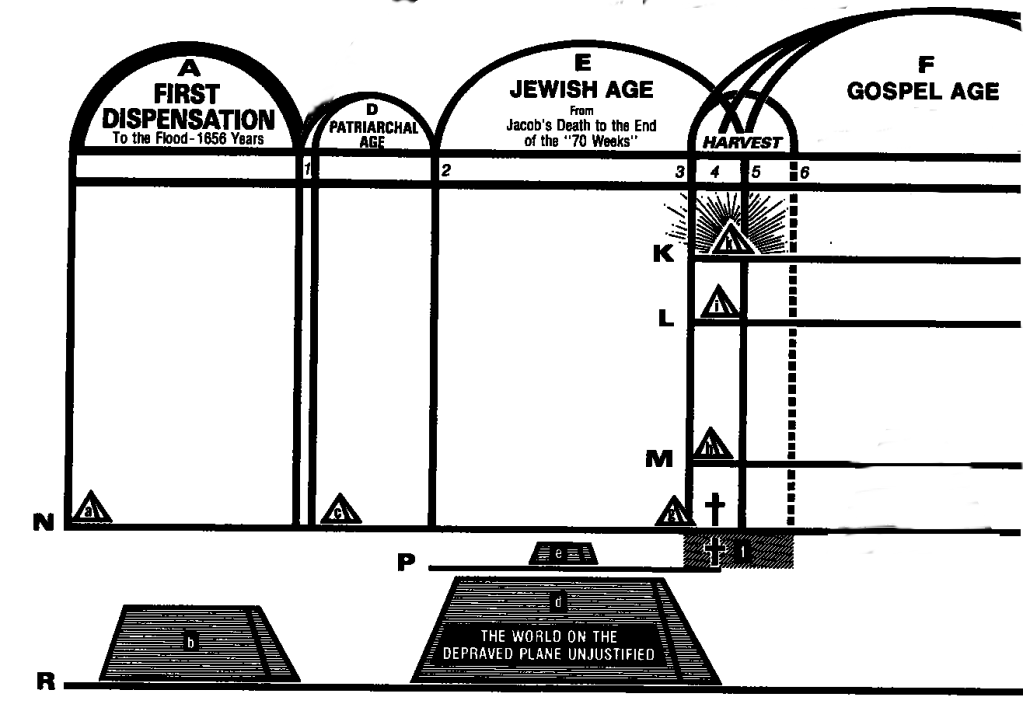
- KEY TO OUR PLAN SO FAR
- AGES
- A – First Dispensation (Creation to Flood)
- D – Patriarchal Age
- E – Jewish Age
- Harvest of the Jewish Age (29 AD to 70 AD)
- F – Gospel Age (new addition)
- PLANES
- N – Plane of Human Perfection, Friendship, or Tentative Justification
- P – Plane of Typical Justification
- R – Plane of Depraved Mankind
- M – Plane of Spirit Begettal
- L – Plane of Spirit Beings
- K – Plane of Glorious Divine Spirit Beings
- OBJECTS
- a – Adam, created perfect (Genesis 1:27)
- b – Mankind, Degraded by Sin (Psalms 51:5, Romans 3:9-12)
- c – Abraham, Isaac and Jacob, Justified by Faith (Acts 7:32, James 2:23, Galatians 3:6)
- d – World of Mankind Unjustified (Romans 3:9-12)
- e – Israel’s Typical Justification (Hebrews 10:1,4)
- f – Time of Trouble, Fire of Trial on Fleshly Israel (Luke 3:17, 1 Thessalonians 2:14-16)
- g – Jesus, a Perfect Man (John 1:14, Hebrews 2:9,16)
- Cross on P – Redemption of the Jews (Galatians 3:13, Luke 1:68,69, Galatians 4:4,5)
- Cross on N – Ransom for All (1 Timothy 2:4-6, Romans 5:15-19, 1 Corinthians 15:21,22, 1 John 2:2)
- h – Jesus, a Spirit Begotten New Creature (John 1:32, Luke 3:21-23, Hebrews 2:10, 17, 18)
- i – Jesus, a Spirit Being before Pentecost (Hebrews 5:8,9; Ephesians 1:20-23; 1 Timothy 3:16)
- k – Lord Jesus, Divine Spirit Being (Acts 3:19-21; Colossians 1:18, Hebrews 8:1)
- NUMBERS/DATES (new addition)
- 3 – 29AD – Baptism of Christ (new addition)
- 4 – 33AD – Death & Resurrection of Christ (new addition)
- 5 – 36AD – End of 70 Weeks
- 6 – 70AD – Destruction of Jerusalem/End of Jewish Age Harvest
- AGES
In our next study in this series, we pause to reflect on our Lord Jesus; in particular, a command he gave to his followers in his last hours before his death; one that resonates down through the centuries to those of us who follow him in this present day. We will consider the appropriateness of this command for the time of year we are in at the time of this writing (March of 2022), as well as a beautiful example of types and antitypes that the scriptures give us regarding our Lord. Given that we are now, in our series of studies, entering into our considerations of the Gospel Age, the next study will also serve to demonstrate some fundamental conclusions that will be built upon as we continue to follow God’s plan for mankind.
Posts in the “God’s Plan for Mankind” Study
- A Study in God’s Plan for Mankind – Study 1: In the Beginning
- A Study in God’s Plan for Mankind – Study 2: The World That Was
- A Study in God’s Plan for Mankind – Study 3: The Patriarchal Age part 1
- A Study in God’s Plan for Mankind – Study 4: The Patriarchal Age part 2
- A Study in God’s Plan for Mankind – Study 4a: Jacob’s Hip
- A Study in God’s Plan for Mankind – Study 5: The Jewish Age part 1: The Children of Israel
- A Study in God’s Plan for Mankind – Study 6: The Jewish Age part 2: Typical Justification and Life
- A Study in God’s Plan for Mankind – Study 7: The Jewish Age part 3: Judges, Kings and Prophecies
- A Study in God’s Plan for Mankind – Study 8 – The Jewish Age Harvest part 1: Prophecies Fulfilled
- A Study in God’s Plan for Mankind – Study 9 – The Jewish Age Harvest part 2: The Four Phases of Jesus’s Human and Post-Resurrection Existence
- A Study in God’s Plan for Mankind – Study 10 – Beginnings, Endings and Overlaps
- A Study in God’s Plan for Mankind – Study 11 – The Gospel Age part 1: Justification by Faith
- A Study in God’s Plan for Mankind – Study 12 – The Gospel Age part 2: The Promise of the Restitution of All Things
- A Study in God’s Plan for Mankind – Study 13 – The Gospel Age part 3: The Cost of Mankind’s Ransom
- A Study in God’s Plan for Mankind – Study 13a – The Gospel Age part 3a: Faith: The Work of a Lifetime
- A Study in God’s Plan for Mankind – Study 14 – The Gospel Age part 4: The High Calling
- A Study in God’s Plan for Mankind – Study 15 – The Gospel Age part 5: God’s Plan and the Permission of Evil
- A Study in God’s Plan for Mankind – Study 16 – The Gospel Age part 6: The Great Company
- A Study in God’s Plan for Mankind – Study 17 – The Gospel Age part 7: The Gospel Age in Summary
- A Study in God’s Plan for Mankind – Study 18 – The Gospel Age Harvest part 1: An Introduction to the Concept of the Harvest at the End of the Gospel Age
- A Study in God’s Plan for Mankind – Study 19 – The Gospel Age Harvest part 2: The Lord’s Return and Presence in the Gospel Age Harvest
- A Study in God’s Plan for Mankind – Study 20 – The Gospel Age Harvest part 3: The Completion of the Church Class
Further Readings and References
- For a structured and detailed examination of Israel’s 70 weeks prophecy of Daniel 9, study three, titled “The Fulfillment of Time Prophecy at the First Advent of Christ” from the larger collection of studies, The Time is at Hand, will provide the interested student with thoughts and insights into topics that were touched upon in this study.
- For a broader overview of the timeline presented in these studies, the booklet God’s Grand Plan of the Ages may be of interest. The booklet contains many full color illustrations and diagrams that may provide further insight into many of the topics covered in these studies.
- For a more detailed description of the ever-increasing number of icons and symbols on our chart, study XII of The Divine Plan of the Ages may be of interest
- The pictures in this study are from the article “The Baptism of Jesus” of the greater work The Photo-Drama of Creation. This book contains many other rich illustrations as well as accompanying articles and other faith-inspiring reflections on our wonderful God and His plan for mankind.
- Wikipedia provides a historical overview of the prophetic day-to-year concept.
- (Please note that although some of these links will take you to the Chicago Bible Students online bookstore, where physical copies of these books may be purchased, each of the books may also be downloaded from the store, free of charge, with no obligation to provide any personal information. Simply click under the description of each item to find the download link)
 State College Bible Students