Study Approach #3: “Symbolic Language”
One of the most intimidating ideas facing any prospective student of the Bible is the concept of Biblical symbolism. Those with even a passing familiarity with the Bible are familiar with the concept that not all of the content of the Bible is meant to be taken literally. In fact, attempting to do so can quickly lead to confusion, frustration, and an incorrect impression of the basic foundation message of the Bible. For those of us who believe in the Supreme Creator, and further believe that He wants mankind to draw close to Him; to understand Him and His character and plan, the Bible stands as an irreplaceable and infinitely precious gift. However, like any knowledge that is worth gaining, an understanding of the Bible should not reasonably expected to come easily. One does not simply pick up a physics text book, read a page every day for a year, and become a doctor of physics. The approach takes years of study, and even the best student will eagerly admit that the study is never quite completed. Biblical study is much the same. There will always be something new to learn, to consider. However, Biblical study is quite different than other courses of study, in that Biblical study also has the benefit of developing a character within the earnest student that will be pleasing to the Supreme Creator of the universe. How great a benefit!
Before continuing on, let us take a few minutes to consider a few basic questions that many throughout history have asked about symbolism and the Bible. If there really is a God, and if the Bible really is the mechanism by which He wants mankind to know Him and His plan for mankind, why not make the Bible as easy to understand as possible? Why not just spell out His plan in plain language, with dates and instructions that are easily seen and followed? Some have said “the Bible is an old fiddle upon which any song can be played” – certainly down through the many centuries, there have been different interpretations of the many symbols in the Bible; haven’t these led to confusion, misunderstanding and even conflicts? Many over the years have probably asked themselves, who am I to properly interpret the symbols in the Bible? Shouldn’t this interpretation be left to those ordained by established Church systems? And if this is so, why did God make the Bible so difficult to understand that I need someone else to tell me how to understand it?
These are certainly deep questions, which have no doubt been echoed throughout each generation over the centuries. In response to these questions and the concerns they raise, let us examine a few proposed thoughts and potential responses to these questions.
First, let us consider a few sets of scriptures on this matter. The first set of scriptures, from the book of John, records Jesus’s own response to a very similar question:
John 16:12 I have yet many things to say unto you, but ye cannot bear them now.
John 16:13 Howbeit when he, the Spirit of truth, is come, he will guide you into all truth: for he shall not speak of himself; but whatsoever he shall hear, that shall he speak: and he will shew you things to come.
John 16:14 He shall glorify me: for he shall receive of mine, and shall shew it unto you.
Not all of God’s plan for mankind is due to be understood at the time is was written in scripture, or even in the present day. When reading the New Testament, it becomes obvious that many thought the kingdom of God was imminent, or at least, not that far away. Imagine their reaction if they understood that some two thousand years later, mankind would still be waiting for the full ushering in of this kingdom. Such a revelation may have been disheartening, and thus, not revealing that aspect of His plan at the time can be seen as a mercy by God. This thought, in turn, gives way to another set of scriptures that are often applied to the concept of time being an aspect to understanding God’s plan, that of “meat in due season”:
Matthew 24:44 Therefore be ye also ready: for in such an hour as ye think not the Son of man cometh.
Matthew 24:45 Who then is a faithful and wise servant, whom his lord hath made ruler over his household, to give them meat in due season?
Matthew 24:46 Blessed is that servant, whom his lord when he cometh shall find so doing.
The concept of “meat in due season” is much the same as the previous concept. None of mankind have ever had a full picture of God’s plan. As stated before, this is perhaps a mercy on God’s part. God’s plan is executing, and has ever executed, exactly on-time and on-schedule. Mankind’s perception of time is so different that it would be exceedingly difficult for us to appreciate the times involved at every point in the plan; thus God, in His infinite wisdom, sees fit to portion out that knowledge throughout the ages, as He sees appropriate.
In addition, as stated previously, study of the scriptures builds character and faith in God:
James 4:8 Draw nigh to God, and he will draw nigh to you. Cleanse your hands, ye sinners; and purify your hearts, ye double minded.
Finally, the basic message of the Bible, which sees the Old Testament laying out mankind’s fall, followed by the need for a savior, then predicting the coming savior; and the New Testament chronicling the arrival of the savior, and what type of character is needed for us to cultivate in order to please God, is fairly straightforward and fundamentally not hidden. Although studying symbols in the Bible will lead to blessings and potentially positive character development, the study of symbols does not obscure this very basic and important message.
These questions being considered, however briefly, let us now continue on with a few suggested approaches to the concept of symbolism in the scriptures. The first step to any study of Biblical symbolism is, of course, the identification of the use of symbolism in a scripture or set of scriptures. This concept is not unique to Bible study; any scientific inquiry first starts with an observation which leads to a question. At some point, someone asked the question, does what I’m seeing make sense? Why is this happening? Consider any effort of engineering – before a project can begin, a problem or a need is first identified, else a design and a plan cannot be formulated. Before mankind could start to develop trigonometry, the need for accurate measuring and planning first had to be identified, and circumstances, situations and needs to developing those measurements needed to be realized.
Any study of potential Biblical symbolism is the same. Before investigating the meaning of a potential symbol, the student needs to first discern what is a symbol and what is not. This sounds simple, perhaps even obvious; however, this very concept has led to much disagreement among different branches of Christianity, and perhaps, even non-Christians, down through the centuries. When either reading the scriptures or performing a more scholarly study on them, the student may find themselves, perhaps without even realizing it, formulating one or more of the following questions:
- “Did I read this before in another part of the Bible?”
- Does the text seem to describe objects or concepts that don’t quite seem to fit in with the immediate context, or even greater context of the Bible?
- Does the surrounding context itself describe the scripture in question in a manner which seems as if the writer did not intend the text to be taken literally? For example, was the scripture in question part of a parable? Was it introduced with a “this is a like unto…” or other text that identifies a symbolic picture, and not a literal person, place, event or concept?
When one of these questions arises, it is highly likely that one has encountered a usage of symbolic language in the scriptures. Having thus identified potential symbolic language in a scripture or set of scriptures, let us now examine some useful strategies or approaches that a student may find helpful in determining the meaning behind the symbolic language.
Approach #1: Look for other occurrences of the same word or words in other parts of the Bible, and see if there is a common theme surrounding their references – we will discuss this approach in greater detail later in this study.
Approach #2: Consult other researches on the potential symbol – again, we will discuss, and use a practical example of this approach later in this study.
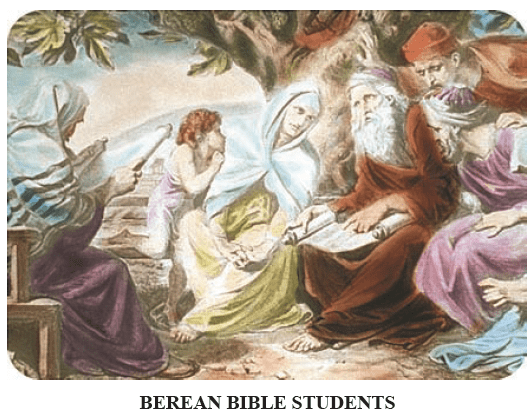
Approach #3: Discuss the symbol with other students of the Bible, like you – Discussion of the scriptures with other earnest seekers of understanding of God’s plan is absolutely essential. Much like any academic course of study, searchers of truth and answers find much more meaningful results when gathered together with those similarly searching for answers. This type of study was well-known, even in the early days of the Christian churches. Consider this account, written by Paul in the book of Acts. Paul describes a group of early Christians in a place called Berea, who did not simply accept the concepts and teaching they were given; but worked and studied the scriptures together to determine the truth of these teachings:
Acts 17:10 And the brethren immediately sent away Paul and Silas by night unto Berea: who coming thither went into the synagogue of the Jews.
Acts 17:11 These were more noble than those in Thessalonica, in that they received the word with all readiness of mind, and searched the scriptures daily, whether those things were so.
Acts 17:12 Therefore many of them believed; also of honourable women which were Greeks, and of men, not a few.
Contrast this brief description of the students at Berea against the scribes and Pharisees of Jesus’s time. The scribes and Pharisees were meant to be the religious leaders of the time. As such, many of the Jewish people of the time looked to them for interpretations of the scriptures, the Jewish law, and even interpretations on previous interpretations. The priests, scribes and Pharisees of the time, as a class, allowed their understanding of the scriptures and the Jewish law outlined within them to “harden their hearts”, which cultivated characters that drifted toward possessiveness and pridefulness. Consider this exchange between Jesus and a group of scribes and Pharisees:
Matthew 23:1 Then spake Jesus to the multitude, and to his disciples,
Matthew 23:2 Saying The scribes and the Pharisees sit in Moses’ seat:
Matthew 23:3 All therefore whatsoever they bid you observe, that observe and do; but do not ye after their works: for they say, and do not.
Matthew 23:4 For they bind heavy burdens and grievous to be borne, and lay them on men’s shoulders; but they themselves will not move them with one of their fingers.
Matthew 23:5 But all their works they do for to be seen of men: they make broad their phylacteries, and enlarge the borders of their garments,
Matthew 23:6 And love the uppermost rooms at feasts, and the chief seats in the synagogues,
Matthew 23:7 And greetings in the markets, and to be called of men, Rabbi, Rabbi.
Matthew 23:8 But be not ye called Rabbi: for one is your Master, even Christ; and all ye are brethren.
Matthew 23:9 And call no man your father upon the earth: for one is your Father, which is in heaven.
Matthew 23:10 Neither be ye called masters: for one is your Master, even Christ.
Matthew 23:11 But he that is greatest among you shall be your servant.
Matthew 23:12 And whosoever shall exalt himself shall be abased; and he that shall humble himself shall be exalted.
Matthew 23:13 But woe unto you, scribes and Pharisees, hypocrites! for ye shut up the kingdom of heaven against men: for ye neither go in yourselves, neither suffer ye them that are entering to go in.
Matthew 23:14 Woe unto you, scribes and Pharisees, hypocrites! for ye devour widows’ houses, and for a pretence make long prayer: therefore ye shall receive the greater damnation.
Matthew 23:15 Woe unto you, scribes and Pharisees, hypocrites! for ye compass sea and land to make one proselyte, and when he is made, ye make him twofold more the child of hell than yourselves.
Matthew 23:16 Woe unto you, ye blind guides, which say, Whosoever shall swear by the temple, it is nothing; but whosoever shall swear by the gold of the temple, he is a debtor!
Matthew 23:17 Ye fools and blind: for whether is greater, the gold, or the temple that sanctifieth the gold?
Matthew 23:18 And, Whosoever shall swear by the altar, it is nothing; but whosoever sweareth by the gift that is upon it, he is guilty.
Matthew 23:19 Ye fools and blind: for whether is greater, the gift, or the altar that sanctifieth the gift?
As a class, the scribes and Pharisees had allowed their positions, which were largely granted to them by their study of the scriptures and the Jewish law, to produce a prideful and intolerant character. This character eventually drove the Pharisee class to plotting the death of another, Jesus:
Matthew 12:14 Then the Pharisees went out, and held a council against him, how they might destroy him.
In comparing the students of Berea with the Pharisees, the importance of searching the scriptures oneself as validation of any interpretation or idea comes clearly to light. This comparison also includes the importance of studying together with others, especially, perhaps, concepts as open to interpretation as Biblical symbols. It is at least implied that the students of Berea studied the scriptures together, while the Pharisees, as a group, believed they alone held the knowledge and meaning of the scriptures and the law, and thus, two different character types merged; the former described as “noble”, while the latter condemned by our Lord as “empty” and “hypocrites”.
Approach #4: Use aids like a concordance to search for other occurrences of the same key words, and examine those occurrences for potential clarification – Sometimes, when coming across a verse or passage of scripture that seems as if it might have symbolic meaning, it is often helpful to examine other occurrences of key words in the passage. We will examine this approach in greater practical detail later in this study.
Approach #5: Trust in the Holy Spirit – It is important to remember that each one of us that has truly made a consecration to God; each one of us that earnestly devotes their lives to seeking God, has just as much right, and responsibility, to search the scriptures as any other.
Galatians 3:23 But before faith came, we were kept under the law, shut up unto the faith which should afterwards be revealed.
Galatians 3:24 Wherefore the law was our schoolmaster to bring us unto Christ, that we might be justified by faith.
Galatians 3:25 But after that faith is come, we are no longer under a schoolmaster.
Galatians 3:26 For ye are all the children of God by faith in Christ Jesus.
Galatians 3:27 For as many of you as have been baptized into Christ have put on Christ.
Galatians 3:28 There is neither Jew nor Greek, there is neither bond nor free, there is neither male nor female: for ye are all one in Christ Jesus.
I Thessalonians 5:21 Prove all things; hold fast that which is good.
As suggested previously, consider the students of Berea, who trusted in the Holy Spirit to guide them in their scriptural studies; who worked and studied together as a group to prove, scripturally the things they were told. Contrast this with the majority of the Jewish nation at the time of Jesus’s advent, who were content to follow the leadership of the chief priests, scribes and pharisees without question, to the extent that they, as a nation and as a whole, did not recognize the very messiah they had awaited for so many years.
Approach #6: Keep the need to understand the symbol in perspective – As noted previously, there have been different interpretations of symbols in the Bible over the centuries; many of which have been researched and contemplated by earnest seekers of understanding of God’s truth and plans. Yet, somehow, disagreements and inconsistencies have still arisen. As with any important study or pursuit, a debate, or discussion of differences, is healthy, even critical to arriving at a meaningful conclusion. However, before allowing a debate to escalate into negative feelings, or even excluding one who has a differing view from further fellowship, consider the discussion topic or symbol in question. Is a “correct” understanding of the symbol so attainable that there is not the slightest possibility for a different interpretation? Is a different interpretation so important that it is worth injuring a relationship with another who is also earnestly seeking to understand God’s plan?
With these six suggested approaches to study of Biblical symbols at least outlined, let us now turn to examining some of the approaches suggested above in greater detail, and actually combine them and put them into practice in studying a specific scripture. During the course of any study of Biblical symbols, it is usual that many of the strategies listed above will likely dovetail with one another.
As an entry point to our study, let us consider the following scripture:
I Thessalonians 4:17 Then we which are alive and remain shall be caught up together with them in the clouds, to meet the Lord in the air: and so shall we ever be with the Lord.
I Thessalonians is part of letter written to the early church of Thessalonica by the Apostle Paul. Certainly, the Bible is clear about the level to which Paul was blessed to understand God’s plan, and exhibited a beautiful talent for explaining facets of that plan to the early churches of the time, and, through the preservation of his inspired writings as parts of the New Testament, to those of us still seeking to follow God in today’s times. As such, the writing of the Apostle Paul, as part of the Bible, hold a very special place in the lives of Christians. As such, his words and writings are worthy of special consideration.
When reading this verse, particularly out of context, it seems to fit into one of the previously identified criteria for potentially identifying a scripture with a symbolic application; in particular, the questioning of the verse in terms of whether a literal interpretation harmonizes with other understandings put forth in the Bible. Let us use one of the suggested approaches and examine the context of the verse in question by reviewing the surrounding scriptures:
I Thessalonians 4:15 For this we say unto you by the word of the Lord, that we which are alive and remain unto the coming of the Lord shall not prevent them which are asleep.
I Thessalonians 4:16 For the Lord himself shall descend from heaven with a shout, with the voice of the archangel, and with the trump of God: and the dead in Christ shall rise first:
I Thessalonians 4:17 Then we which are alive and remain shall be caught up together with them in the clouds, to meet the Lord in the air: and so shall we ever be with the Lord.
I Thessalonians 4:18 Wherefore comfort one another with these words.
An examination of the context reveals that Paul is discussing the return of the Lord Jesus, which, at the time of his writing, was still a future event. Verse 17, in particular, describes a partial vision of Paul’s, involving those faithful followers of Jesus still on earth after the time of his return. For those alive today, who consider themselves followers of Jesus, and who also may sense that events in God’s plan seem to be rapidly progressing toward some type of major event or milestone, this verse can have very special interest.
Taken literally, the verse describes those faithful who are still alive at a certain point in time being “caught up together” and further mentions “in the clouds”. If taken literally, this verse can convey the picture of followers of Jesus (and thus followers of God) being lifted off the ground and pulled or levitated into the sky, where, inside a bank of clouds, they will somehow meet with not only Jesus, but a group of previously dead, but now risen, followers of Jesus.
There are branches of Christianity who entertain at least a version of this literal picture. Sometimes referred to as “the Rapture”, some branches of Christianity believe that there will come a day when all of God’s followers will literally be lifted from the earth and transported to heaven, and this scripture seems to fit into that picture. Even non-Christian culture has long had the image of people, post-death, reclining or resting on clouds, sometimes in long white robes and sometimes with golden halos. Perhaps this scripture has contributed to that image over the years.
However, there is another possible interpretation regarding these scriptures that tends to see the workings of God and the unfolding of His plan in a, respectfully, sometimes less fantastical fashion. It is clear to even a passing student of the Bible that, throughout the scriptures, many miraculous events are recorded that would be, by any definition, incorrectly written off as not having occurred, or occurred the way in which the scriptures describe the events. Even still, many of these miracles and fantastical events still seem to have a certain logic to them; some can even be potentially explained by a series of natural events, placing the miracle in God’s ability to line up these events to achieve his intended outcome at the intended point of time. From this perspective, it may seem that scriptures which describe a “rising up of followers to meet their Lord in the clouds” may have a different, more symbolic interpretation. So if this verse is even potentially partially symbolic, how does the student determine that, and is it possible to even further determine a meaning for the potentially symbolic language?
Let us examine the scripture in question in two different parts – first, the thought of “coming together to meet their Lord”, described, although indirectly, as a “rising up.” Second, let us then consider the thought of coming together taking place “in the clouds”.
For our first step in examining this scripture for a potential symbolic meaning, let us first examine the expended context surrounding 1 Thessalonians 4:17. As noted earlier, Paul’s writings here were part of a larger letter to the early church in Thessalonica:
I Thessalonians 1:1 Paul, and Silvanus, and Timotheus, unto the church of the Thessalonians which is in God the Father and in the Lord Jesus Christ: Grace be unto you, and peace, from God our Father, and the Lord Jesus Christ.
This is an important note, because understanding the intended audience of Paul’s letter is essential to understanding our scripture in question. Paul is addressing members of the early church; brothers and sisters in Christ who, like himself, had consecrated their lives to following our common master, Jesus, in order to, in turn, serve and please God. Throughout the New Testament, there is a clear separation of individuals along this line. During Jesus’s time as a human, he clearly sought out only those members of the nation of Israel who were willing to give up all they had in order to follow him. This class, sometimes referred to as, among other titles, “the little flock”, “the church” or the “bride of Christ” was, and still is, promised a reward of exceeding wonder and magnitude:
Luke 12:32 Fear not, little flock; for it is your Father’s good pleasure to give you the kingdom.
Luke 12:33 Sell that ye have, and give alms; provide yourselves bags which wax not old, a treasure in the heavens that faileth not, where no thief approacheth, neither moth corrupteth.
Luke 12:34 For where your treasure is, there will your heart be also.
This calling of truly faithful people to be members of this “little flock” was later open to all people who had the proper heart attitude and were willing and joyful to make such a consecration commitment, even if they were not of the Jewish faith. This opening of the calling started with Cornelius, and continues today:
Acts 10:47 Can any man forbid water, that these should not be baptized, which have received the Holy Spirit as well as we?
Before continuing, an important note is that although the context of I Thessalonians 4:17 is this “little flock” of truly faithful followers, Jesus’s sacrifice and paid ransom price includes eventual salvation for all mankind, not just for those who see and hear the high calling today, and choose to respond to that calling. There will be entire future studies laying out a scriptural foundation for this belief, but for now, while considering the special salvation and special privileged calling of this “little flock” or “church class”, it is important to at least keep in mind that Jesus’s sacrifice will eventually allow all of mankind to have an opportunity for resurrection and everlasting life:
I Timothy 2:5 For there is one God, and one mediator between God and men, the man Christ Jesus;
I Timothy 2:6 Who gave himself a ransom for all, to be testified in due time.
In summary so far, we have concluded that the context of 1 Thessalonians, including chapter four, tells us that the intended recipient for these verses is this “little flock” of faithful ones.
Another aspect of I Thessalonians 4:17 is one of timing as well as an implied “direction”. At the time of Paul’s writing, Jesus had been resurrected and ascended from a human state, to that of a spiritual being, and then finally to a divine, immortal being. This process of progressive transformations through different states, from human up to divine, is often associated with the symbolic thought of an upward progression. Even the term “ascension” brings with it the thought of an upward direction. In 1 Thessalonians 4:17, there is the thought of faithful followers “ascending” in an upward direction; perhaps there is the same symbolic application toward the thought of followers that have been proven faithful “ascending” to a higher plane of being. After all, the scriptures clearly define the state, or nature of man as lower than the state of the angels, who are spirit beings:
Psalm 8:4 What is man, that thou art mindful of him? and the son of man, that thou visitest him?
Psalm 8:5 For thou hast made him a little lower than the angels, and hast crowned him with glory and honour.
Likewise, continuing with this thought of “higher” and “lower” states, God Himself, and Jesus, after his ascension in the beginning of the book of Acts, are equally of a “higher” state than the state applied to the angels, hence the directional upward concept again:
Hebrews 1:2 Hath in these last days spoken unto us by his Son, whom he hath appointed heir of all things, by whom also he made the worlds;
Hebrews 1:3 Who being the brightness of his glory, and the express image of his person, and upholding all things by the word of his power, when he had by himself purged our sins, sat down on the right hand of the Majesty on high:
Hebrews 1:4 Being made so much better than the angels, as he hath by inheritance obtained a more excellent name than they.
It seems appropriate, then, to attribute the thought of a “rising” in 1 Thessalonians 4:17 to conceivably not a physical levitation, but a “ascension” through states of being; from man to divine.
Let us next examine another aspect of this scripture, namely that of, at the end of the age, the remaining of the “little flock” will be “caught up together with them in the clouds”. Does this mean, literally, faithful followers, at the end of the current age, will find themselves levitating into the sky to meet with others, who have gone before us, in the literal clouds?
To examine this question, let us use another strategy for examining Biblical symbols, specifically examining other, perhaps more solidly understood, portions of the Bible that may have applicability to the text in question. In this case, scriptures describing the condition at the end of the current age, and our Lord’s return, like I Thessalonians 4:17 refers to, would be of great significance. When considering this time period, one set of scriptures immediately stands out as among the most well known scriptures; that of Daniel chapter twelve.
Daniel 12:1 And at that time shall Michael stand up, the great prince which standeth for the children of thy people: and there shall be a time of trouble, such as never was since there was a nation even to that same time: and at that time thy people shall be delivered, every one that shall be found written in the book.
This scripture, perhaps well known by most students of the Bible, foretells a “time of trouble” at the end of the current age; the very time in which Paul is referring to in 1 Thessalonians 4:17. This same time is also the subject of another Old Testament prophecy, this one in the book of Zephaniah:
Zephaniah 1:14 The great day of the LORD is near, it is near, and hasteth greatly, even the voice of the day of the LORD: the mighty man shall cry there bitterly.
Zephaniah 1:15 That day is a day of wrath, a day of trouble and distress, a day of wasteness and desolation, a day of darkness and gloominess, a day of clouds and thick darkness,
Here, again, a “time of trouble” is foretold. In this prophecy, however, note the description of “a day of clouds.” When taken in the context of the rest of the verse, it is likely that this does not refer to a literal day when there will be nothing but clouds in the literal sky, but a time of symbolic darkness and trouble. Just as literal clouds obscure the natural light of the sun, symbolic clouds may be seen as symbols of trouble or distress, obscuring the reassuring light of peace and harmony and truth.
Applying this thought back to 1 Thessalonians 4:17 may now provide a different perspective. Given the time frame of 1 Thessalonians 4:17 is this same “time of trouble” and “great distress” that accompanies our Lord’s second coming and the end of the current age, it seems feasible that the verse is describing a scenario which sees some members of “the little flock” still alive and serving God when this “time of trouble” begins. While the earlier verses describe that the members of “the little flock” will have been resurrected to a divine existence alongside their ascended Lord Jesus, verse 17 describes how, during the symbolic clouds of this “time of trouble”, those remaining members of “the little flock” that are still alive on earth will be called forth and ascend to the divine nature as well, thus completing the “church class.”
Let’s approach the scripture now from yet another direction. Another strategy for studying Biblical symbols, as stated before, is examining other uses of the same word or term throughout the Bible. We already used this strategy once, with reference to Zephaniah 1:15. Let us now use this strategy again, but confine our search to the New Testament. We start, as we usually do when searching for word occurrences, with looking in Strong’s Concordance for uses of the term “clouds” in the New Testament. As it happens, there are exactly eight uses of the term “clouds” in the New Testament, including our 1 Thessalonians 4:17 verse. Let us briefly examine each of the other seven occurrences, and see if they support, contradict, or do not relate to our scripture in question.
We start with our first occurrence of the word “clouds” in Matthew chapter 24:
Matthew 24:29 Immediately after the tribulation of those days shall the sun be darkened, and the moon shall not give her light, and the stars shall fall from heaven, and the powers of the heavens shall be shaken:
Matthew 24:30 And then shall appear the sign of the Son of man in heaven: and then shall all the tribes of the earth mourn, and they shall see the Son of man coming in the clouds of heaven with power and great glory.
Matthew 24:31 And he shall send his angels with a great sound of a trumpet, and they shall gather together his elect from the four winds, from one end of heaven to the other.
This verse, Matthew 24:30, is the first in the New Testament to use the word “clouds”. This verse, as it turns out, is of special interest, in that this verse, as well as the verses surrounding it, were spoken by Jesus. In these verses, Jesus is referring to the same ending of the current age referred to in Daniel and Zephaniah. His words, highly symbolic, reflect the same tone and many of the same words and descriptive phrases as those of Zephaniah. Considering this is a description of the same “time of trouble”, it is feasible to interpret these verses as Jesus telling his followers to expect his return during this same time, and that the “clouds in heaven” are the same clouds of the “time of trouble” referred to in Zephaniah.
This interpretation seems to be in harmony with another well-known prophecy of the Bible, this one in the book of Revelation. The beginning of Revelation chapter 7 describes this period of time as well, this “time of trouble”, which will not be allowed to progress in full measure until all those members of the “little flock” have had a chance to fully complete their calling. Revelation 7 speaks of this preventing of the full “time of trouble” as “holding back the four winds”, which is also referred to, by Jesus, in Matthew 24:31, again strengthening the thought the the clouds refer to the symbolic darkness of this “time of trouble.”
Revelation 7:1 And after these things I saw four angels standing on the four corners of the earth, holding the four winds of the earth, that the wind should not blow on the earth, nor on the sea, nor on any tree.
Revelation 7:2 And I saw another angel ascending from the east, having the seal of the living God: and he cried with a loud voice to the four angels, to whom it was given to hurt the earth and the sea,
Revelation 7:3 Saying, Hurt not the earth, neither the sea, nor the trees, till we have sealed the servants of our God in their foreheads.
The second occurrence of “clouds” is also in Matthew, some short time later. Matthew 26:64 records Jesus’s words again, this time in response to a Jewish high priest’s questioning. The words here very much are in line with Jesus’s words in Matthew 24:30:
Matthew 26:62 And the high priest arose, and said unto him, Answerest thou nothing? what is it which these witness against thee?
Matthew 26:63 But Jesus held his peace, And the high priest answered and said unto him, I adjure thee by the living God, that thou tell us whether thou be the Christ, the Son of God.
Matthew 26:64 Jesus saith unto him, Thou hast said: nevertheless I say unto you, Hereafter shall ye see the Son of man sitting on the right hand of power, and coming in the clouds of heaven.
Again, it is feasible to see the similarity to the description of the “clouds of heaven” with the “time of trouble” descriptions of Daniel 12 and Zephaniah 1. The addition of “of heaven” can be seen as, the clouds, the “time of trouble” is brought about by Jesus’s second coming, in preparation for a new age in God’s plan for mankind.
The next two occurrences of the word “clouds” in the New Testament are both from the book of Mark; Mark 13:23 and Mark 14:62. These are Mark’s accounts of Jesus’s same words found in Matthew 24:30 and 26:64 which we have just covered, so we will not cover them again, but rely on the same interpretation of them that we applied to their counterparts in Matthew.
Skipping the next listing, which is our 1 Thessalonians 4:17 verse under examination, we next encounter the word “clouds” in II Peter 2:17:
II Peter 2:17 These are wells without water, clouds that are carried with a tempest; to whom the mist of darkness is reserved for ever.
A quick examination of the first verse of this chapter tells the reader that Peter is discussing false prophets in this chapter, comparing them to “wells without water” and “clouds that are carried with a tempest”. As such, there is no relationship here with clouds to the clouds of the “time of trouble” in Zephaniah 1. It is interesting, however, that clouds are used here in a symbolic nature as well, still conveying a negative or troublesome application.
The next occurrence of the word “clouds” is in Jude 12:
Jude 1:12 These are spots in your feasts of charity, when they feast with you, feeding themselves without fear: clouds they are without water, carried about of winds; trees whose fruit withereth, without fruit, twice dead, plucked up by the roots;
In a very similar fashion to Peter, in our last reference, Jude is writing regarding the need to resist negative influences that had begun to creep into the early church. He likens these influences to “clouds without water”; again, as in our verse from II Peter, there is no direct relationship to the clouds of Zephaniah 1, although, again, interestingly, clouds are used in relationship to troublesome and negative influences and concepts.
The final occurrence of the word “clouds” in the New Testament is in the first chapter of Revelation:
Revelation 1:7 Behold, he cometh with clouds; and every eye shall see him, and they also which pierced him: and all kindreds of the earth shall wail because of him. Even so, Amen.
There is certainly quite a lot to this one verse of Revelation, and like our scripture from 1 Thessalonians, Revelation 1:7 could form an entire study in itself. However, keeping to our topic of the possible symbology of clouds, we do see a relationship between the “clouds” of this verse and the clouds of Matthew and Mark. Like the previously examined verses of Matthew and Mark, Revelation 1:7 is describing the time of Jesus’s second coming. From this perspective, it is not surprising to see “clouds” referred to again. As in the scriptures we reviewed from Matthew and Mark, there does seem to be a relationship here with “the time of trouble” of Daniel 12, the “clouds” of Zephaniah 1, and the “clouds” with which “he cometh” in Revelation 1:7. There is a harmony among these scriptures when considering them from the perspective of this relationship, which seems to strengthen confidence in the interpretation of the constant symbolic meaning of the “clouds” across both Old and New Testament scriptures.
Let us consider one final thought before we leave 1 Thessalonians 4:17. If we apply this interpretation of this scripture as referring to members of God’s “little flock, “the bride of Christ” that are still living during the time of Zephaniah’s “clouds”, of Daniel’s “time of trouble”, do the other parts of the scripture harmonize with this view? Due to the length of this study already, we will simply suggest yes; the major remaining part of the scripture describes the “little flock” meeting “the Lord in the air.” This can be harmonized with the thoughts previously touched upon from Revelation 7:1-3; namely that the full force of the “time of trouble” will be held back until the “little flock”, the “bride of Christ”, is complete. Once all of this class has “ascended” to partake of the divine nature with their Lord, the “time of trouble” will begin in earnest, facilitating the end of the present age in God’s plan for mankind, and beginning the next, glorious phase. “In the air” implies being “above the clouds”; in a more literal sense, protected from and outside of the “time of trouble” due to their spiritual ascension.
The study of Biblical symbols is far from exact. Clearly, in just this one scripture from 1 Thessalonians, there is room for different interpretations, and thus, in cases such as this, different predictions as to what will eventually happen concerning the remaining of the “little flock” at the end of the present age. We have laid out a case that tends to favor interpretation of this scripture as perhaps more symbolic than other interpretations. We believe that this interpretation harmonizes the concepts of I Thessalonians 4:17 with the scriptures that describe that in the “time of trouble”, predicted in Daniel 12, at the end of the current age. We have attempted to lay out a case that harmonizes both the I Thessalonians and Daniel scriptures with those of Zephaniah 1 and Revelation 7, both of which are also symbolic in nature, and describe the “time of trouble” at the end of the current age. This interpretation suggests that the remaining members of “the little flock” will be symbolically “ascended” to a higher state to meet with their ascended Lord, while not physically levitating into a set of physical clouds for that meeting. This harmonization among scriptures, we believe, adds merit to the thought that this interpretation is worthy of consideration. However, it is certainly understood that other interpretations of these scriptures exist. As stated before, no member of mankind has ever had, or has, a perfect understanding of God’s plan. If the perfect understanding of any particular scripture, symbolic or otherwise, was important to His followers, those who were seeking to become members of “the little flock”, God surely would have provided that means for understanding. Although we should be careful that whatever interpretations we apply to Biblical symbols are in harmony with the whole of the Bible, we should also not be afraid to study these symbols, with a fear we will “get them wrong” or “we’re not smart enough to understand or interpret them.” In the end, God provided the Bible as the means for mankind to understand Him and His plans and purposes. Those seeking to understand Him through earnestly making use of the means He provided, like the before-mentioned Bereans, will surely be blessed.
Let us conclude our review of the concept of recognizing and researching symbols as a facet of studying the Bible with a final, concluding thought. The scriptures, in multiple places, encourage seekers of truth to search and study the scriptures themselves, and to work together for understanding. There are also admonitions and declarations of not allowing oneself from being detracted from the faith that develops as a result of those studies:
Hebrews 10:23 Let us hold fast the profession of our faith without wavering; (for he is faithful that promised;)
While it is important to remain faithful to the commandments and characters that we have determined God desires us to cultivate and maintain, it is equally important to keep in mind that, other than our Lord, no human who ever lived, or lives, has a perfect understanding of every scripture or a perfect vision of God’s complete plan for mankind. Although some may have been seemingly blessed over the years with a greater insight into the scriptures than others, none had, or have, a perfect insight. Perhaps it is important to keep this in mind during study; indeed, humbleness and a recognition of our own imperfections are clearly character attributes that our Lord commanded us to have. The pursuit of understanding the scriptures, when approached with an earnest and humble heart, develop our characters and keep us in tune with God. It is important for those who have named themselves as followers of our Lord to remain faithful to his commandments and remain diligent and faithful in cultivating characters that reflect him. Although the study of Biblical symbols can add richness to our study, and thus potentially to our characters, it is equally important to be cautious about how our decisions on Biblical symbols affect our characters when encountering those who have different interpretations. In the end, our Lord never commanded “you will be able to achieve a perfect understanding of the scriptures in this lifetime, and become hardened against those who do not share your conclusions”, but he did issue the following simple, profound, and in the end, overruling commandment to all who would seek to refer to themselves as his followers:
John 13:34 A new commandment I give unto you, That ye love one another; as I have loved you, that ye also love one another.
Posts in the “How to Study” Series
- How to Study The Bible: Part 1 – Topical Study
- How to Study the Bible: Part 2 – Types and Antitypes
- How to Study the Bible: Part 3 – Symbolic Language
Further Readings and References
- For those wishing to further look into the study of Biblical symbols, the booklet How to Study the Bible and Have it Make Sense provides further thoughts on this topic
- The picture in this study are from the article “The Baptism of Jesus” of the greater work The Photo-Drama of Creation. This book contains many other rich illustrations as well as accompanying articles and other faith-inspiring reflections on our wonderful God and His plan for mankind.
- (Please note that although some of the links provided in this post will take you to the Chicago Bible Students online bookstore, where physical copies of these books/booklets may be purchased, each of the books/booklets may also be downloaded from the bookstore, free of charge, with no obligation to provide any personal information. Simply click under the description of each item to find the download link)
 State College Bible Students