The Gospel Age part 1: “Justification by Faith”
The transition period between the time of God’s plan for mankind that we previously referred to as the Jewish Age, and the period of time known as the Gospel Age was certainly a time of very great milestones. As might be expected, the actual coming of Israel’s long promised means to salvation, in the form of Jesus, resulted in a dramatic progression in God’s plan, as well as the potential for an increase in understanding not only past events in God’s plan, that may have been only dimly understood prior to Jesus’s coming and sacrifice, but also a greater understanding of God’s plan as a whole. One of those key understandings that was made evident during the early years of the Gospel Age, after Jesus’s death, pertained to the concept of justification.
The term justification, in its general sense refers to a line of reasoning or a series of actions that can be taken to prove that a person, concept or idea is “right” or correct. A person who is asked to “justify” their actions will often proceed to provide evidence to demonstrate that their actions were in harmony with, or contributed to, a predefined set of expectations. A scientist or a scholar who wishes to provide “justification” for a theory may proceed to cite results of experiments, or studies, or observations that collectively demonstrate the legitimacy of the theory. Justification, when viewed through a Biblical context, usually refers to the concept of being considered righteous in terms of God’s justice.
Before considering the concept of justification further, it may be appropriate to first quickly review the reason why mankind, both in the past, going back to the very first human beings, all the way through the centuries up to those of us living in the present day. The reason why mankind lacks justification according to God’s justice is extremely simple, and has remained ever constant throughout the many generations of mankind – sin.
In terms of God’s justice, sin and disobedience are so inextricably linked as to be really the same thing. As has been covered in many previous studies, mankind was created in God’s image; the implication being that since God is perfection itself, so too must the image of perfection be perfection:
Genesis 1:27 So God created man in his own image, in the image of God created he him; male and female created he them.
The first man and woman, Adam and Eve, enjoyed a life of contentment and peace, with the condition that they remain obedient to God. Genesis recounts one command that God gave to them:
Genesis 2:16 And the LORD God commanded the man, saying, Of every tree of the garden thou mayest freely eat:
Genesis 2:17 But of the tree of the knowledge of good and evil, thou shalt not eat of it: for in the day that thou eatest thereof thou shalt surely die.
When they disobeyed that command, that disobedience, sin, carried a penalty for not only themselves, but all of their descendants, including all of us living today. Thus it was that men and women were born, lived their lives, but eventually died all the same. God’s justice was, and is, absolute, and the punishment for Adam and Eve’s disobedience continued down through the generations with no known hope of appeal or escape. Centuries later, however, a major event in God’s plan would change that, at least for a select group of mankind. During the beginning of what, in previous studies, was labeled “the Jewish Age” in God’s Plan for mankind, God gathered together the descendants of a man who had been a faithful servant to him and formed the nation of Israel. He gave to this nation, and no others of mankind, a series of laws and a set of instructions for sacrifices, that if kept perfectly, would provide the person who perfectly kept the law and sacrifices righteousness, or justification, in view of God’s justice, and having attained a state of righteousness, earned the individual the right to life:
Leviticus 18:5 Ye shall therefore keep my statutes, and my judgments: which if a man do, he shall live in them: I am the LORD.
The perfect keeping of the law, as well as observing and keeping the proscribed series of sacrifices, would require no small amount of effort and work on the part of the individual. This concept, of obtaining justification through effort or work performed by the individual is sometimes referred to as “justification by works.”
Although the law, and the instructions for the sacrifices accompanying the law, were very clearly laid out by God through His servants who recorded the words now found in the books of Leviticus, Numbers and Deuteronomy, the concept of justification by works proved problematic for mankind. First, the law and the instructions for sacrifices were only given to the nation of Israel. Any person outside of the nation of Israel, therefore, was not eligible to even be considered for this type of justification. Second, the perfect law required perfect obedience, and none of the nation of Israel were able to maintain a perfect keeping of the law, so justification by works was as elusive to them as it was to any other of mankind. Third, the pursuit of keeping God’s law was intended to produce a certain heart condition; one of love for God and for mankind. However, for the religious leadership of the nation of Israel in general, a heart condition of pride, jealousy and superiority developed instead over the generations, causing Jesus, their long awaited king to criticize them and ultimately reject Israel as a nation.
Just as the gathering of the nation of Israel and the giving of the law by God to Israel was a major event in God’s plan, so, too, was the coming of our Lord Jesus to the nation of Israel. Jesus did what no other individual had been able to do. He perfectly kept the law, and in so doing, obtained the long sought, but never achieved, justification by works. Also in so doing, he not only identified himself as the long awaited messiah, but, as described in his own words, brought an end to the law and to the sacrifices by “fulfilling” the law:
Matthew 5:17 Think not that I am come to destroy the law, or the prophets: I am not come to destroy, but to fulfil.
Matthew 5:18 For verily I say unto you, Till heaven and earth pass, one jot or one tittle shall in no wise pass from the law, till all be fulfilled.
When something is fulfilled, the need for it is ended. With the law ended, so, too, did the sacrifices end. This was foretold, years before Jesus’s time on earth, by the prophet Daniel:
Daniel 9:27 And he shall confirm the covenant with many for one week: and in the midst of the week he shall cause the sacrifice and the oblation to cease, and for the overspreading of abominations he shall make it desolate, even until the consummation, and that determined shall be poured upon the desolate.
The term “oblation” as used in this verse from Daniel is Strong’s Hebrew word 4503, and carries the meaning of “a sacrificial offering.” The term oblation is also used in the book of Leviticus (such as in Leviticus 3:1, for example) to describe the series of sacrifices proscribed by God during His giving of the law to the Israelites. Although “oblation” in the book of Leviticus is from Strong’s Hebrew word 7133, the term still refers to a sacrificial present.
With the law now fulfilled, or finished, so, too, was the concept of justification by works. The law and its related sacrifices no longer had any power or ability to provide justification or righteousness in God’s justice. As foretold in Daniel’s prophecy, the sacrifices and oblations had ended. However, the ending of one form of justification proved to be simply the opening of another, even grander form of justification – the concept of justification by faith.
Much of our understanding of the concept of “justification by faith” comes from the writings of the Apostle Paul. In retrospect, this really isn’t all that surprising. Paul was the only apostle who was not a follower of Jesus during Jesus’s human life. In addition, Paul received his commission from a vision of Jesus about the same time that the opportunity for following God by following Jesus was extended to all the peoples of the earth, including those who were not descendants of Israel. These two influences perhaps gave Paul the motivation to explain and expound upon concepts that the other apostles also understood but, perhaps, did not feel the same drive to explain as fundamentally. Paul seemed like an ideal choice to explain the revelations of God’s plan and the implications of Jesus’s sacrifice to the Gentile people, who, in some cases, had previously not even known God at all. Surely it was by God’s grace and foreknowledge that He enabled such a careful and thorough student as Paul to pen documents outlining aspects of His plan in such a way that they would not only be valuable to the Gentile people of the time, but also to explain fundamental truths to us, centuries later.
It seems appropriate, almost expected, then, that the actual term “justification” only appears three times in the entirety of the Bible, according to Strong’s Concordance, and further that all three of these occurrences happen in the book of Romans, which was written by Paul. Opening up the search a little more broadly to include the term “justified” adds a further 43 occurrences; the majority of which are still in the New Testament, and also in books of the Bible written by Paul. However, even though the actual words “justification” and “justified” may only be used in select places of the Bible, the concept of justification by faith, as we will propose, is very much in harmony with the message of the scriptures, both Old and New Testament.
To begin our examination of the concept of justification by faith, let us examine a few scriptures, all written by Paul, which touch upon the subject:
Romans 9:31 But Israel, which followed after the law of righteousness, hath not attained to the law of righteousness.
Romans 9:32 Wherefore? Because they sought it not by faith, but as it were by the works of the law. For they stumbled at that stumblingstone;
In these two verses, Paul briefly outlines the same concept regarding justification by works as we covered previously in this study. Those of the nation of Israel were the only ones eligible to even attempt to attain justification by works, because they were the only set of mankind to be eligible to attempt to keep the law. However, since none were able to perfectly keep the law, none were able to achieve this righteousness. In fact, the possession of the law and the pursuit of its interpretation and its keeping cultivated in many a heart condition of pride and jealousy, which proved to be a “stumblingstone” when their king arrived to assess the results of possessing the law for generations.
Let us consider a further writing of Paul’s next:
Galatians 2:16 Knowing that a man is not justified by the works of the law, but by the faith of Jesus Christ, even we have believed in Jesus Christ, that we might be justified by the faith of Christ, and not by the works of the law: for by the works of the law shall no flesh be justified.
Here is much more straightforward statement by Paul, regarding the equation between justification by works versus justification by faith. His words are clear – no works can provide any sort of justification. By adding the phrase “of the law” after the word “works”, Paul is further emphasizing that a path that was once open is now closed and replaced with something different.
When considering the two phrases or concepts, one of the most obvious differences between the two is the change from “works” to “faith”. It seems fitting, then, to begin the examination of this transition from works to faith with a consideration of what exactly is meant by the term “faith”. Instead of consulting the concordance or other resources, let us consider first, more directly, the words of Paul himself on the subject:
Hebrews 11:1 Now faith is the substance of things hoped for, the evidence of things not seen.
In this simple, yet profound statement, Paul provides us with a great deal to contemplate. In order to hope for something, by very definition of the term, the thing that is being hoped for has not yet been obtained; otherwise, what would be the point in hoping?
Consider another scripture in which Paul makes a very similar point about faith:
Romans 8:24 For we are saved by hope: but hope that is seen is not hope: for what a man seeth, why doth he yet hope for?
Romans 8:25 But if we hope for that we see not, then do we with patience wait for it.
One something is seen or obtained, hope becomes obsolete. The only way that it is feasible to hope for something, anything, is if thing that is hoped for has not been seen, experienced, or obtained. Since by Paul’s own definition, faith is the substance, the fundamental constituent or ingredient, of hope, logic then dictates that faith also is only applicable to things that have not yet been obtained. Further, as noted in both sets of scriptures, hope, and thus faith can be applied to things which have not even been “seen”, or witnessed, or physically experienced. Once something has been actually seen, evidence and experience overtakes the need to have faith in something that was previously unseen.
When we thus return to considering the phrase “justification by faith”, the meaning of this concept becomes ever more clear. By the very naming of the concept, justification, or righteousness in view of God’s justice, can be achieved by faith and hope. Further, remember, with the concept of justification by works being ended and replaced, obtaining any sort of righteousness in God’s justice through any action on an individual’s part becomes impossible.
Simple as this concept seems, there is a little more to it than just “I believe in God, I believe in Jesus; there’s nothing more I need to do.” To begin to understand that, let us consider the somewhat logical question: “Justification through faith? Faith in what, exactly?”
Throughout mankind’s history, the premium that God places on faith, as demonstrated by mankind toward Him, His character, and His plan is plainly evident in the scriptural record. Consider Genesis chapter 6, where God instructs a man named Noah to create a great ark on dry land, and to gather his family and a large group of animals into the ark. Surely Noah exhibited great faith to take on such a work, at the cost of ridicule and doubt from those around him. He could not see with his eyes the reason for God’s commandment; it was enough for Noah that God made a commandment to him. Consider Genesis chapter ten, where a man named Abram is asked to have enough faith on God to uproot his entire family and household and move everything and everyone to an unknown land. Later, that same man, renamed Abraham, was again asked to have faith when God seemingly asked him to sacrifice his most beloved only son. Consider further the later prophets such as Elijah, Zechariah and Jeremiah, to name but a few, who were asked to have enough faith in God’s direction that they were to go among their own people and preach what were surely very unpopular messages.
In each of these cases, the parameters by which each of these individuals was asked to apply faith to is, thanks to the scriptural records, relatively straightforward for us, centuries later, to clearly see and understand. What, then, is different about the faith that these individuals exhibited versus the faith necessary to achieve “justification by faith”? Paul lays out this difference for us very clearly:
Galatians 2:16 Knowing that a man is not justified by the works of the law, but by the faith of Jesus Christ, even we have believed in Jesus Christ, that we might be justified by the faith of Christ, and not by the works of the law: for by the works of the law shall no flesh be justified.
All of the people we discussed previously, although they had great faith in God, lived decades, even centuries, before Jesus or his great sacrifice. Some we mentioned, like Noah and Abraham, lived decades, even centuries before there even was a nation is Israel. Although they certainly showed faith to God by obeying his commands, their works, because of the time in which they lived, prior to Jesus’s sacrifice, did not provide them with any type of permanent justification (although, as we considered in a previous study, it did provide them a measure of temporary, or tentative justification). It was not feasible for them to understand God’s plan far enough into the future to expect Jesus, or to understand the impact of the sacrifice of his earthly life on mankind’s behalf. Certainly, however, Jesus’s coming, his sacrifice, and the impact of his perfect obedience to God’s law was, and is, a critical part of God’s plan but, logistically and practically, only able to be understood after it had occurred. Thus it is that Paul’s words on being “justified by faith” are specifically about faith in Christ, but faith in Christ is a further refinement and specificity of an overall faith in God and in His plan.
The next reasonable question, then, regarding Paul’s words is what exactly is “faith in Christ?” Certainly, there is an aspect to faith in Christ as to understand and believe in the basic concepts. God is the Supreme Creator of all things. His son Jesus, at one point, took on human form and sacrificed his life on mankind’s behalf. These two beliefs are certainly the underpinnings of the various branches of Christianity. This being said, is it enough to say “I believe in God. I believe in Jesus. Maybe I’ve gone so far as to be baptized. I can expect justification through my faith. Nothing more needs to be done”, or is there, perhaps more to the matter to consider? The answers to this question that can be approached from two different angles.
First, consider the religious leaders of the Jewish nation at the time of Jesus. Here was there long-awaited king, expecting to see characters that had been forged through generations that had his Father’s law. Instead, he, in general, found the opposite of what he was looking for. Consider the words of Jesus himself regarding this very subject:
Matthew 23:1 Then spake Jesus to the multitude, and to his disciples,
Matthew 23:2 Saying The scribes and the Pharisees sit in Moses’ seat:
Matthew 23:3 All therefore whatsoever they bid you observe, that observe and do; but do not ye after their works: for they say, and do not.
Matthew 23:4 For they bind heavy burdens and grievous to be borne, and lay them on men’s shoulders; but they themselves will not move them with one of their fingers.
Matthew 23:5 But all their works they do for to be seen of men: they make broad their phylacteries, and enlarge the borders of their garments,
Matthew 23:6 And love the uppermost rooms at feasts, and the chief seats in the synagogues,
Matthew 23:7 And greetings in the markets, and to be called of men, Rabbi, Rabbi.
Matthew 23:8 But be not ye called Rabbi: for one is your Master, even Christ; and all ye are brethren.
Matthew 23:9 And call no man your father upon the earth: for one is your Father, which is in heaven.
Matthew 23:10 Neither be ye called masters: for one is your Master, even Christ.
Matthew 23:11 But he that is greatest among you shall be your servant.
Matthew 23:12 And whosoever shall exalt himself shall be abased; and he that shall humble himself shall be exalted.
Matthew 23:13 But woe unto you, scribes and Pharisees, hypocrites! for ye shut up the kingdom of heaven against men: for ye neither go in yourselves, neither suffer ye them that are entering to go in.
Having God’s law, even having faith in God Himself, was not sufficient for the scribes and Pharisees to achieve justification. God had intended that his law would not only be kept in word, intellectually, but also in spirit. This spirit should have reflected Jesus’s own character; one of love, giving and self-sacrifice. If seeking justification by works demanded such a character development, then it logically follows that its replacement, justification by faith, demands a similar character development. By Jesus’s words, this group of people allowed their love of ceremony, position and prestige more than the spirit and character that God’s law was intended to cultivate. If these are traits that our Lord would have us not develop, what type of character, then, should one who truly has “faith in Christ” manifest? How does anyone determine what true “faith in Christ” is? And maybe more to the point, how does developing a character that is pleasing to our Master, and thus to God, demonstrate “faith in Christ”?
Appropriately, the answer to these questions can be found in the words of Jesus himself, upon being confronted by this same group of religious leadership. During a confrontation with Jesus, one of the religious leaders asked him what the greatest commandment of the law is. Jesus’s answer was as immediate as it was definitive:
Matthew 22:37 And he said unto him, Thou shalt love the Lord thy God with all thy heart, and with all thy soul, and with all thy mind.
Matthew 22:38 This is the great and first commandment.
Matthew 22:39 And a second like [unto it] is this, Thou shalt love thy neighbor as thyself.
A separate encounter with a different individual highlights exactly what Jesus’s expectations were for one who truly embraced these two commandments. In this encounter, a rich young ruler approached Jesus. He understood the law, and professed to keep it, but still he evidently felt that something was missing. He felt this so keenly that he approached Jesus in hopes of an answer, which Jesus provided:
Matthew 19:16 And behold, one came to him and said, Teacher, what good thing shall I do, that I may have eternal life?
Matthew 19:17 And he said unto him, Why askest thou me concerning that which is good? One there is who is good: but if thou wouldest enter into life, keep the commandments.
Matthew 19:18 He saith unto him, Which? And Jesus said, Thou shalt not kill, Thou shalt not commit adultery, Thou shalt not steal, Thou shalt not bear false witness,
Matthew 19:19 Honor thy father and mother; and, Thou shalt love thy neighbor as thyself.
Matthew 19:20 The young man saith unto him, All these things have I observed: what lack I yet?
Matthew 19:21 Jesus said unto him, If thou wouldest be perfect, go, sell that which thou hast, and give to the poor, and thou shalt have treasure in heaven: and come, follow me.
Matthew 19:22 But when the young man heard the saying, he went away sorrowful; for he was one that had great possessions.
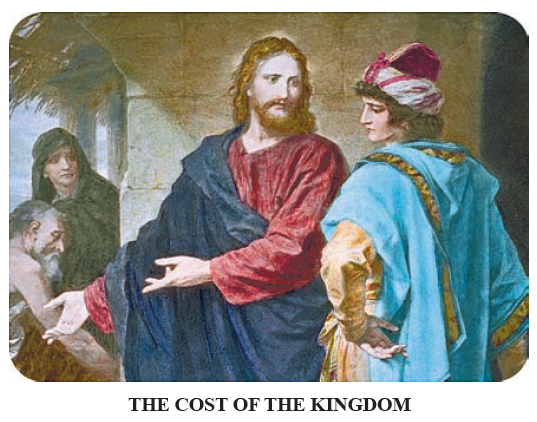
It is, perhaps, sometimes easy to look at the rich young ruler in this encounter, and think, how I would have jumped at the chance to be an actual follower of Jesus! What could the young man have possessed that could have compared to being there with our master during his time on earth? To actually hear the words come out of his mouth? To be able to serve him during his travels? It is more sobering, however, to realize that Jesus’s words are just as applicable to us today as they were to the rich young ruler. To give up one’s possessions – not, perhaps, to the point of living destitute; to the point of not even providing for one’s family, but certainly sacrificing earthly comforts in favor of serving God is more than possible. When we have a choice of how to spend our time, one of the most finite and valuable things we have, how do we choose to spend that time? Note how even the phrase “spend” our time implies that time has great value; do we “spend” this precious currency of time in pursuit of worldly respect and accomplishments, as the scribes and Pharisees did? When the necessary work of our occupations is done, and our commitments to our family and friends are met, do we “spend” our time on passing entertainments or hobbies? When faced with the choice of advancement at our jobs and careers, for opportunities of greater worldly respect and monetary compensation, but at a cost of our precious time, such that we have less time for studying God’s word and developing our characters, or even at the expense of our families, where do we find our hearts drifting toward? Do we have “faith in Christ” enough that we are confident that denying these types of distractions and earthly ambitions is truly the correct course, even when those around us may not understand and encourage us otherwise? Certainly, the world, and our own human nature, as well as society in general, attempt to influence us in ways that are not always conducive to serving God to the best of our abilities. When all is said and done, when the decision is left up to us, do we truly have sufficient faith in Christ – that he exists; that God exists; that our work in their service is valued; do we truly have enough faith to give up that respect or fame or wealth, things that we can see and feel and measure, as can those around us – all in service to something that cannot be seen or measured? That many say is not real anyway? Surely, the importance of “faith in Christ” can begin to be seen.
Let us now examine the second aspect to the answer of the question, “what is faith in Christ?”. Strive as we might, none of us are perfect. It is no more possible for us to have perfect “faith in Christ” every second of every day of our lives any more than it was possible for the Jewish people to perfectly keep God’s law. This brings up a second aspect to “faith in Christ”. We are promised by the scriptures that if our intentions are pure; if we are working toward “faith in Christ”, with our hearts and minds truly engaged, that our Lord and Master will stand as our advocate in front of God. He will cover our shortcomings, which we are bound to have. Paul discusses this very concept in his letter to the Corinthians:
2 Corinthians 12:8 Concerning this thing I besought the Lord thrice, that it might depart from me.
2 Corinthians 12:9 And he hath said unto me, My grace is sufficient for thee: for [my] power is made perfect in weakness. Most gladly therefore will I rather glory in my weaknesses, that the power of Christ may rest upon me.
Paul here presents a powerful concept. Our master knows our imperfections. He knows if we attempt to follow him, we will have failures and setbacks. He knows we will stumble. However, the thought here is that for those who are truly seeking to follow Jesus’s commandments and serve God, our master will provide a “grace” that will cover those failures. In fact, as the scripture states, it is these very weaknesses and failings that make our master’s ability to cover those shortcomings so powerful.
Being as keenly aware of our own imperfections and failures as we sometimes are, it can be very difficult for us to forgive ourselves. We may look at our own lives and our own shortcomings and think “I’m not living in a special sanctuary or monastery. I’m not an ordained member of any clergy. Even if I try to follow Jesus’s commandments in order to serve God, I know I’m not going to be able to do so perfectly. Surely this promise of justification, of righteousness, could never apply to me, because my faith and my actions can never be enough. Besides, don’t others seem to know more about God and the Bible and religious matters than me? How am I ever going to live up to God’s expectations?”
The answer to these doubts is, of course, faith. This second aspect to “faith in Christ”, simply put, is, do we have sufficient faith in our master’s promise to cover our shortcomings that we are prepared to risk following him to the best of our ability and at whatever the cost? Are we prepared, like Rebekah in Genesis 58, when we are called, to say “I will go with him”?
The thought of Jesus acting as our advocate when we try, but fail, to follow his example and commandments is again repeated by John:
1 John 2:1 My little children, these things write I unto you that ye may not sin. And if any man sin, we have an Advocate with the Father, Jesus Christ the righteous:
This second aspect to “faith in Christ” is incredibly important. We know we have failed to perfectly love God with all our hearts, soul and mind, and to love our neighbors as ourselves. We know that we will continue to fail as long as we are in these imperfect bodies and imperfect conditions. Do we have faith enough in Christ, as our advocate, to still try, with all that we have, and do we trust him enough to cover us in front of the Almighty Creator and Supreme Judge when we fail? Do we truly trust him with our beings, knowing that penalty for failure is death? By any definition, trusting someone enough to hand over one’s entire well-being and continued existence requires a great deal of faith.
We have covered many topics and many concepts so far in this study, and truth to tell, there are many more aspects to the concept of “justification by faith” that we have scarcely touched on, and some aspects that we have not examined at all. However, let us attempt to pull all of the various thoughts together that we have so far covered, and return to the basic question – after all of these various concepts we have covered, what, then, is “justification by faith”? Simply put, if one trusts in Jesus enough to consider him their Lord, then it follows that one should want to obey his commands. By his own words, the greatest commands are to love God with all one’s heart, soul and mind, and to love one’s neighbor as oneself. To truly take on this command means to understand that this will not be a short proposition – not just a baptism in water then continuing on with one’s life and occasionally going to church. To truly take on this command is a lifetime journey and transformation. It is a daily struggle against distractions and ambitions and goals that would take one’s time and attention away from serving God and studying His word and plan. It means serving others, especially those who have also chosen to follow Jesus. It means understanding and accepting that once making that commitment, there will be failures, large and small. It means accepting those failures, and having sufficient faith in Jesus’s willingness to cover those failures in front of God’s perfect justice. This is not an easy path by any definition, and perhaps it becomes a bit more understandable why the rich young ruler turned away and went sadly home. However, the concept of “justification by faith”, by the very definition of those terms, means that one who expresses such faith, one who truly embraces Jesus’s commandments and has the faith to both follow the path he laid out and accept his willingness to advocate for us when we stumble and fail, one who so trusts in that advocacy that even after failures, one learns from the failure and continues down the established path – such a one is promised justification in view of God’s justice because of that faith.
As we progress through the next few studies, the concept of justification by faith will prove to be one of the cornerstones when considering God’s plan for mankind in the Gospel Age. In this study, we have only begun to examine this concept. There are still many unanswered questions concerning justification by faith and its implications; questions that we shall consider in the forthcoming studies:
- Who specifically is the concept of justification by faith meant for?
- We’ve discussed *what* justification by faith is; what are the implications and possible outcomes for those who have truly been justified by faith?
- Does the ability to become justified by faith apply only to a certain period of time? Will there be a time when the opportunity for justification by faith will be passed? If so, will a different concept replace it, just as justification by faith replaced justification by works?
- What about all of mankind who lived before the time of Jesus’s sacrifice? What about all those who live today who have not had an opportunity to understand Jesus’s sacrifice, or even those who know about God and Jesus, but do not fully pursue justification by faith? How does God’s plan apply to all mankind, not just a select few?
God’s plan as revealed throughout the Gospel Age through the scriptures will provide satisfying answers to all of the above questions, as well as their implications to all mankind. As we progress through the next few studies, we will begin to see God’s true character shine more and more through the scriptures; not the character that has become so dimmed and clouded by centuries of misinterpretations and scripturally unsound traditions, but one of such unspeakable power, perfect and unquestionable justice, profound wisdom, and a love so all-encompassing and staggering that it can cause one to be fundamentally awestruck. In our next study, we will examine a second aspect of God’s plan that, like the concept of justification by faith, was only made manifest and possible as a result of Jesus’s sacrifice. Unlike justification by faith, however, we will see that this second concept applies not to just a certain select few people who make certain choices, but all mankind – every single person who has ever lived. Like the concept of justification by faith, this second concept will lay another important building block in understanding God’s plan for mankind as our studies progress through the Gospel Age. Following this next study, we will propose a third study that compares and contrasts the two concepts, and consider how both concepts, although perhaps only dimly understood, if at all, until (and to some large extent, during) the Gospel Age, are wonderfully and harmoniously testified by the scriptures.
I Corinthians 15:22 For as in Adam all die, even so in Christ shall all be made alive.
Posts in the “God’s Plan for Mankind” Study
- A Study in God’s Plan for Mankind – Study 1: In the Beginning
- A Study in God’s Plan for Mankind – Study 2: The World That Was
- A Study in God’s Plan for Mankind – Study 3: The Patriarchal Age part 1
- A Study in God’s Plan for Mankind – Study 4: The Patriarchal Age part 2
- A Study in God’s Plan for Mankind – Study 4a: Jacob’s Hip
- A Study in God’s Plan for Mankind – Study 5: The Jewish Age part 1: The Children of Israel
- A Study in God’s Plan for Mankind – Study 6: The Jewish Age part 2: Typical Justification and Life
- A Study in God’s Plan for Mankind – Study 7: The Jewish Age part 3: Judges, Kings and Prophecies
- A Study in God’s Plan for Mankind – Study 8 – The Jewish Age Harvest part 1: Prophecies Fulfilled
- A Study in God’s Plan for Mankind – Study 9 – The Jewish Age Harvest part 2: The Four Phases of Jesus’s Human and Post-Resurrection Existence
- A Study in God’s Plan for Mankind – Study 10 – Beginnings, Endings and Overlaps
- A Study in God’s Plan for Mankind – Study 11 – The Gospel Age part 1: Justification by Faith
- A Study in God’s Plan for Mankind – Study 12 – The Gospel Age part 2: The Promise of the Restitution of All Things
- A Study in God’s Plan for Mankind – Study 13 – The Gospel Age part 3: The Cost of Mankind’s Ransom
- A Study in God’s Plan for Mankind – Study 13a – The Gospel Age part 3a: Faith: The Work of a Lifetime
- A Study in God’s Plan for Mankind – Study 14 – The Gospel Age part 4: The High Calling
- A Study in God’s Plan for Mankind – Study 15 – The Gospel Age part 5: God’s Plan and the Permission of Evil
- A Study in God’s Plan for Mankind – Study 16 – The Gospel Age part 6: The Great Company
- A Study in God’s Plan for Mankind – Study 17 – The Gospel Age part 7: The Gospel Age in Summary
- A Study in God’s Plan for Mankind – Study 18 – The Gospel Age Harvest part 1: An Introduction to the Concept of the Harvest at the End of the Gospel Age
- A Study in God’s Plan for Mankind – Study 19 – The Gospel Age Harvest part 2: The Lord’s Return and Presence in the Gospel Age Harvest
- A Study in God’s Plan for Mankind – Study 20 – The Gospel Age Harvest part 3: The Completion of the Church Class
Further Readings and References
- For an overview of God’s plan for mankind, the booklet God’s Grand Plan of the Ages touches upon each age or time period in God’s plan, past, present and future, as revealed in the scriptures.
- For a much more in-depth and scholarly examination of God’s plan for mankind, as well as studies in the basic building blocks of God’s plan, such as God’s character, the permission of evil, justification by works versus justification by faith, the book The Divine Plan of the Ages will certainly prove to be an invaluable and thought provoking resource.
- The illustration of the rich young ruler’s encounter with Jesus is part of the larger work The Photo-Drama of Creation. The work contains many other such illustrations of Biblical events and themes, as well as descriptive yet concise studies on each topic illustrated
- The Bible Students YouTube channel provides an online repository of many studies in various Biblical and Christian topics of interest. Students who are considering the concepts of justification by faith may find that the study “Don’t Be a Fool” provides several thought-provoking considerations regarding the importance of decision making to an individual that is seeking such justification.
- (Please note that although some of these links will take you to the Chicago Bible Students online bookstore, where physical copies of these books may be purchased, each of the books may also be downloaded from the store, free of charge, with no obligation to provide any personal information. Simply click under the description of each item to find the download link)
 State College Bible Students