Luke 2:4 And Joseph also went up from Galilee, out of the city of Nazareth, into Judaea, unto the city of David, which is called Bethlehem; (because he was of the house and lineage of David:)
Luke 2:5 To be taxed with Mary his espoused wife, being great with child.
Luke 2:6 And so it was, that, while they were there, the days were accomplished that she should be delivered.
Luke 2:7 And she brought forth her firstborn son, and wrapped him in swaddling clothes, and laid him in a manger; because there was no room for them in the inn.
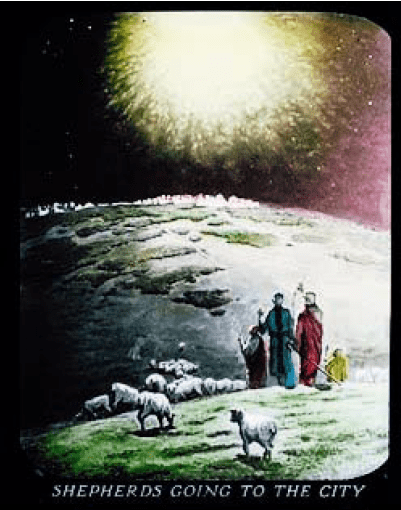
Luke 2:8 And there were in the same country shepherds abiding in the field, keeping watch over their flock by night.
Luke 2:9 And, lo, the angel of the Lord came upon them, and the glory of the Lord shone round about them: and they were sore afraid.
Luke 2:10 And the angel said unto them, Fear not: for, behold, I bring you good tidings of great joy, which shall be to all people.
Luke 2:11 For unto you is born this day in the city of David a Saviour, which is Christ the Lord.
Luke 2:12 And this shall be a sign unto you; Ye shall find the babe wrapped in swaddling clothes, lying in a manger.
Luke 2:13 And suddenly there was with the angel a multitude of the heavenly host praising God, and saying,
Luke 2:14 Glory to God in the highest, and on earth peace, good will toward men.
Luke 2:15 And it came to pass, as the angels were gone away from them into heaven, the shepherds said one to another, Let us now go even unto Bethlehem, and see this thing which is come to pass, which the Lord hath made known unto us.
Luke 2:16 And they came with haste, and found Mary, and Joseph, and the babe lying in a manger.
2:17 And when they had seen it, they made known abroad the saying which was told them concerning this child.
Luke 2:18 And all they that heard it wondered at those things which were told them by the shepherds.
Luke 2:19 But Mary kept all these things, and pondered them in her heart.
Luke 2:20 And the shepherds returned, glorifying and praising God for all the things that they had heard and seen, as it was told unto them.
Romans 13:10 Love worketh no ill to his neighbour: therefore love is the fulfilling of the law.
Romans 13:11 And that, knowing the time, that now it is high time to awake out of sleep: for now is our salvation nearer than when we believed.
Romans 13:12 The night is far spent, the day is at hand: let us therefore cast off the works of darkness, and let us put on the armour of light.
Many centuries ago, a major, and wonderful, milestone in God’s plan for mankind occurred. After thousands of years of existence in a degraded, imperfect state, mankind experienced an event that would have a profound impact on its future, and an opportunity to rise out of the condition it found itself in. God allowed His Son to take on human form, born as a human baby, and eventually walk among mankind. The announcement of the long-awaited Messiah’s arrival was proclaimed, as described in the scriptures, by a multitude of heavenly beings all singing praises to God. This Messiah was, of course, Jesus, whose birth much of the world remembers during this season of the year.
Jesus spent his life praising God, crediting Him in all things, and devoting his life to his Father’s service. As part of his service, he sought out those among mankind who also had the desire to devote, or consecrate, their lives to the Father who sent him. The New Testament is filled with examples of Jesus’s love for those he encountered, as well as how that love, in turn, inspired faith, confidence and love within those he encountered. Many of these people became his apostles, disciples and followers. The example that Jesus left, as testified by the scriptures, echoes down through the centuries to reach those living today.
As human beings, it can be easier for us to perhaps relate to stories of Jesus’ love for us than it is to relate to God’s love to us. Not to question God’s love in the slightest! Consider that although Jesus had an existence as a spirit being, who the scriptures describe as the Logos, Jesus did become human, and as such had many experiences and interactions with others that we, as humans, can relate to. It is far more difficult for us to comprehend a being on a different plane of existence, such as God. Further, not only does God exist on a different plane than mankind, He exists on the pre-eminent plane of existence, many levels removed from us. Additionally, God is a perfect being. Our imperfect minds can, by definition, only maintain imperfect distortions of even the best of a perfect concept.
Fortunately, God understands this, yet still wants us, His creation, to know something of Him and to understand Him as best as we are able. To this end, God has provided the holy scriptures, the Bible. To those who believe in it and understand it, the Bible provides all that we, today, need to know of God, the facets of His character that are understandable to us, and how to please Him. One of the best ways we can understand and appreciate the goodness and love of God is through the scriptural accounts of His Son. Throughout his life, in all things, Jesus gave credit to God and made sure that God’s name, above all, was praised:
Matthew 19:17 And he [Jesus] said unto him, Why callest thou me good? there is none good but one, that is, God: but if thou wilt enter into life, keep the commandments.
John 6:38 For I [Jesus] came down from heaven, not to do mine own will, but the will of him that sent me.
John 8:28 Then said Jesus unto them, When ye have lifted up the Son of man, then shall ye know that I am he, and that I do nothing of myself; but as my Father hath taught me, I speak these things.
Further, Jesus spoke often of the “oneness” between his Father and himself. Although some branches of Christianity have debated the exact meaning of this concept throughout the centuries, all will no doubt agree that Jesus exemplified the best of the nature, state of mind, and heart condition possible for mankind to possess. In this, Jesus pleased God in every way. This can be easily proven by the words of God Himself:
Matthew 3:17 And lo a voice from heaven, saying, This is my beloved Son, in whom I am well pleased.
Clearly, then, God’s love for mankind can be seen reflected in His Son, Jesus, and the actions that he took, for if Jesus reflected God and God’s character, and if Jesus’ actions demonstrate a love for mankind, then so, to, must there be a love in the Father whom Jesus reflects. Although every day of every year is appropriate for reflection on God’s love, and on considering Jesus’s works, teachings and example, this season of the year, when so many draw together to remember Jesus’ birth, seems an apt time to consider and rejoice in some of the examples given to us by the scriptures of this love.
Jairus’ Daughter
Luke 8:41 And, behold, there came a man named Jairus, and he was a ruler of the synagogue: and he fell down at Jesus’ feet, and besought him that he would come into his house:
Luke 8:42 For he had one only daughter, about twelve years of age, and she lay a dying. But as he went the people thronged him.
Luke 8:43 And a woman having an issue of blood twelve years, which had spent all her living upon physicians, neither could be healed of any,
Luke 8:44 Came behind him, and touched the border of his garment: and immediately her issue of blood stanched.
Luke 8:45 And Jesus said, Who touched me? When all denied, Peter and they that were with him said, Master, the multitude throng thee and press thee, and sayest thou, Who touched me?
Luke 8:46 And Jesus said, Somebody hath touched me: for I perceive that virtue is gone out of me.
Luke 8:47 And when the woman saw that she was not hid, she came trembling, and falling down before him, she declared unto him before all the people for what cause she had touched him, and how she was healed immediately.
Luke 8:48 And he said unto her, Daughter, be of good comfort: thy faith hath made thee whole; go in peace.
Luke 8:49 While he yet spake, there cometh one from the ruler of the synagogue’s house, saying to him, Thy daughter is dead; trouble not the Master.
Luke 8:50 But when Jesus heard it, he answered him, saying, Fear not: believe only, and she shall be made whole.
Luke 8:51 And when he came into the house, he suffered no man to go in, save Peter, and James, and John, and the father and the mother of the maiden.
Luke 8:52 And all wept, and bewailed her: but he said, Weep not; she is not dead, but sleepeth.
Luke 8:53 And they laughed him to scorn, knowing that she was dead.
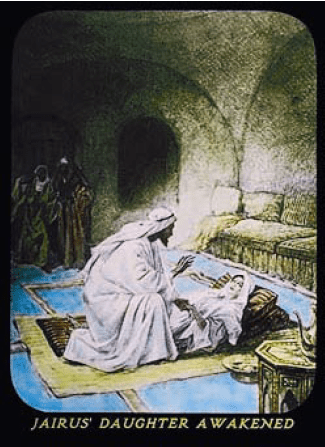
Luke 8:54 And he put them all out, and took her by the hand, and called, saying, Maid, arise.
Luke 8:55 And her spirit came again, and she arose straightway: and he commanded to give her meat.
Luke 8:56 And her parents were astonished: but he charged them that they should tell no man what was done.
Jairus was a man living during Jesus’ time on earth. The scriptures describe him as a “ruler in the synagogue”. As such, Jairus doubtlessly had what was considered a good life. His position in the synagogue would have provided him with a lifestyle that was more comfortable than the average person of the time. From many different perspectives, Jairus would have had the respect of not only the general public, but of the more influential leadership of the time as well. Jairus had a family as well as a larger household, as evidenced by verse 49. As the majority of the religious leadership at the time rejected the idea of Jesus as the awaited Messiah, Jairus may have felt pressure to conform to this guidance, and even propagate this view to the people. However, when his daughter became sick, to the point of death, Jairus obviously began to feel differently. In his position, he had no doubt heard about Jesus’ miraculous healing of the sick. Although he may have struggled with a perceived loyalty to his position and guidance from his superiors regarding Jesus, in the end, the ingrained love of a father for his daughter won Jairus’ heart. Such a love will do almost anything to secure the well-being of the one it treasures.
So it was that Jairus sought out Jesus, the man whom many of his colleagues or superiors no doubt warned him against. At the point when Jairus approached Jesus, Jairus’ daughter’s health must have been very poor, as indicated by the urgency of Jairus’ plea to Jesus. This turned out to be true, as a slight delay caused by a woman reaching out to Jesus for healing on the way to Jairus’ home resulted in Jesus, Jairus and the accompanying party arriving too late. Jairus’ beloved daughter, whom he potentially risked all of his position and prosperity for by seeking out Jesus, had died.
Verses 49 through 53 provide a very interesting narrative describing a reaction to the news. After hearing the news, verse 51 describes Jesus, Jairus, Jairus’ wife, Peter, James and John going into the house. The verse is very clear on this list alone entering the house. Verse 52 indicates that “all” (presumably all in the list in verse 51 except, perhaps, for Jesus) began to “wail”, or mourn the girl. Jesus then says in verse 52 that the girl “is not dead” but sleeps. Interestingly, verse 53 then indicates that “they” laughed him to scorn. It seems difficult to believe that the apostles Peter, James and John would have “scornfully” laughed at their master even though the verse is not clear. Certainly, a group of “they” would mean multiple people and thus have at least needed to include Jairus and his wife, perhaps overtaken in their grief. Perhaps some of Jairus’ scorn was even based on his disappointment in what he may have perceived as a reinforcement of the views of the other religious leaders. In desperation for his daughter, he allowed himself to believe enough in Jesus to seek him out for help, and yet, despite acting against the direction of the religious leadership, his daughter had still died.
Instead of responding to the scorn, verse 54 states that Jesus dismissed them all from the room, and commanded the girl to rise, which she did. Jairus and his wife were described as “astonished” in verse 56, but not mentioned in the scriptural record again. It is difficult, therefore, to know what impact, if any, this event had upon Jairus, but the fact that God saw fit not to mention him in the scriptural record after this point implies that the point was not deemed important for us, today, to understand in terms of God’s plan. Instead, consider what the event does stress, in terms of God’s love as reflected in His Son.
Many were suffering and dying in Jesus’s time, just as many are suffering and dying in the present day. As with today, the time of Jesus’ first advent was not yet the appointed time in God’s grand plan to flow restitution, life and health to all mankind. However, this one act of healing one girl, provides a beautiful picture of that coming time. Through this event, the love of God to mankind is certainly pictured, shining forth brilliantly through the love and compassion of Jesus, who so ably mirrored His will. However, the love of a father; the willingness of a respected and successful man to put his reputation and position at risk all for the chance to save that which he held most dear – the precious treasure of his beloved daughter – is also a lesson in love and trust. All that we have, even that which we hold most dear, is safe for us when we seek God’s care, offered to us through His Son.
Take Up Thy Bed and Walk
5:2 Now there is at Jerusalem by the sheep market a pool, which is called in the Hebrew tongue Bethesda, having five porches.
5:3 In these lay a great multitude of impotent folk, of blind, halt, withered, waiting for the moving of the water.
5:4 For an angel went down at a certain season into the pool, and troubled the water: whosoever then first after the troubling of the water stepped in was made whole of whatsoever disease he had.
5:5 And a certain man was there, which had an infirmity thirty and eight years.
5:6 When Jesus saw him lie, and knew that he had been now a long time in that case, he saith unto him, Wilt thou be made whole?
5:7 The impotent man answered him, Sir, I have no man, when the water is troubled, to put me into the pool: but while I am coming, another steppeth down before me.
5:8 Jesus saith unto him, Rise, take up thy bed, and walk.
5:9 And immediately the man was made whole, and took up his bed, and walked: and on the same day was the sabbath.
This account describes a man who had been suffering with “an infirmity” for almost forty years. Forty years is certainly a large portion, perhaps the majority, of one’s life. As the account opens, this man is lying beside a pool of water, which was believed to have certain healing capabilities. However, due to blindness and an inability to easily move, the man could not reach the water in a sufficient capacity to receive its healing effects. Jesus, coming upon the man, asks him if he would “be made whole”. Perhaps not understanding who he was talking to, the man responded that he had no one to help him approach the pool, and thus receive its healing effects. Jesus then told the man to stand up, gather his things and to walk. Upon receiving Jesus’s words, the man was immediately “made whole”, and as Jesus commanded, began to walk.
In this event, we see multiple different levels of God’s love for mankind, as reflected in the actions of His Son. The account itself demonstrates the love that Jesus had for those who were in great need; who were ignored by the rest of mankind and left to tend to themselves as best they could. The fall into a degraded condition was originally brought about by mankind’s disobedience to God’s commandments. Mankind could have lived in perpetual perfection, but due to Adam and Eve’s sin, fell from that state. It is through God’s mercy and love for us that He provided a means by which His fallen, imperfect creation would eventually be brought back into harmony with Him. The means of this restitution is through His Son. Thus, the picture of the crippled man, so close to the pool of healing water, yet unable to reach it on his own, healed by Jesus, is a particularly harmonious vision of God’s ultimate love for His fallen creation who, like the man, is unable to heal itself, yet, through Jesus, obtains healing and the ability to rise up, which could not have been obtained otherwise.
Additionally, not only did Jesus provide a ransom for all mankind, that will, in due time, lead to the restitution of every person that ever lived, but he also provided the opening of a new, “narrow way” by which God could call those who were willing to hear. Consider for a moment how many scriptures refer to the act of consecrating one’s life to God, of living in God’s service, as a “walk” or a “way” or a “run” or a “race”. All of these analogies bring to mind the thought of one actively progressing down a course in one’s life. To name a few of these scriptures:
Habakkuk 2:2 And the LORD answered me, and said, Write the vision, and make it plain upon tables, that he may run that readeth it.
Matthew 7:14 Because strait is the gate, and narrow is the way, which leadeth unto life, and few there be that find it.
I Corinthians 9:25 And every man that striveth for the mastery is temperate in all things. Now they do it to obtain a corruptible crown; but we an incorruptible.
I Corinthians 9:26 I therefore so run, not as uncertainly; so fight I, not as one that beateth the air:
II Timothy 4:7 I have fought a good fight, I have finished my course, I have kept the faith:
The thought of “progression” implies a starting point, when the walker or runner is inactive. How beautifully, then, does the picture of Jesus and the man at the pool exemplify both the love of God and of Jesus to those who have chosen to consecrate their lives to God. Just as the man at the pool lay, blind and unable to move, so too, were all before God called them. Although such individuals may have been able to vaguely perceive God, like the man at the pool may have been able vaguely perceive the water, the water was nonetheless out of reach. All would have remained in such a state, if not for the love of Jesus. Jesus provided the way to be able to break out of the darkness and immobility of such conditions.
Through his love and his sacrifice, Jesus provided this class, this “little flock” with the opportunity to cast off the blindness of their imperfect human understandings and limitations, to rise up out of the sickbed of sin and indolence and hear his Father’s call to something better; something grander than can possibly be grasped. To this class, faith in Jesus truly allows them to set aside their metaphorical beds and begin to walk and run the course of the “narrow way”. By following Jesus’ example, these individuals, who recognize this call, rise up out of “their beds” of their old lives and walk the path laid out for them by their Master. Thus, the scriptures testify that in addition to the general restitution planned for mankind, God has also provided a different, higher reward for those who, though belief in Him, and through faith in His Son, consecrate their lives to Him now, in the present age. Truly, God’s love for the totality of mankind is abundantly reflected in this one picture of the man healed by the pool’s side.
The Beautiful Song: Closer Than When We First Believed
For those have heard the call to follow the example first laid down by Jesus, centuries ago, the need for urgency in maintaining the strength and integrity of one’s vows is clearly stressed by the scriptures.
Philippians 3:13 Brethren, I count not myself to have apprehended: but this one thing I do, forgetting those things which are behind, and reaching forth unto those things which are before,
Philippians 3:14 I press toward the mark for the prize of the high calling of God in Christ Jesus.
Romans 12:1 I beseech you therefore, brethren, by the mercies of God, that ye present your bodies a living sacrifice, holy, acceptable unto God, which is your reasonable service.
Hebrews 12:1 Wherefore seeing we also are compassed about with so great a cloud of witnesses, let us lay aside every weight, and the sin which doth so easily beset us, and let us run with patience the race that is set before us,
The present life is the only time that those called forth into consecration in order to be found worthy of the reward put before them. This finite amount of time carries with it a weight of urgency, spoken of by Paul as “the night is far spent”, quoted in Romans 13:12 at the beginning of this study. Like the man healed by the pool, the time to rise up from their beds is past. Now is the time to follow the Lord who healed them enough to walk the path put before them. Once their lives have been spent, once God’s plan passes the point when the call to follow is over and the door to “the narrow way” is shut, the opportunity will be gone. Every day, every minute, therefore, is precious for such to spend in service to God and in furthering the development of their minds and characters to become closer images to their Master. Thus, from this perspective, the thought of “the night” being “far spent” should reinforce in these individuals a sense of sobering and a sense of priority. Yet, even so, this though awakens another set of feelings as well.
Yes, the time to make one’s calling and elections sure is short; shorter than it was this time last year. Yes, the work is hard and the temptations to slacken our efforts may be strong. But take a few minutes to rejoice in that fact as well! The time is short! If we but stand fast to the commitments we have made, we will find, we will feel, down to our core, that the night time of our trials during the present time is far spent. Take a moment and use your faith to listen! Can you hear it? The glorious song of the great heavenly host, trumpeting out from the darkness of our present doubts and trials like the song that broke through the darkness surrounding the shepherds and their flocks all those centuries ago! It was also night then – a night that was made glorious by the most beautiful of songs! That song, that precious reward, is closer than when it was first recognized. Many may have already walked a long distance on the “narrow way”, and many may have yet a further long way to walk. Only God, in His infinite wisdom knows. Yet, by definition, if one is walking, the path is that made that much shorter by every hard won step taken! Regardless of how much or how little progress may have been made, the reward for faithfulness is closer than when we first believed enough to start the way! The song is there! The calling is there! Let us renew the strength of the conviction that first led us to enter the “strait gate” and follow the call to the harmonious and beautiful reward that awaits all of the victorious at the finish line!
My dear, precious friends, until that wonderful, glorious day when, if we, through God’s grace are found worthy, we are altogether with our glorified Lord and Master, gathered together in our Father’s infinite love, I rejoice with you in that beautiful song! The time may be shortened by the centuries that have past by since that long ago night when the heavens opened proclaiming the coming of the long-awaited Savior of mankind, but the notes, the chorus, the message is the same today as it was then, and made more magnificent by the fact that the night is indeed far spent, and the day is at hand! The song is that same song, made only more beautiful by its familiarity to us, who have been so abundantly blessed to recognize it:
Luke 2:14 Glory to God in the highest, and on earth peace, good will toward men.
As the world perhaps softens its collective heart this season; as many open their minds to the possibility of believing in the great Savior of mankind and the Father who sent him, we rejoice in the love of the Great Architect. We rejoice in the grace of that same Great Architect who saw fit to reveal Himself to us through the scriptures, and to provide us with a reflection of His love, in His Son, whose birth the world commemorates during this season. May another year in His service find all yet faithful to the vows that have been made; and find each one closer to the great reward offered to those judged worthy enough to have spent their lives pursuing it.
Romans 13:12 The night is far spent, the day is at hand: let us therefore cast off the works of darkness, and let us put on the armour of light.
Further Readings and References
- Above Strength is a discourse given by Tim Alexander that provides many beautiful and moving reflections on examples of Jesus, his love, and the account of Jairus and his daughter.
 State College Bible Students