The Gospel Age Part 7: “A Summary of the Gospel Age”
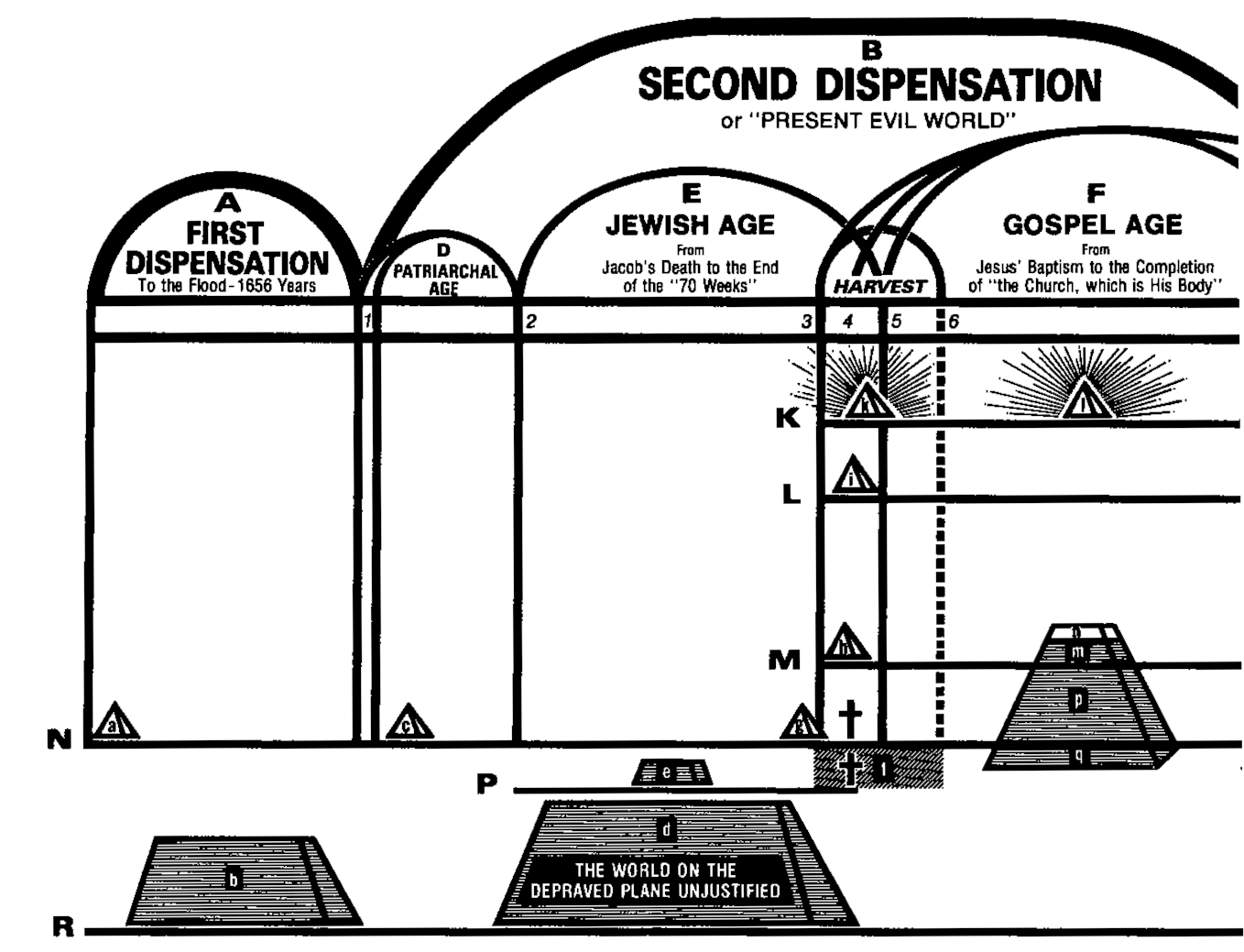
Over the past months, the series of studies in God’s plan for mankind have endeavored to show that from the point of mankind’s creation, to the present day, and into the future, God has had a plan and message for mankind that is as consistent as it is exciting and beautiful. Through the Bible, the means through which God has chosen to reveal His plan for those willing to search for it, we have examined how God created the original two members of the human race, Adam and Eve. The scriptures declare that these were made in “God’s image”, implying a state of perfection; human perfection, but perfection nonetheless. In desiring an intelligent creation, God also created Adam and Eve with free will; an intellect that could decide to follow His rules, or to disobey them. We followed the account of how, through disobedience, this state of perfection was lost. As a result of this loss, sin, sickness and death entered into not only Adam and Eve’s life, but into the lives of all their descendants, including us, as members of the human race, in this present day. During these studies, God’s plan was laid out in a chart form, and divided into several periods of time, which were broken down into wide segments, or “dispensations”. These “dispensations” were sometimes broken into further sub-divisions known as “ages”. This period of time, from the time of Adam and Eve, until another momentous event known as the Flood (Genesis 1-7) was given the title of “the First Dispensation” or “The World that Was”.
Our studies reviewed how, centuries after Adam and Eve, one particular member of mankind, Abraham, was singled out by God for his great faithfulness. As a result of that faithfulness, God made a series of great promises to Abraham. As reviewed in our studies, these promises had various dimensions. Some of these dimensions were specific to Abraham’s direct descendants, some would have future applications to a select group of mankind who, like Abraham, would need to demonstrate their faithfulness to God, and some further would have applicability to all of mankind past, present and future. During these studies, we began the time period of the “Second Dispensation” with Abraham, and further sub-divided the time period of God’s direct dealings with Abraham, his son Isaac, and his grandson Jacob, as the “Patriarchal Age”.
In keeping with His promises, God developed a special relationship with the descendants of Abraham’s grandson Jacob, who would later be renamed Israel. To these descendants, God delivered a special series of laws and sacrifices. He also promised that whoever kept with the promise that, if these laws and sacrifices were kept perfectly in both act and heart, they would receive justification, or righteousness, in terms of God’s justice, and thus be granted a right to life. Through the scriptures, we reviewed how although none of the descendants of Israel, the Israelites, could keep this law perfectly, God foretold, through His prophets, that eventually a Messiah would come, who would. This period of time, in which the scriptures chronicle God’s special dealings with the descendants of Israel, forming them into a nation of special favor, was labeled “the Jewish Age” in our chart.
After centuries of preparation and special favor under God’s law, the promised Messiah finally came to the nation of Israel in the form of Jesus. Our studies reviewed the scriptural record declaring that Jesus was in fact the first and only direct creation of God, “God’s only begotten son”, who had a long prior existence as a spirit being known as the Word or the Logos. Having taken on a human life, Jesus perfectly kept God’s law in both word and heart, and was thus the first person to gain the right to justification under that law. However, he willingly sacrificed his life to balance the scales of God’s justice, that had been put out of balance by Adam’s long ago sin. In doing so, Jesus provided a ransom price for all of mankind, the results of which will be known and felt by mankind during the coming ages. We reviewed how the death of Jesus was also one of the signals of the ending of the Jewish Age, and the beginning of the next age in God’s plan.
During his ministry, Jesus also sought out those from the nation of Israel who would be willing to commit their lives to the service of God; an act which is also referred to as “consecration to God”. Through faith in Jesus’s ability to provide a ransom price for mankind, and also through faith in Jesus’s willingness to act as an advocate to God to mediate shortcomings, a wonderful new opportunity was offered to those of the Israelites who were willing to accept it. This opportunity was somewhat obscurely referred to throughout the Old Testament scriptures, but now would snap into a sharper clarity. An opportunity for those willing to accept the call that Jesus put forward, to follow him and consecrate their lives to God, was now put forth. If found faithful, these were promised a higher reward than would be received, at a future point in God’s plan, by all mankind. This calling and searching by Jesus among the Jewish people was marked as “the Jewish Age Harvest” period on our chart. This “harvest” period overlapped with the end of the Jewish age, and the following age.
Due to a lack of zeal of those among the nation of Israel, this call, sometimes referred to as “the high calling”, since it was a call to a higher reward than the reward that will eventually be open to all mankind, was opened to all mankind. Jewish people could, and can, still respond to the call, but it was, and is, open to all the people of the earth. This period of time in God’s plan, when the call to sacrifice in hopes of a higher reward was opened to all mankind, was labeled as “the Gospel Age” on our chart.
The Primary Purpose of the Gospel Age
During our studies of the Gospel Age, we reviewed the scriptures that indicate that the main purpose of the Gospel Age is for God to call out those among mankind who are willing and eager to put Him first in their lives. These will demonstrate this desire by responding to His calling through the act of consecration of their lives to Him and His service. This class of individuals are referred to, by the scriptures, by many titles, such as “the little flock”, “the bride of Christ” or “the church class”. The main purpose of the Gospel Age is to call out this group of individuals from among all mankind, and allow them to demonstrate their faithfulness by completing their consecration vows. This class has a set number that will be accepted, and after this number has been filled, the next phase of God’s plan will commence.
Having thus reviewed God’s plan for mankind up to this point, and having completed a series of studies on the Gospel Age, it seems an appropriate time to return to the chart of God’s plan that we began some few studies ago, and update this chart with the conclusions that, through the course of the past few studies, have been reached concerning the Gospel Age.
Other Goals of the Gospel Age
Before continuing with an examination on how to represent the Gospel Age on our chart of God’s plan, it may be helpful to also review some of the secondary, but still important goals of the Gospel Age. These goals are not specific to the Gospel Age. They are common themes and goals throughout all of God’s plan for mankind, from the time of Adam and Eve up until the present day. As such, we will not add specific symbols to the Gospel Age section of the chart for these. However, as events during the Gospel Age also further these longer-term goals, it may be valuable to review them:
- Mankind’s experience with sin and disobedience continues. This lesson, begun with Adam and Eve’s choice in the Garden of Eden, will provide mankind with the ability to make an informed decision on whether to obey God’s laws, and the penalty for not doing so.
- Mankind’s lesson that only God’s ways will solve problems continues through the Gospel Age. No system, human philosophy or government, despite the best or most noble intentions, have been able to solve mankind’s problems.
- God’s disfavor and punishment of the nation of Israel, as laid out in the scriptures, continues throughout the Gospel Age.
The Gospel Age in the Chart of God’s Plan
Having reviewed God’s plan for mankind up to the Gospel Age, let us now turn our attention to updating the chart on which we had been outlining God’s plan. When deciding how to represent the Gospel Age on this chart, consider the main purpose of the Gospel Age. As noted earlier, the primary goal of the Gospel Age is the calling, development and selection of a group of consecrated followers to form the “little flock” or the “church class”. Since the goal of the Gospel Age is centered around the Church, it seems appropriate to add items to the chart that are associated with Jesus, the head of the Church, and the Church itself.
Before proceeding, with an examination of these elements, it is important to remember that although no additions to the Gospel Age section of the chart will be made for the vast numbers of mankind who, throughout history, either do not know Jesus, or who ignore or disregard him and God’s plan in general, the future ages of God’s plan do indeed hold a special place for all of mankind. Similarly, although no additions will be added to the Gospel Age section of the chart for the nation of Israel, God’s promises to them remain as valid as ever, and future ages will also highlight the special place God has promised for them as well.
As we consider an appropriate set of symbols or icons to represent the various concepts we wish to represent on the chart, consider the pyramid. The highest point of a pyramid is a single stone, shaped itself like a pyramid. Each layer of stones in the pyramid, from the capstone to the ground, is successively larger than the preceding layer. As we shall suggest in the coming sections, these concepts make the pyramid an ideal symbol of the developing church in the Gospel Age. Having thus decided on a pyramid shape as a reasonable shape to represent the Church, head and body, during the Gospel Age, let us begin to examine each successive layer of the pyramid representation, beginning, as appropriate, with the capstone itself.
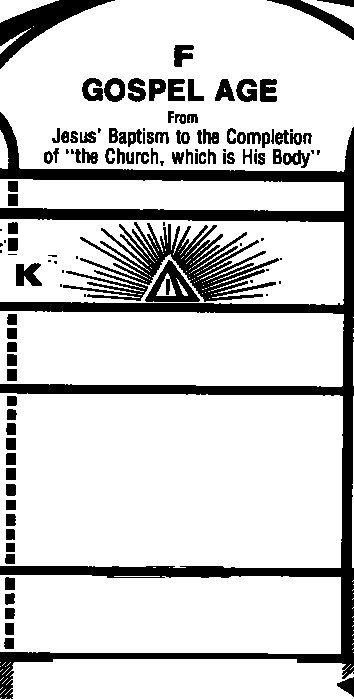
Christ Himself, Glorified
Appropriately, the first addition that we will add to the Gospel Age portion of our chart will represent the head of the Church class. Despite any teachings or traditions of mankind that may have developed over the centuries, the scriptures are very clear on who, and who alone, constitutes this head:
Colossians 1:13 Who hath delivered us from the power of darkness, and hath translated us into the kingdom of his dear Son:
Colossians 1:18 And he is the head of the body, the church: who is the beginning, the firstborn from the dead; that in all things he might have the preeminence.
When we examined the end of the Jewish Age harvest period that overlapped the Jewish Age and the then-dawning Gospel Age, we examined how Jesus rose from the grave as a spirit being, and after a brief period of appearing and instructing his disciples, ascended to a new plane of being. This new plane of being was identified as the divine plane – the highest plane of being possible.
The scriptures also state that Jesus will remain on this plane during the Gospel Age, while the church class is being developed and selected:
Acts 3:19 Repent ye therefore, and be converted, that your sins may be blotted out, when the times of refreshing shall come from the presence of the Lord.
Acts 3:20 And he shall send Jesus Christ, which before was preached unto you:
Acts 3:21 Whom the heaven must receive until the times of restitution of all things, which God hath spoken by the mouth of all his holy prophets since the world began.
Note that these scriptures do not indicate, as some interpret, that at some point, Jesus will return to earth in human form. The entire basis of the concept of the ransom price is that Jesus sacrificed his human life as a balancing payment for Adam’s disobedience. Jesus expressed this to his disciples before his death, even though, at the time, the apostles did not understand his meaning:
John 16:16 A little while, and ye shall not see me: and again, a little while, and ye shall see me, because I go to the Father.
Thus, an increased presence, unseen though it may be, of Jesus’s influence would be a sign of the “restitution of all things” referred to in Acts 3:21, and covered in previous studies, but would be an event in the future after the Gospel Age. Thus, Jesus is depicted as the capstone of the pyramid we will use to represent the development of the church. The concept is also appropriate from the sense that the capstone is a pyramid itself, formed from a single stone. This is a fitting analogy for the relationship that Jesus has with the members of the Church. Each true member of the Church strives to be a picture of Jesus, an image of that perfect “capstone”. Many scriptures express this desire of the true Church members to be “as one” with their head, Jesus:
Galatians 3:28 There is neither Jew nor Greek, there is neither bond nor free, there is neither male nor female: for ye are all one in Christ Jesus.
Romans 12:5 So we, being many, are one body in Christ, and every one members one of another.
This capstone, representing the glorified Jesus becomes the first Gospel Age symbol added to the chart. The capstone will continue to be placed on plane K, as it was at the end of the Jewish Age Harvest period. Plane K, as introduced in previous studies, remains the “Plane of Divine Spirit Beings”. Throughout the majority of the Gospel Age, this plane continues to include the glorified Jesus, but no members of the “church class” or “body of Christ”. For these, we need to consider the next layer of the pyramid we have chosen to represent the Church, and a lower plane of existence that the Divine Plane.
The True Church Class, or “The Little Flock”
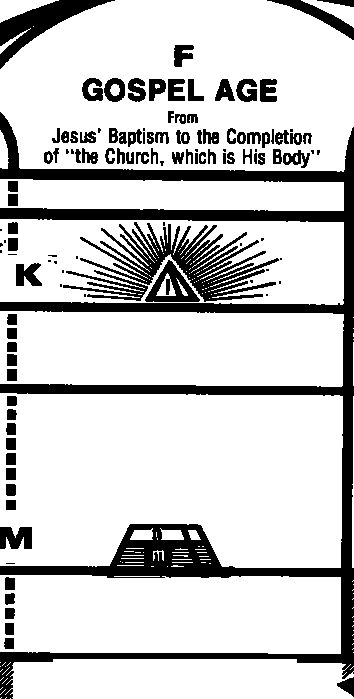
Two planes below the Plane of Divine Spirit Beings is the “Plane of Spirit Begettal”, marked as plane M. At the end of the Jewish Age, this was the plane of existence to which Jesus was reckoned when he received the Holy Spirit, after his baptism (John 1:29:34).
Paul refers to those who have truly committed themselves to God by following the example of Jesus and trusting in his sacrifice as being “new creatures”:
II Corinthians 5:17 Therefore if any man be in Christ, he is a new creature: old things are passed away; behold, all things are become new.
This “new creature” is the beginning of the creation that, if found faithful, each member of the Church will find themselves developed into. “Begettal” carries with it the thought of a new beginning, and is an apt way to describe the experience of the members of the Church during the Gospel Age. An individual is called forth by God to recognize Him and serve Him. Some answer the call; many do not, and still many others do not answer the call sufficiently as to prove themselves worth of the promised reward:
Matthew 22:14 For many are called, but few are chosen.
James speaks of how God begins this work in these individuals by providing them with “the word of truth”.
James 1:17 Every good gift and every perfect gift is from above, and cometh down from the Father of lights, with whom is no variableness, neither shadow of turning.
James 1:18 Of his own will begat he us with the word of truth, that we should be a kind of firstfruits of his creatures.
Peter expresses a similar concept, comparing the beginning of one’s process of consecration to a birth, which again fits the thought of a “begettal”:
I Peter 1:22 Seeing ye have purified your souls in obeying the truth through the Spirit unto unfeigned love of the brethren, see that ye love one another with a pure heart fervently:
I Peter 1:23 Being born again, not of corruptible seed, but of incorruptible, by the word of God, which liveth and abideth for ever.
Through the act of consecration, individuals who maintain their vows to love God first and foremost, and to love their neighbors as themselves, find themselves receiving the Holy Spirit, the unseen power and influence of God, as a gift and helper from God. This receipt of the Holy Spirit begins them down the course of becoming “new creatures.” These individuals are often referred to as “spirit begotten”. One of the main purposes of the Gospel Age is the calling of these individuals, their “spirit begettal”, as it pleases God; the opportunity for these individuals to prove their consecrations to God, and if judged worthy by God, to receive their ultimate reward at the end of the age:
Revelation 2:10 Fear none of those things which thou shalt suffer: behold, the devil shall cast some of you into prison, that ye may be tried; and ye shall have tribulation ten days: be thou faithful unto death, and I will give thee a crown of life.
For this class, who prove themselves by the keeping of their vows, we add the next layer of the pyramid, titled “the Church in the Gospel Age”, and label it as object n. Notice how the symbol of the pyramid aptly reflects the thought of the number that will prove worthy to be included in this class. Of the objects in the Gospel Age that will represent portions of mankind, this object is the smallest, which fitly represents the thought that the way of inclusion in this class is a “narrow way” that few are able to find or even understand.

The “Great Company” – The Class of “Not Quite”
Also considered in previous studies was the concept that there would be some who would hear, and answer God’s call, and while not turning their backs on that calling completely, fail to put God and their vows to God first in their lives. These individuals allow their zeal to cool and over time allow their time and resources to become used in other pursuits.
As covered previously, the difference between members of this class and members of the “little flock”, or Church class, is exemplified in the parable of the wise and foolish virgins, as found in Matthew 25. In this parable, a group of virgins set out to meet the bridegroom with a lamp and a supply of oil. The oil in the parable pictures the Holy Spirit, indicating that both groups, the wise and the foolish start out with the Holy Spirit. From this picture, both groups start out, during the Gospel Age, on the plane of spirit begettal.
However, once arriving at the door to the wedding, the virgins discover that the bridegroom is delaying his coming. One group of virgins keeps their lamps trimmed and thus maintains their supply of oil. The second group allow their oil to run out, and thus need to go forward in search of more when the bridegrooms impending arrival is announced. This group thus misses the bridegroom and is shut out from the wedding.
This group of individuals is larger than those who are found worthy of keeping their consecration vows. This idea harmonizes with the thought that “many are called, but few are chosen”. In previous studies, this class was named “the Great Company”, since the number of individuals comprising this class is understood to be much larger. This group maintains their status on the plane of spirit begettal; they started their consecrated walk with the Holy Spirit; but a lack of commitment keeps them from being judged worthy to be in the smaller group. Thus, a new pyramid slice, appropriately larger than the little flock’s object n, is added to the chart; below object n, but still on plane M. We will assign this object a value of m in our chart, and label it “the Great Company in the Gospel Age”
Christians in Name, But Have Not Answered The Calling
Throughout the centuries of the Gospel Age, many have understood God, His son Jesus, and the sacrifice Jesus made on mankind’s behalf. Many have adopted Jesus as their personal savior during the course of the age. Many have expressed a love of God, and many are sincere in that love. However, for one reason or another, this group has not answered the call to consecration to God. Some may not understand that the calling exists; some may believe the calling is not for them, or even that the calling is closed. Others profess to love God, and pray to Him, and attend services, but fail to fully grasp that the same instructions that Jesus gave years ago still apply to those who would seek membership in the Church Class today:
Matthew 19:21 Jesus said unto him, If thou wilt be perfect, go and sell that thou hast, and give to the poor, and thou shalt have treasure in heaven: and come and follow me.
This comprises the majority of those who have referred to themselves as Christians throughout the Gospel Age. Many in this group may consider the cost of consecration to be too high; too in conflict with their professional or personal goals in their lives. Many, perhaps even most, have been baptized in some manner or fashion, but few have been baptized with the understanding that baptism is meant to be only an outward symbol of one’s devotion and consecration to God. Because of this fundamental difference of heart and intention, these cannot be said to have truly received the full measure of the Holy Spirit promised to those who answer God’s call.
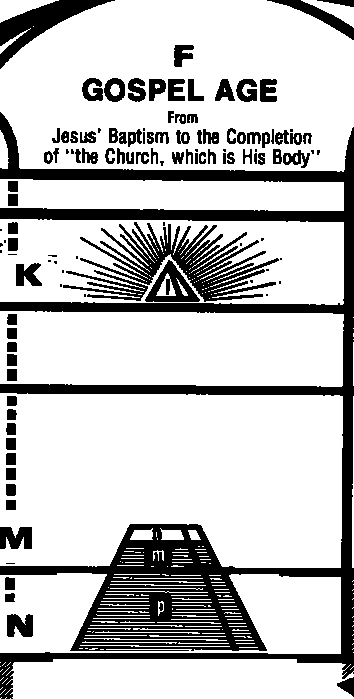
When considering the placement of an object on the chart to represent this group, then, the object cannot be appropriately place on plane M, the Plane of Spirit Begettal. However, these who understand some measure of God’s love and of Jesus’ sacrifice do have the potential for God to call them. Although these cannot be said to have an opportunity for “justification by faith” in terms of God’s justice during the Gospel Age, they can be said to have achieved a tentative form of justification; perhaps even “friendship” with God. Thus, a new object is created for this group on plane N, the “Plane of Human Perfection, Friendship or Tentative Justification”. This new object is place below the Great Company’s object m, and appropriately forms an even larger portion of the pyramid. We will assign this object a value of “p”, and title the object “Christians in Name Only, Untried”. The “untried” portion of the title is meant to describe the thought that unlike the consecrated, who are on trial now, during the Gospel Age, for how well their vows of consecration are being kept, this class, having made no vow of consecration, will experience their trial during the next age (as will be covered in future studies).
Non-Believers Professing The Name of Christ
While throughout the Gospel Age, perhaps the majority of people who have come to an understanding of God, His plan, Jesus, and his sacrifice have truly harbored love in their hearts for both God and Jesus. Some may have responded to that understanding with an act of consecration, others just with allowing the knowledge of God to influence their lives in perhaps more a more positive direction than otherwise would have been possible. However, throughout the Gospel Age, there have been some who have claimed an understanding of God and an understanding of Jesus, but responded to that knowledge with nothing positive in their hearts. Whether it is worldly power, influence, wealth or some other goal, these have tried to use the concepts of God and Jesus to their own selfish ends. Members of this group may profess to have adopted Jesus’ commandment to love God with all one’s heart and to love one’s neighbor as one’s self, but their actions belie their motives. Thus, thought they may claim to understand God and Jesus, they cannot be said to be truly “believers” in any sense of the word. These are among those that Jesus warned his followers about:
Matthew 7:15 Beware of false prophets, which come to you in sheep’s clothing, but inwardly they are ravening wolves.
Matthew 7:16 Ye shall know them by their fruits. Do men gather grapes of thorns, or figs of thistles?
Matthew 7:17 Even so every good tree bringeth forth good fruit; but a corrupt tree bringeth forth evil fruit.
Having not truly believed in God nor Jesus, let alone Jesus’ sacrifice, this group cannot even be said to have achieved the “tentative justification” of those represented by object p. Thus, as it would not be appropriate to put them above plane N, we place this final slice of pyramid below plane N. This final piece of the pyramid symbol is given a symbol of “q”, and is labeled “Non-believers who profess Christ”.
With the addition of this final symbol, the final version of the chart, including the now completed addition of the Gospel Age, may be depicted, in its entirety to this point, thusly:
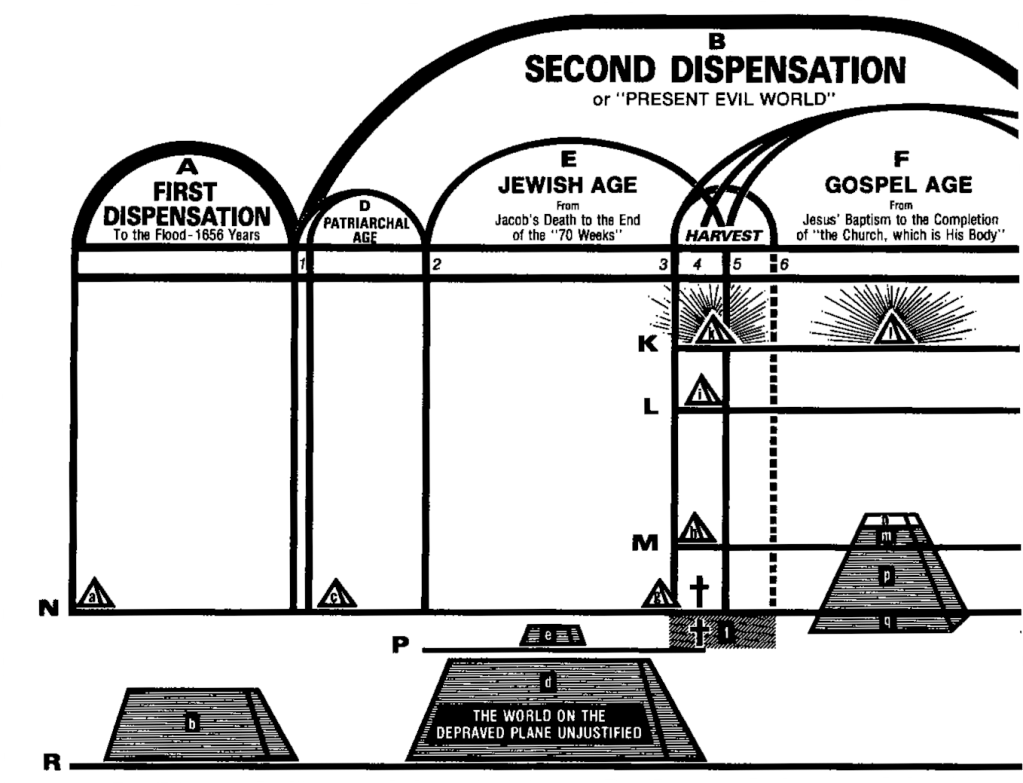
KEY TO OUR PLAN SO FAR
- AGES
- A – First Dispensation (Creation to Flood)
- D – Patriarchal Age
- E – Jewish Age
- Harvest of the Jewish Age (29 AD to 70 AD)
- F – Gospel Age
- PLANES
- N – Plane of Human Perfection, Friendship, or Tentative Justification
- P – Plane of Typical Justification
- R – Plane of Depraved Mankind
- M – Plane of Spirit Begettal
- L – Plane of Spirit Beings
- K – Plane of Glorious Divine Spirit Beings
- OBJECTS
- a – Adam, created perfect (Genesis 1:27)
- b – Mankind, Degraded by Sin (Psalms 51:5, Romans 3:9-12)
- c – Abraham, Isaac and Jacob, Justified by Faith (Acts 7:32, James 2:23, Galatians 3:6)
- d – World of Mankind Unjustified (Romans 3:9-12)
- e – Israel’s Typical Justification (Hebrews 10:1,4)
- f – Time of Trouble, Fire of Trial on Fleshly Israel (Luke 3:17, 1 Thessalonians 2:14-16)
- g – Jesus, a Perfect Man (John 1:14, Hebrews 2:9,16)
- Cross on P – Redemption of the Jews (Galatians 3:13, Luke 1:68,69, Galatians 4:4,5)
- Cross on N – Ransom for All (1 Timothy 2:4-6, Romans 5:15-19, 1 Corinthians 15:21,22, 1 John 2:2)
- h – Jesus, a Spirit Begotten New Creature (John 1:32, Luke 3:21-23, Hebrews 2:10, 17, 18)
- i – Jesus, a Spirit Being before Pentecost (Hebrews 5:8,9; Ephesians 1:20-23; 1 Timothy 3:16)
- k – Lord Jesus, Divine Spirit Being (Acts 3:19-21; Colossians 1:18, Hebrews 8:1)
- l – Jesus, Divine Spirit Being in Gospel Age (Acts 3:19-21, Colossians 1:18, Hebrews 8:1) (new addition)
- m – Great Company in the Gospel Age (Matthew 25:1-3; 1 Corinthians 3:10-19; 5:5,6) (new addition)
- n – Church in the Gospel Age (Revelation 2:10; 1 Peter 2:5; Mark 8:35; Matthew 13:38-39, 16:24-25; Luke 12:32, 14:28-33; Acts 15:14; Romans 12:1,2; Colossians 1:21-23; 1 Peter 2:9-12; Hebrews 3:14, 11:6) (new addition)
- p – Christians in Name Only, Untried (1 John 2:15) (new addition)
- q – Non-believers who profess Christ (Matthew 7:15; 1 John 4:3,5) (new addition)
- NUMBERS/DATES
- 3 – 29AD – Baptism of Christ
- 4 – 33AD – Death & Resurrection of Christ
- 5 – 36AD – End of 70 Weeks
- 6 – 70AD – Destruction of Jerusalem/End of Jewish Age Harvest
Introducing the Harvest at the End of the Gospel Age
Before closing out our examination of the Gospel Age, and beginning an examination of the next age in earnest, there is an extremely important section of time yet to consider. During the transition between the end of the Jewish Age and the beginning of the Gospel Age there was an overlapping period of time between the two ages in which some truly momentous events happened. Among other things, this was the period of time when Jesus went among the people of Israel, searching for those who had, through generations under God’s law, developed hearts and minds that would be pleasing to God. We referred to this period of time as “The Jewish Age Harvest”, likening Jesus’ search among the people of Israel to a reaper harvesting crops that had developed and ripened.
In our next study, we will beginning to look at the period of time between the Gospel Age and the dawning new age. We will see a grand parallel in this period of time with the Jewish Age Harvest period, and come to know this period as the Gospel Age Harvest. Like its predecessor, this harvest period will be full of momentous events, all in preparation for the most glorious period of time in mankind’s history yet.
 State College Bible Students