Any kind of work reflects some aspect of its creator. God’s plan for mankind is no exception to this observation. When viewed in its totality, His plan reveals a depth of love and mercy beyond our ability to fully appreciate and comprehend. It also reveals an Architect of profound wisdom; of unimaginable forethought and planning. As the time comes due, according to His design and will, for mankind to understand more of His plan than perhaps ever before, the elaborate harmony of this plan becomes clearer as well.
Consider the beautiful and harmonious cycles of nature. Each spring gives way to summer. Summer gives way to fall, and fall elapses into winter. Winter inevitable warms into spring, and the cycle begins again. From one perspective, change seems to be a constant process. However, when viewed from a wider perspective, each year passes in the same cycle of seasons, and thus, even in change, there is harmony.
Two major segments, or ages, of God’s plan for mankind, reflect this concept of change and harmony. When the descendants of Israel accepted God’s calling to become His special people (Exodus 19:5-8), an age of God’s plan began, sometimes referred to as the Jewish Age. By following the laws that God gave them, in spirit and in deed, the descendants of Israel were expected to develop a character, heart, and mind that would be worthy of an even greater reward than the resurrection and restitution that will, in the fullness of God’s time, be granted to all mankind, past, present and future. After a sufficient amount of time had passed, God sent His son, Jesus, to gather those from the descendants of Israel, who had developed such a character, heart and mind. This gathering is often compared to a harvesting period, and is thus many times referred to as the Jewish Age Harvest.
When Jesus did not find a sufficient number of acceptable characters, hearts and minds to meet God’s plan, the call to serve God was opened to all the people of the earth, Jew and Gentile. This change ushered in the next great segment, or age, of God’s plan, often referred to as the Gospel Age. In harmony with the preceding Jewish Age, the purpose of the Gospel Age was for God to extend the invitation to serve Him to a selection of mankind. Throughout the centuries, those called forward have been expected to follow God’s laws, mainly through following the teachings of Jesus. Likewise, after a sufficient amount of time passes, the Gospel Age will also end in a “harvest” period, when those who have been privileged to understand God’s laws and follow the example and teachings of His son, Jesus, will be “gathered” and “sifted.” In further harmony with the Jewish Age Harvest period, the Gospel Age Harvest is also denoted by the presence of Jesus. Jesus’s presence, and the difference between the physical presence of the Jewish Age Harvest period versus the spiritual presence of the Gospel Age, was covered in the previous study in this series.
An Examination of I Corinthians 15: I Corinthians 15:1-18 – The High Calling Versus the General Resurrection
The Apostle Paul is sometimes referred to as “the apostle to the Gentiles.” A significant portion of the New Testament is comprised of Paul’s letters to the early Christian churches. During this period of time, both Jew and Gentile were called forth by God to His service, and if judged worthy, would find themselves eligible for the grandest reward imaginable; namely the divine nature (II Peter 2-4). This is a much different path, or salvation, than is laid out, just as mercifully, to all of mankind. Every person who ever lived will have the opportunity for a restitution to the condition that was lost due to Adam and Eve’s disobedience in the Garden of Eden. The orderly execution of God’s plan places this restitution after the death, resurrection and promotion to the divine condition of Jesus; as well as after the calling, development and similar promotion of those called forth by God. This beautiful timeline highlights that the Gospel Age’s purpose is for the development of this “called forth” class, sometimes referred to as “Christ’s church”, “Christ’s bride”, or “the little flock.”
Paul’s letter to the early church at Corinth, particularly chapter 15, gives us a great deal of insight into this sequence of events. During the years following Jesus’s death and resurrection, the early churches struggled as other philosophies crept into their understandings of God’s plan. In some ways, this struggle exists today as well, but in those early days, the danger was particularly acute. The concept of a resurrection of the dead was a particular point of contention among the church at Corinth during Paul’s day. Despite the short number of years that had elapsed since Jesus’s resurrection, and despite that a relatively large number of people had seen Jesus following his resurrection (I Corinthians 15:5-8), many were beginning to doubt that this resurrection had actually happened. This belief, or more appropriately disbelief, may have originated from the influence of a sub-division of the Jewish religious leadership called the Sadducees, who believed that there was no resurrection from death (Acts 23:8). This potential influence highlights the need for God’s followers, even today, to prove all things told to them against the harmony of scriptures, even when those things are believed and told to them by those who may be considered learned and in positions of leadership.
As a result of this, Paul devotes the first portion of chapter 15 to a recounting of Jesus’s resurrection, as well as a logical argument as to why the truth of Jesus’s resurrection is the foundation of all hope. He emphasizes this point in verses 17 and 18:
I Corinthians 15:17 And if Christ be not raised, your faith is vain; ye are yet in your sins.
I Corinthians 15:18 Then they also which are fallen asleep in Christ are perished.
These verses, although short, convey two very powerful meanings beyond the basic message of Jesus’s resurrection, which Paul continues to expand in the subsequent verses of the chapter. First, Paul uses the phrase “fallen asleep,” clearly referring to people who have died. A few words later, Paul then uses the word “perished,” which brings sharply into focus that there is a difference between the state of death and a “perished” state. The word “perished” is Greek word 622 in Strong’s Concordance and has a definition of “to destroy fully.” In these few simple words, Paul defines a contrast between those who are “lost” for the moment in the condition of death against a state of irretrievable destruction. This is an important distinction, in that it not only contrasts the state of death versus a state of complete destruction, but also, upon consideration, clearly defines that there are two possible states for those who have died – a “sleeping” state and an “utterly destroyed” state.
Those who have died are in a state of being “asleep.” When this metaphor is considered further, a true picture of the condition of death emerges. Those who are asleep are unaware and detached from the events of the awake world and passage of time. In a very real sense, their consciousness is suspended until the time of awakening. As will be examined in future studies, this picture of death is in harmony with the overall testimony of the scriptures.
The second of the messages conveyed in these two scriptures is delivered in the phrase “fallen asleep in Christ.” This phrase has two different shades of meaning, which Paul expounds upon in the subsequent verses of chapter 15. The first meaning is that all of mankind “sleeps in Christ” from the perspective that Jesus’s sacrifice is the enabler for the eventual resurrection of all of mankind. The second meaning, and the meaning which will be focused on during the remainder of this study, is that those who have answered God’s high calling to become members of the Church class also “sleep.” Like the remainder of mankind, the eventual awakening from their condition also relies on Jesus as their only means of salvation as well.
An Examination of I Corinthians 15: I Corinthians 15:20-23 – First Fruits and Afterwards
As Paul continues his exposition, he makes what seems to be another simple statement that, when viewed in the harmonious context of the greater scriptural record, offers several more profound truths:
I Corinthians 15:20 But now is Christ risen from the dead, and become the firstfruits of them that slept.
Paul’s words often provide many important insights into God’s plan that go beyond just the major point he is attempting to convey. In verse 20, Paul is continuing to drive home the thought that Jesus’s resurrection is more than just a part of a logical argument. It is a fact. In his words, though, he also makes two other points that may not be immediately appreciated. Paul indicates that Jesus is the “firstfruits of them that slept.”. This indicates the orderly execution of resurrection touched on earlier; namely that Jesus was the first to be resurrected, implying that others will follow. These words also indicate that Jesus experienced the same death condition, the same “sleep” that mankind does.
Another important point made by Paul’s words is the implication that all mankind, including those called forth by God, will “sleep.” This important implication brings the timing of the Gospel Age Harvest into sharp focus. From Paul’s perspective, all mankind will “sleep” in death. At that time, only Jesus had been resurrected from the dead. Consider that during Paul’s lifetime, there were faithful followers of God and Jesus, that had already died, such as Stephen in Acts chapter seven. Paul’s words indicate that he saw the resurrection of these faithful ones to be a future event, from his perspective. This implies that the “harvesting,” or gathering of these faithful ones would be a future event, placing the timing of the Gospel Age Harvest at a point in time after Paul’s writings.
This thought is supported by Paul’s subsequent words in verse 22:
I Corinthians 15:22 For as in Adam all die, even so in Christ shall all be made alive.
This verse is often quoted by God’s followers, due to the succinct and exact manner in which it clearly summarizes one of the most fundamental underpinnings of God’s plan for mankind. Although created perfect and intended to have an everlasting life, Adam lost that everlasting life when he disobeyed God’s commandment. Because of this disobedience, mankind fell from a state of perfection, and death eventually fell on not only on Adam, but all of his descendants, including us, in the present age. This is what Paul means when he refers to “as in Adam all die.” As Paul emphasizes in another of his writings (Romans 6:23), “the wages of sin is death.”
In contrast, though, to this bleak thought, is the wonderful reassurance that mankind will be delivered from this state, because, in the words that Paul uses to conclude verse 22, “in Christ shall all be made alive.” In this, Paul refers to Jesus’s sacrifice as the means of recovery from this state.
Consider these words a little closer. Paul specifically uses the words “shall all be made alive.” In keeping with the thoughts expressed earlier, this implies that Paul saw this recovery from death as a future event. Note his use of the word “all.”. All means all, bringing the thought that the delivery of both those who are found faithful enough to be considered for membership in the Church, as well as later all mankind, as a future event. This, again, implies that Paul saw the timing of the “gathering” or “harvest” as a future event.
As Paul continues with his thoughts, it is clear that timing is on his mind, as well as the thought of the order intrinsically tied to the resurrection of Jesus, the Church, and mankind:
I Corinthians 15:23 But every man in his own order: Christ the firstfruits; afterward they that are Christ’s at his coming.
Paul again uses the term “firstfruits” in this verse with respect to Jesus. The words leading up to that usage are profound in their importance to mankind. By using the phrase “every man,” the reader is assured that Paul’s words, and by extension, the promise of resurrection, apply to all mankind. This means not just those who accept Jesus and follow God in the Gospel Age, but all mankind. However, the words “in his own order” further implies that there are different tiers of future existence. This underscores the thought that there is separation in God’s plan for different types, or “orders” of salvation. There will be a special, or high calling, to God’s service, during the Gospel Age, that will carry a correspondingly greater reward of the granting of the divine nature. There will also be another, separate restitution of all mankind that restore all involved to a perfect human condition. These thoughts are in harmony with Paul’s thoughts of “every man in his own order.”
Verse 23 ends with the phrase “afterward [after Jesus’s resurrection and glorification] they that are Christ’s at his coming.” This thought again emphasizes the sequencing of the Gospel Age Harvest, the gathering of those who successfully answered God’s calling, will be after Jesus’s resurrection. However, a more in-depth examination of this verse reveals a more precise thought regarding the timing of the harvest at the end of the Gospel Age.
The word “coming” at the end of verse 23 can give a misleading thought to the timing of the “harvest.” The word “coming” carries the thought of someone not yet arrived. This gives the impression that Jesus will not yet be present during the time of the “harvest.” The word “coming” at the end of verse 23 is Greek word 3952 in Strong’s Concordance. As covered in the previous post in this series, it is more appropriately translated as “presence” as opposed to “coming.” Consider the verse as translated first by the Revised Version Improved and Corrected Bible, and the Diaglott translation of the New Testament:
I Corinthians 15:23 (RVIC) But each in his own order: 168Christ the firstfruits; after that they that are Christ’s 169in his presence.
168Or, a firstfruit Christ (or, Anointed)
169Or, during his presence.
I Corinthians 15:23 (Diaglott) Each one and in the own band; a first-fruit Anointed, after that those of the Anointed, in the presence of him;
When viewed from this perspective, the thought that Jesus must be present for the gathering of the faithful members of the Church becomes clearer. This, then, is the time of the Gospel Age Harvest; a time in the future from Paul’s time; a time when those who faithfully answered God’s calling throughout the Gospel Age would be resurrected; a time when Jesus would be present and working toward the execution of his Father’s plan.
An Examination of I Corinthians 15: I Corinthians 15:24-28 – The Elimination of Death and the End of the Gospel Age Harvest
Although the age following the Gospel Age Harvest will be covered in future studies, while we are considering I Corinthians chapter 15, consider the next few verses in the chapter:
I Corinthians 15:24 Then cometh the end, when he shall have delivered up the kingdom to God, even the Father; when he shall have put down all rule and all authority and power.
I Corinthians 15:25 For he must reign, till he hath put all enemies under his feet.
I Corinthians 15:26 The last enemy that shall be destroyed is death.
I Corinthians 15:27 For he hath put all things under his feet. But when he saith all things are put under him, it is manifest that he is excepted, which did put all things under him.
I Corinthians 15:28 And when all things shall be subdued unto him, then shall the Son also himself be subject unto him that put all things under him, that God may be all in all.
In this sequence of thought, Paul reveals important details regarding the progressive unfolding of God’s plan. After the Gospel Age Harvest has been completed, the remainder of mankind will be resurrected (note that this thought is not clearly discerned by these verses, although the thought will be covered in future studies). Notice that part of the process of this transition is that Jesus will have “put all enemies under his feet” and that one of these enemies, the last enemy in fact, will be death. The destruction of death implies that that all of mankind will be resurrected from the dead by this point. The conclusion, then, is that, since the Gospel Age Harvest is the gathering together and sifting of all those who have been called forth across the Gospel Age, this process must be completed by time the new age begins, placing the timing of this harvest period at the end of the Gospel Age.
An Examination of I Thessalonians 4: The Timing of the Gospel Age Harvest
Paul examines the concepts of the high calling to God’s service, the gathering of those who answered the calling, and Jesus’s role in that gathering many times throughout his writing. One particular set of his writings, however, has a particular relevance to our reflections on I Corinthians 15. These verses are found in Paul’s writings to the early church at Thessalonica:
I Thessalonians 4:13 But I would not have you to be ignorant, brethren, concerning them which are asleep, that ye sorrow not, even as others which have no hope.
I Thessalonians 4:14 For if we believe that Jesus died and rose again, even so them also which sleep in Jesus will God bring with him.
I Thessalonians 4:15 For this we say unto you by the word of the Lord, that we which are alive and remain unto the coming of the Lord shall not prevent them which are asleep.
I Thessalonians 4:16 For the Lord himself shall descend from heaven with a shout, with the voice of the archangel, and with the trump of God: and the dead in Christ shall rise first:
I Thessalonians 4:17 Then we which are alive and remain shall be caught up together with them in the clouds, to meet the Lord in the air: and so shall we ever be with the Lord.
These verses have caused much confusion over the centuries; however, when examined carefully, their harmony with Paul’s other writings, and of the scriptural record of God’s plan in general, becomes more easily seen.
First, the word “coming” in verse 15 is the same Strong’s Greek word 3952 that was seen previously in I Corinthians 15:23. The use of this same word in I Thessalonians 4:15 ties these two sections of scripture together as being accounts of the same period of time; namely, the time of Jesus’s returned presence during the Gospel Age Harvest period. In verse 13 and 14, Paul also indicates that both the audience and the subject of his words are those who have made a consecration to God during the Gospel Age – those who Paul considers his brethren, like Jesus did (Matthew 12:49-50).
Paul discusses two groups of these fellow members of the Church class: some who have fallen asleep before Jesus’s presence during the harvest period, and some who have not yet fallen asleep, or in other words, are alive, during the harvest period. Verse 16 depicts Jesus “descend[ing] from heaven with a shout.” The concept of the “shout” as being a metaphorical “shout” and not an actual audible sound will be covered in a future study in this series. Of particular interest to this study, however, is the concept that it is only after this “shout” that the “dead in Christ shall rise first.” This thought is in keeping with the previous reflections on I Corinthians 15; namely that upon completion of their lives, those who have respond to God’s High Calling fall into death. During the “gathering” of the harvest, they are resurrected, and if found worthy of their commitments, granted their reward.
In verse 17, Paul calls attention to the fact that the High Calling will continue on throughout the Gospel Age and into the Gospel Age Harvest itself. By referring to “those who are alive and remain,” Paul indicates that there will be those who are answering the High Calling at the same time, even after, those who had, in the many years before harvest period, answered the calling, finished their course in life, “fell asleep” in death, and were resurrected and granted their reward. Eventually, these, too, will finish their course and “fall asleep” in death, but also be resurrected and if found worthy, be granted their reward as well. These will “fall asleep,” just not as long as those who “fell asleep” centuries ago, at the beginning of the age. This is the same concept Paul refers to in I Corinthians 15:51-52.
Thus, these words in I Thessalonians describe the joyous time of the Gospel Age Harvest period, when all of those who have been faithful to God by following Jesus’s teachings will, if found worthy, at last be united with their Lord and share in the wonderful, unimaginable blessing of the divine nature. This is the wonderful union described in verse 17. Much like Jesus’s presence itself, this union will be on a different plane than mankind, and thus, will not be a visible event. The metaphorical language of verse 17 thus represent the final members of the Church class being “elevated,” after successfully completing their life’s courses, to a “higher” plane of being. This union, and the preceding gathering and sifting to determine those who will be granted this reward, is one of the primary purposes of the Gospel Age Harvest time.
Summary: The Gathering of the Church in the Gospel Age Harvest
Updating our chart of God’s plan for mankind, two new icons are added. Icon “r,” in the shape of a pyramid’s capstone, represents Jesus in his returned and glorified state, receiving the joyful overcomers of the Church class, represented by icon “s”. With this union completed, the first phase of the Gospel Age Harvest period is completed.
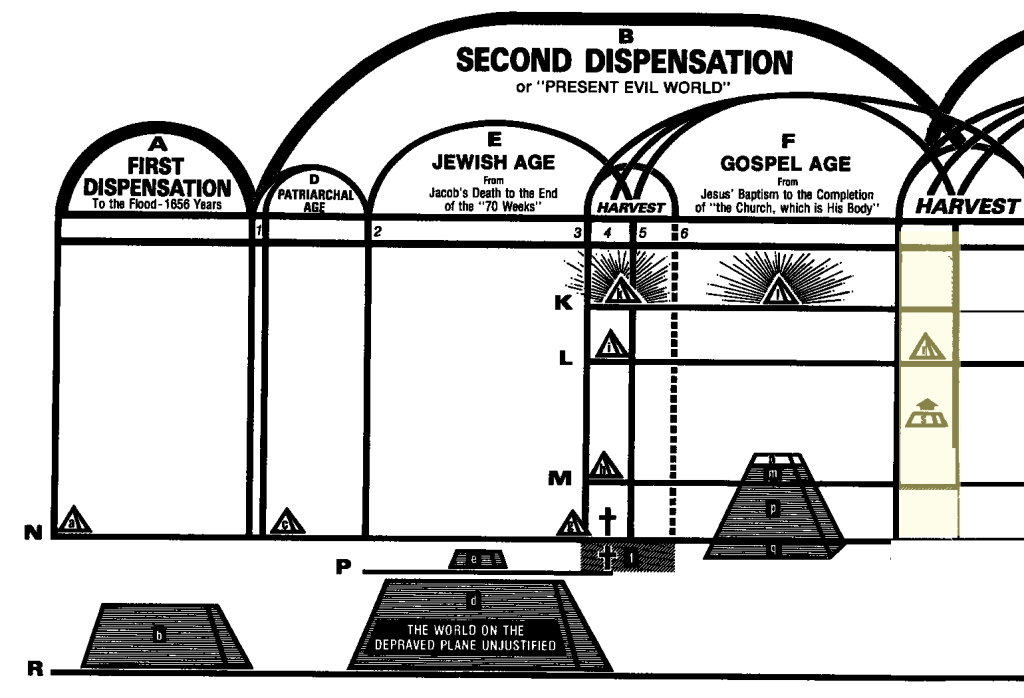
- AGES
- A – First Dispensation (Creation to Flood)
- D – Patriarchal Age
- E – Jewish Age
- Harvest of the Jewish Age (29 AD to 70 AD)
- F – Gospel Age
- PLANES
- N – Plane of Human Perfection, Friendship, or Tentative Justification
- P – Plane of Typical Justification
- R – Plane of Depraved Mankind
- M – Plane of Spirit Begettal
- L – Plane of Spirit Beings
- K – Plane of Glorious Divine Spirit Beings
- OBJECTS
- a – Adam, created perfect (Genesis 1:27)
- b – Mankind, Degraded by Sin (Psalms 51:5, Romans 3:9-12)
- c – Abraham, Isaac and Jacob, Justified by Faith (Acts 7:32, James 2:23, Galatians 3:6)
- d – World of Mankind Unjustified (Romans 3:9-12)
- e – Israel’s Typical Justification (Hebrews 10:1,4)
- f – Time of Trouble, Fire of Trial on Fleshly Israel (Luke 3:17, 1 Thessalonians 2:14-16)
- g – Jesus, a Perfect Man (John 1:14, Hebrews 2:9,16)
- Cross on P – Redemption of the Jews (Galatians 3:13, Luke 1:68,69, Galatians 4:4,5)
- Cross on N – Ransom for All (1 Timothy 2:4-6, Romans 5:15-19, 1 Corinthians 15:21,22, 1 John 2:2)
- h – Jesus, a Spirit Begotten New Creature (John 1:32, Luke 3:21-23, Hebrews 2:10, 17, 18)
- i – Jesus, a Spirit Being before Pentecost (Hebrews 5:8,9; Ephesians 1:20-23; 1 Timothy 3:16)
- k – Lord Jesus, Divine Spirit Being (Acts 3:19-21; Colossians 1:18, Hebrews 8:1)
- l – Jesus, Divine Spirit Being in Gospel Age (Acts 3:19-21, Colossians 1:18, Hebrews 8:1)
- m – Great Company in the Gospel Age (Matthew 25:1-3; 1 Corinthians 3:10-19; 5:5,6)
- n – Church in the Gospel Age (Revelation 2:10; 1 Peter 2:5; Mark 8:35; Matthew 13:38-39, 16:24-25; Luke 12:32, 14:28-33; Acts 15:14; Romans 12:1,2; Colossians 1:21-23; 1 Peter 2:9-12; Hebrews 3:14, 11:6)
- p – Christians in Name Only, Untried (1 John 2:15)
- q – Non-believers who profess Christ (Matthew 7:15; 1 John 4:3,5)
- r – Returned Glorified Jesus Receiving His Bride (John 14:3, I Thessalonians 4:16, I Corinthians 14:45, John 14:1-3 (new addition)
- s – Church Separating from Babylon & Being Resurrected to Meet the Lord (I Thessalonians 4:17, I Corinthians 15:23, Romans 6:4-6, Revelation 19:6-9)
- NUMBERS/DATES
- 3 – 29AD – Baptism of Christ
- 4 – 33AD – Death & Resurrection of Christ
- 5 – 36AD – End of 70 Weeks
- 6 – 70AD – Destruction of Jerusalem/End of Jewish Age Harvest
The gathering of the Church class, and its union with the returned and present Jesus closes the first half of the Gospel Age Harvest period. However, this period in God’s plan still has further events and considerations that will need to occur before the next age can begin. The next study in this series examines two of Jesus’s parables that have special meaning for the Gospel Age Harvest period, and will serve to frame many of the events of the ending of the Gospel Age and its harvest period. Through these parables, as well as throughout these studies, the beauty and harmony of God’s planning continues to showcase His wisdom and His abiding love for His creation.
Jeremiah 17:7 Blessed is the man that trusteth in the LORD, and whose hope the LORD is.
Jeremiah 17:8 For he shall be as a tree planted by the waters, and that spreadeth out her roots by the river, and shall not see when heat cometh, but her leaf shall be green; and shall not be careful in the year of drought, neither shall cease from yielding fruit.
Further Readings and References
- The Divine Plan of the Ages is a series of studies focusing on God’s plan for mankind as revealed through the scriptures. Each age, including the Gospel Age and the Gospel Age Harvest, is covered in detail, and provides a wonderful and inspiring insight into the character of our grand and loving Heavenly Father.
- The subject of I Thessalonians 4:17 was covered more in-depth in a previous study on the use of symbolism in the Bible.
 State College Bible Students