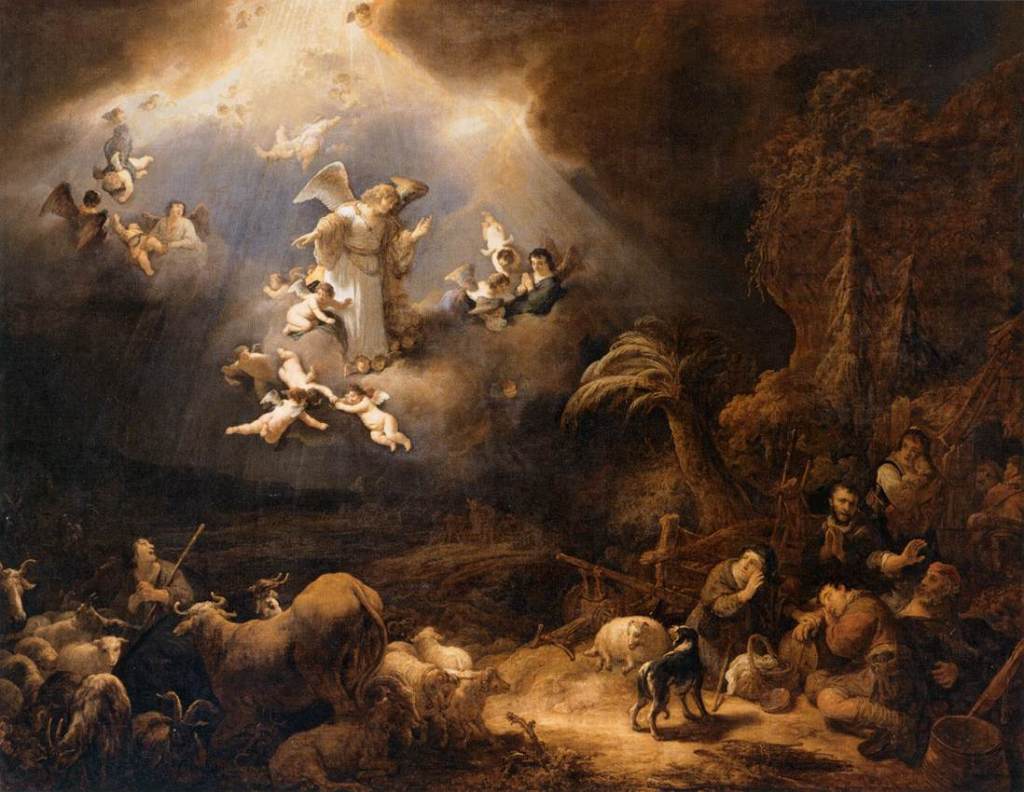
Luke 2:10 And the angel said unto them, Fear not: for, behold, I bring you good tidings of great joy, which shall be to all people.
Luke 2:11 For unto you is born this day in the city of David a Saviour, which is Christ the Lord.
Sometimes, things that are well-known are well-known for a reason. The account of the angel appearing to the shepherds in the field to proclaim the birth of Jesus is perhaps one of the most well-known accounts in the entire Bible. The details of the account, even sometimes the exact words, are known to many Christians and non-Christians alike. However, that familiarity does nothing to diminish the power and beauty behind both the words of the account, as well as the deeper meaning to them, that has an applicability not just to Christians, to all of mankind, past, present and future. After all, the angel’s words proclaim that the “good tidings of great joy” shall be to all people.
Throughout history, songs have served a number of purposes. Songs promote harmony by their very existence. Melody and harmony are intrinsic characteristics of songs. Songs provide a way for feelings, concepts and occasions to be remembered generations later. Songs can convey truths about feelings and the heart that hundreds of ordinary words cannot capture. The best songs inspire.
As the angel in Luke chapter two finished his message to the shepherds, a great number of angels, described as “a multitude of the heavenly host” began to sing praises to God. Luke 2:14 records the words of this praise. As Christmas begins to draw near, many begin to turn their thoughts to Jesus’s birth, and the message of the angels to the shepherds of the field. Jesus’s birth, life and death are crucial events in God’s plan for mankind. Like a song, God’s plan echoes down through the generations and inspires the hearts and minds of those with an ear to hear it. In this spirit, let us liken the plan of God to a beautiful song, and reflect on the magnitude of the praise expressed by the multitude of the heavenly host on that long ago night.
Hear The Song, Verse One: Mankind Created and Tested
God’s plan for mankind started long before mankind’s creation. Genesis 1:1-26 describe the unfathomable complexity of God’s planning and creation. All of these immense and incredible acts culminate in the creation of mankind in verse 27. The fact that God considered mankind to be the end result of all His prior planning and creation is easily seen. Although He considers every phase of His creation “good” (Genesis 1:4, 10, 12, 18, 21 and 25), it is only after mankind’s creation that He looks across all His creation and declares it to be “very good” (Genesis 1:31).
Being created in God’s image (Genesis 1:26, 27), Adam and Eve, the first man and first woman were perfect, as nothing that truly reflects God can be anything other than perfect, by definition. However, Adam and Eve were also created with free will. God did not want an unthinking, unreasoning ultimate creation. This is evident in the fact that God issued a commandment to Adam in Genesis 2:16, 17. He was free to eat from any tree except one. Without free will, God would have had no need to command Adam as, without free will, Adam would have had no choice but to obey God. Without reasoning, God could not have expected Adam to be capable of keeping His commandment, just as we, today, may order a pet to obey, but know that they do not have the reasoning capability to perfectly obey our commands.
Adam and Eve chose to disobey God’s commandment, and eat from the forbidden tree. As a result, they fell from perfection and were subject to death (Genesis 3:6, 17-19). This fall from perfection into subsequent death would be carried forth to all of Adam and Eve’s descendants, who would form the population of mankind.
However, while declaring Adam and Eve’s just punishment for disobedience, God also included a small thought that was undoubtedly not well understood at the time, and even today, is not well understood by the majority of mankind:
Genesis 3:15 And I will put enmity between thee and the woman, and between thy seed and her seed; it shall bruise thy head, and thou shalt bruise his heel.
Through a great lie, the orchestrator of Adam and Eve’s disobedience helped bring about mankind’s current condition of sin and death. However, although only vaguely hinted at, God made known that eventually, through one of Eve’s descendants (one of the members of mankind), the adversary’s plans would be undone.
The song of God’s plan for mankind began long before the first man and woman were even created. God spent an incalculable amount of time planning and overseeing the creation of all things, to result in the creation of mankind. The beautiful song of His plan took on a sad and tragic note as, through their own disobedience, mankind found themselves subject to sickness, degeneration, and death. However, through it all, a small note of hope quietly sounded, hinting that God’s plan was far from over.
Hear The Song, Verse Two: God’s Promise to Mankind
Many centuries after Adam and Eve’s disobedience, God began to interact with a very few select members of mankind. In a man named Abraham, God saw a man full of faith and love for Him. God gave Abraham a series of difficult commandments, such as the moving of his entire household into a new land (Genesis 12:1) and later, the sacrifice of Abraham’s son (Genesis 22). Because of his willing obedience to God, God delivered a promise to Abraham. This promise was repeated by God several times over Abraham’s life. One of the most beautiful iterations of this promise came after God stopped Abraham from the actual sacrifice of his son Isaac to God:
Genesis 22:17 That in blessing I will bless thee, and in multiplying I will multiply thy seed as the stars of the heaven, and as the sand which is upon the sea shore; and thy seed shall possess the gate of his enemies;
Genesis 22:18 And in thy seed shall all the nations of the earth be blessed; because thou hast obeyed my voice.
Although the details were not clear at the time, God was clear in his intention to bless not only Abraham’s descendants, but “all the nations of the earth.” God gave no timeline for the fulfillment of this promise, and gave no details as to exactly how the promise would be fulfilled, but did offer one remarkable thing to both Abraham, as well as to us, centuries later, who read these words. God swore on His very self that His promise would be kept:
Genesis 22:16 And said, By myself have I sworn, saith the LORD, for because thou hast done this thing, and hast not withheld thy son, thine only son:
It is impossible for God to lie. The simple act of God saying something is enough to have full confidence that the thing that was said is true. However, God swore to Abraham that all the nations, all the peoples of the earth, would be blessed. In so doing, By extension, He also swore this promise to us, as members of the “peoples of the earth.” This emphasis was not needed by God to fulfill His purpose. The emphasis was added for us, down through the ages, to highlight that no matter what, the blessing will surely come.
Over time, God repeated this promise to Isaac, Abraham’s son. He also repeated His promise to Abraham’s grandson Jacob, who would later be renamed Israel. One of the most beautiful repetitions of this promise was given to Jacob/Israel in a dream, sent from God:
Genesis 28:14 And thy seed shall be as the dust of the earth, and thou shalt spread abroad to the west, and to the east, and to the north, and to the south: and in thee and in thy seed shall all the families of the earth be blessed.
Beyond all expectation, a major verse had been added to the song of God’s plan for mankind. Each time God repeated His promise to Abraham, Isaac of Jacob/Israel, the message was clear. God did not intend to leave His creation, who He loved so dearly, in the state of punishment and death that they justly found themselves in. The specific notes of the song may not have been clear, but the message certainly was – God would bless all mankind – each and every member – all the families of the earth.
Hear The Song, Verse Three: God’s Law
Over time, the descendants of Jacob/Israel grew in number, and true to God’s word, would be formed into a nation. After delivering them from years of captivity in Egypt, God asked this group of people if they would be His chosen people (Exodus 19:3-6). The people agreed soon after:
Exodus 19:8 And all the people answered together, and said, All that the LORD hath spoken we will do. And Moses returned the words of the people unto the LORD.
As a result, God delivered a set of laws and sacrifices that the people were expected to keep. Although there were many details to these laws, the first of them was extremely clear:
Exodus 20:3 Thou shalt have no other gods before me.
Just as with Adam and Eve, God wanted His creation to understand that His ways, being perfect, would lead to happiness and life, and that disobedience would lead to only misery and death. God was looking for His creation to love Him, from the reason of the mind and from the love of the heart, and to understand that all other ways were simply unreasonable and wrong. To highlight this point, God delivered a set of laws and sacrifices to the descendants of Israel, and made it clear that a perfect keeping of these laws would result in a right to continued life:
Leviticus 18:4 Ye shall do my judgments, and keep mine ordinances, to walk therein: I am the LORD your God.
Leviticus 18:5 Ye shall therefore keep my statutes, and my judgments: which if a man do, he shall live in them: I am the LORD.
However, as a nation and as individuals, Israel could not perfectly fulfill these ordinances, and thus, none could attain the promised right to life. As the generations passed, life under God’s laws should have prepared the people’s hearts and minds to know and appreciate God and the reasons behind His commandments. Even though none could perfectly keep the law, preparation was taking place for something as yet to be fully unfolded.
A new verse had been revealed to the song of God’s plan. A pathway to life was now open. It may have only been open at that time to a select few of mankind, who were the descendants of Israel, and it may have required such a perfect keeping that none at the time could accomplish its requirements, but a way was open nonetheless. The stage was set for the next verse of the song of God’s plan, and soon, the notes of the scriptures would begin to prophesize a coming king.
Hear The Song, Verse Four: The Promised King
In the later chapters of the Old Testament, God began to deliver prophecies of a coming king to the people of Israel (Zechariah 9:9, for example). The king was expected to “deliver Israel” from their oppressors, but, although not well understood at the time, would also have a much wider and more profound impact on not only Israel, but all of mankind.
John chapter one describes how the mighty spiritual being, referred to as “the Word” (also translated as “the Logos”) left his spiritual state and took on a human form. In so doing, he would share the same experiences as any other of mankind, beginning with birth, continuing into childhood, and on into adulthood. This human would be named Jesus, and although many of his experiences would be the same as others of mankind, he would prove to be unique.
The scriptures declare that Jesus was “obedient unto death:”
Philippians 2:7 But made himself of no reputation, and took upon him the form of a servant, and was made in the likeness of men:
Philippians 2:8 And being found in fashion as a man, he humbled himself, and became obedient unto death, even the death of the cross.
The scriptures also are very clear in declaring that the thing Jesus was perfectly obedient to was the will of God, His Father:
Matthew 3:16 And Jesus, when he was baptized, went up straightway out of the water: and, lo, the heavens were opened unto him, and he saw the Spirit of God descending like a dove, and lighting upon him:
Matthew 3:17 And lo a voice from heaven, saying, This is my beloved Son, in whom I am well pleased.
John 6:38 For I came down from heaven, not to do mine own will, but the will of him that sent me.
As a Jew, part of pleasing God meant the perfect keeping of the laws that God gave to the people generations ago. Through the perfect keeping of that law, Jesus intended to “fulfill” the law, or put an end to its purpose:
Matthew 5:17 Think not that I am come to destroy the law, or the prophets: I am not come to destroy, but to fulfil.
Through his perfect obedience to God, Jesus was the first and only person to earn a right to life. However, Jesus also willingly allowed that life to be taken from him. In so doing, Jesus fulfilled a key aspect to God’s justice, namely “a life for a life.” Through a willing disobedience, Adam lost his right to life, and subsequently, all of mankind down through the generations also lost their right to life. Through a willing and perfect obedience, however, Jesus earned his right to life under God’s law. In giving that life, Jesus “purchased” mankind from the state of sin and death that they otherwise found themselves incapable of escaping. The Apostle Paul talks about this exact concept in Romans chapter 5. In this chapter, Paul lays out this relationship between Adam, Jesus and mankind, as exemplified in verse 19:
Romans 5:19 For as by one man’s disobedience many were made sinners, so by the obedience of one shall many be made righteous.
Thus, a major new verse was at last added to the ongoing song of God’s plan. God’s only begotten son left his heavenly position and became human. Through his obedience to his Father, and through his great sacrifice, Jesus enabled the next great phase in God’s plan Further, he magnified the harmony of that wonderful song by beautifully and faithfully reflecting the perfect love of God.
Hear The Song, Verse Five: A High Calling
As Jesus walked among the people of Israel, it became clear that he was looking for people who had developed a certain condition of mind and heart after living, as a people, for generations under God’s law:
Matthew 22:37 Jesus said unto him, Thou shalt love the Lord thy God with all thy heart, and with all thy soul, and with all thy mind.
Matthew 22:38 This is the first and great commandment.
Matthew 22:39 And the second is like unto it, Thou shalt love thy neighbour as thyself.
Matthew 22:40 On these two commandments hang all the law and the prophets.
These commandments were not new to the people of Israel. They had been delivered to their ancestors as part of God’s original law. However, Jesus was looking for a class of people who loved God and their fellow people out of more than just a sense of perfunctory obligation. He was looking for people who so loved God that the keeping of His commandments was a joy and a way of life. In short, he was looking for what God was looking for all along – those who recognized God’s ways as superior, and kept His ways, to the best of their abilities, out of a love for Him. As would begin to be seen, Jesus was calling this group of people to something more than the general blessings intended for all mankind.
Jesus died without having found a sufficient number from among Israel who met these qualifications. This call to serve God was subsequently opened to the Gentile, or non-Jewish, people as well (Acts 10). Any member of mankind could now, through commitment to God, be considered one of His chosen people, and thus be eligible for a greater reward than the general blessing promised to mankind. The Apostle Paul refers to this opportunity as a “high calling:”
Philippians 3:14 I press toward the mark for the prize of the high calling of God in Christ Jesus.
Paul’s words stress that this “high calling” comes from God, but is “in” Christ Jesus, meaning that it is only because of Jesus’s sacrifice that this extraordinary calling and opportunity is available. This promise to the comparatively small amount of mankind who choose to consecrate their hearts and minds to God does not negate God’s promise to bless “all the families of the earth.” Instead, it is a separate and richer blessing, still facilitated by Jesus’s sacrifice.
The Apostle Paul discusses this “high calling” in many of his writings, and makes particular note of the great struggle necessary to maintain one’s commitments in Romans chapter eight. Romans 8:17 summarize both this struggle, and the rewards, if found worthy of one’s commitments:
Romans 8:17 And if children, then heirs; heirs of God, and joint-heirs with Christ; if so be that we suffer with him, that we may be also glorified together.
And so a new verse to the song was revealed. This verse added an unforeseen richness to the harmony of God’s plan, and an entirely new dimension to the understanding of the great sacrifice Jesus made on behalf of mankind. During the current time, those of mankind who devote their minds and hearts to God have the opportunity to share in a membership of Christ’s “bride class” and be partakers of the divine nature (II Peter 1:4). As this class finds its last few members and becomes full, the “door will close” to this invitation, and the next great phase, involving all of mankind, will at last begin.
Hear The Song, Verse Six: Good Tidings of Great Joy to All People
The Apostle Paul points out that God’s creation is waiting for the final populating of the class of those who are responding to God’s “high calling:”
Romans 8:22 For we know that the whole creation groaneth and travaileth in pain together until now.
Romans 8:23 And not only they, but ourselves also, which have the firstfruits of the Spirit, even we ourselves groan within ourselves, waiting for the adoption, to wit, the redemption of our body.
God promised, even swore, that all the families of the earth would be blessed. This means, all the people of mankind; not just a few, but all. However, before the fulfillment of that promise can come to its full fruition, those who have “the firstfruits of the Spirit,” namely the understanding that a faithful execution of a commitment to God now will provide a greater spiritual reward, must be given the opportunity to fully prove their faithfulness. When, and only when, this is accomplished, the next phase of God’s plan will begin, in which the “restitution of all things,” promised by God throughout the scriptures, will be fully realized (Acts 3:21).
This is the time we believe we are entering into now. We believe the last members of that class are responding to God’s calling, and soon the time will arrive for the full execution of the next phase of God’s plan. The world seems unaware of the great changes even now beginning to unfold, but Jesus told us that this would be the case (Matthew 24:37-39). No change comes without some level of churn and upheaval. A change so dramatic as the change of ages in God’s plan – as Christ’s church class nears completion and the way begins to be made for the next phase of mankind – can, without question, expected to be accompanied by an equally dramatic amount of churn causing an equally substantial amount of trouble. This is why “things seem to get worse every year.” This is the answer to the question, “why can’t mankind solve its most pressing problems?” The scriptures provide the clear answer that all of this trouble is a necessary part of the great coming change (Daniel 12:1).
Even the tumultuous and difficult times in which mankind finds itself in now and in the near future cannot help but ultimately contribute to the purpose of God, as old ways are swept aside for the wonderful and just existence that God intended for His creation, mankind, from the beginning (Psalm 30:5). Thus, the song still plays. Through all of the confusion and anger and injustice of the current world, God’s harmonious plan continues forward toward a time when all of mankind will be restored to perfection, life and everlasting joy, just as He promised.
Hear The Song, Chorus: Glory to God!
That is the good news that shall be to all people. It doesn’t matter how confused the world is right now. It doesn’t matter how corrupted even the simplest and most basic facts or beliefs seem to be made. It doesn’t matter how hard the negative forces seem to be pushing toward their goals. The All-Powerful and All-Knowing and All-Loving and All-Just has promised – has sworn by His very self – that all the families of the earth will be blessed.
Each and every passing year brings us closer to that marvelous time when the full number of those who chose to follow Jesus’s example and gave up their own wills and hearts to serve God will be complete. Each and every passing year therefore also brings us closer to the unimaginably joyous time when “there shall be no more death, neither sorrow, nor crying, neither shall there be any more pain: for the former things are passed away.” We are one year closer now to the time when every broken heart, every treasured tie that was severed because of sickness or death or injustice will be mended as loved ones are reunited, never to be separated again. As sickness melts away, as sadness and misery and poverty and cruelty become impossibilities… as death itself loses its power over all of us… then will every heart and every mind turn again to their glorious Creator, and His son who sacrificed so much to undo the long-ago incurred punishment for disobedience. Then it will be that every heart will finally fully understand God’s plan for mankind.
Listen for a moment… not with your ears, but with your heart. Reflect on these thoughts, that everything that has happened in the past year has brought us one step further in the fulfillment of God’s plan. It is truly and undeniably closer now than when we first believed. Instead of allowing despair into our hearts with how much the creation may be groaning and travailing, let us, who are privileged to hear the calling during this present time redouble our commitments and stay steadfast in our promises to love and serve God with all our hearts and all our minds and all our souls… because we are one year closer to the time when the opportunity to answer that calling ahead of all of mankind will be over.
Hear the song in your hearts and let it inspire your every thought and word and action. Hear it – instead of growing softer and fainter with age, let it fill your heart with the confidence that it is instead growing ever stronger, building to the great crescendo that will usher in the next marvelous phase of God’s plan. We who are so privileged to hear that song in our hearts are so beautifully and undeservedly able to call the Grand Creator of Everything our Father, and are also able to know, without doubt, that all things work together for those who love Him.
Hear the song that announced the earthly arrival of him who we are so privileged to call our Master, Jesus. God’s own son gave up his heavenly position to take on a human form, just like ours. He gave up all the goals in that life that he could have had, and instead devoted his very existence to serving the will of his Father. Through his perfect keeping of God’s laws, he earned a right to life, but willingly sacrificed that life to balance out the willing disobedience of Adam, centuries ago. In doing so, he enabled the true purpose of God’s plan for all mankind.
Hear the words of that song, that rang out from the very heavens on that night centuries ago. Let the words fill your hearts just as they filled the darkness of the skies. My dear friends, let us give thanks to God for all His abundant goodness, and let us give thanks to His Son, and raise our hearts and our voices in tune with the words of the multitude of the heavenly host whose words echo just as clearly to us today as they did on that long ago night:
Luke 2:13 And suddenly there was with the angel a multitude of the heavenly host praising God, and saying,
Luke 2:14 Glory to God in the highest, and on earth peace, good will toward men.
Image Credits
- Painting by Govert Flinck, via commons.wikimedia.org (Public Domain)
 State College Bible Students
